|
|

|
|
|
|
Horseback riding vacations in
Tanzania
Tanzania boasts such highlights as Mount Kilimanjaro, the Serengeti, Ngorongoro Crater and the spice islands of Zanzibar – making it an unforgettable safari and horse riding holiday location. Recognized world-wide for its wildlife and natural beauty, Tanzania is a wildlife tour location of extreme importance. For many Tanzania has been the ultimate safari destination, with national parks and game reserves covering some 33,660 sq km (or 28%) of the country. Hidden Trails offer three amazing horse riding safaris in Tanzania – each promising an unforgettable experience.
Horse Riding in Tanzania
With Hidden Trails you can experience a true African safari, but on horseback instead of by jeep. For 5-7 hours a day you can horseback ride as fast as the groups of giraffes passing by, or follow alongside herds of zebra, antelope, gazelle, and wildebeest, and from a safe distance watch the "Big Five"- lions, elephants, leopards, buffalo, and rhinoceroses. You will ride between Mount Meru and Mount Kilimanjaro, through savannahs, bush country, and swamps, and stay each night in safari camps. A true equestrian safari.
On the Arusha Riding Safari, you will have the opportunity to live your “Out of Africa” dream trip – riding in the shadow of Mt Kilimanjaro, while elephant, zebra and wildebeest graze nearby.
Tanzania Game Safaris
Our riding safaris are different from the standard bus or landrover safaris. No friendly drivers are in radio contact to draw all nearby tourists to a group of sleepy lions. It will probably take you many hours in the saddle to get the same result, but on horseback you are a part of the natural surroundings and can stay far away from the tourist caravans. You share these special times only with your fellow riders.
The areas in which we operate are scenically some of the most beautiful in East Africa. We ride amongst 'bush', where access is via dirt-track or cross-country. Volcanic peaks rise from the savannah plains which are interspersed with acacia woodland and thorn bush. Only the nomadic Masai people share this scenic land with the numerous animals and birds of the area. After the rains (April-May and November) the land is green and full of flowers, the dry season can be very dusty but it is often the best time to see game. Temperatures usually range between 20-35 degrees centigrade and the altitude is from 1100 - 2000 meters above sea level.
Explore more East Africa Horse Riding Vacations
|
|
Holidays on horseback in Tanzania
See Mini Country Guide
|
Below is a list of our trips in this area with video clips.
 Click on the 'watch video' icon

to view a video clip,
Tanzania
Travel restrictions
The government of Tanzania announced on May 18th 2020 that it had lifted the ban on international flights arriving and departing Tanzania. Major carriers have now resumed flights to Tanzania, though in some cases on a reduced schedule.
The Tanzania Ministry of Health released “Travel Advisory #11 ” effective September 15th 2022, with updated entry and exit requirements for travelers to mainland Tanzania as follows:
- Fully vaccinated travelers will be exempted from both RT PCR and Rapid Antigen Test
requirements. Travelers will be required to present a valid vaccination certificate with QR
code for verification upon arrival. The only accepted vaccines are those which have been
approved by the URT and the World Health Organization.
- Not fully vaccinated, unvaccinated and those not eligible for vaccination due to their
country policies will be required to present a negative COVID-19 RT- PCR or NAATs
certificate with QR code obtained within 72 hours before departure.
- Not fully vaccinated, unvaccinated and those not eligible for vaccination due to their
country policies and have no negative COVID-19 RT- PCR certificate will be tested for
COVID 19 upon arrival using a Rapid Antigen Test at their own cost of TZS 23,000 (10
USD) for Tanzania Mainland except children aged 12 years and below.
Positive cases will be further confirmed by RT- PCR at a cost of 50 USD. For ground
crossings, positive cases will be handled according to Bilateral and Joint Border
Agreements.
Travelers are required to complete an online Health Surveillance Form (at https://afyamsafiri.moh.go.tz/ for Tanzania mainland) within 24 hours prior to arrival. Travelers will then receive a Unique Health Code (UHC), which they will present to health officials upon arrival.
Measures taken by the government
Ports of entry are conducting screening and travelers with a fever are diverted to secondary for further examination.
The government is promoting mitigation measures such as handwashing, masks and social distancing.
Testing
Travelers have reported receiving COVID-19 tests results that do not provide a positive result but instead require a retest. Those tests state in Swahili that “you will not be issued a certificate, please repeat the test after 7 days from the first test.” Individuals who receive this inconclusive result should be prepared to remain in Tanzania for an indeterminate time until they ultimately have a negative test result. In addition, they should assume that they have COVID-19 and act accordingly. The inconclusive result cannot be used to show recovery from COVID-19 or be used to board a flight to depart Tanzania.
While PCR test results can take more than one day and can show inconclusive results, rapid antigen tests are available on a walk-in basis at the international airports, including Terminal 3 of the Julius Nyerere International Airport in Dar es Salaam, Kilimanjaro International Airport, and Abeid Amani Karume International Airport in Zanzibar.
Travelers planning to use an airport rapid test should arrive multiple hours early and contact the airport for additional information. The cost for a rapid test is $10 in mainland Tanzania.
Travelers taking an airport rapid test should register through https://afyamsafiri.moh.go.tz and list both their origin and destination as Tanzania in the system. Please note that airports might require travelers to test within six hours of their scheduled departure.
Julius Nyerere International Airport (Dar es Salaam)
https://www.jnia.go.tz/
+255 22 284 2402/3
info@jnia.go.tz
Kilimanjaro International Airport
https://www.kilimanjaroairport.go.tz/
+255 27 255 4252
kadco@go.tz
Abeid Amani Karume International Airport (Zanzibar)
https://www.zaa.go.tz/index
+255 24 223 3674
info@zaa.go.tz
Travelers can book a COVID-19 PCR test through the Tanzanian Ministry of Health, Community Development, Gender, Elderly, and Children (MoHCDEC) website: https://pimacovid.moh.go.tz/#/booking
COVID-19 test costs vary but are generally between $50 and $200. The MoHCDEC states that you will receive a text message with a link to your COVID-19 certificate when your results are ready.
Emergency number (related to COVID-19) while visiting the country
In case of any medical emergency while in the United Republic of Tanzania, please call the Health Emergency Number 199.
Source:
US Embassy in Tanzania https://tz.usembassy.gov/covid-19-information/
Published on April 3rd 2023 (checked on April 5th 2023)
For more information please visit our COVID-19 Updates page at https://www.hiddentrails.com/article/covid19update.aspx
|
|
Tanzania
At A glance
Capital City: Dar es Salaam (de facto administrative capital) & Dodoma (national capital)
Land size: 885,800 sq km
Population: 63,852,892 (2022 est.)
Official languages: Kiswahili / Swahili and English
Currency: Tanzanian Shilling (TSh / TZS)
UNESCO properties and sites:
- Kondoa Rock-Art Sites
- Ruins of Kilwa Kisiwani and Ruins of Songo Mnara
- Stone Town of Zanzibar
- Kilimanjaro National Park
- Selous Game Reserve
- Serengeti National Park
- Ngorongoro Conservation Area
Source: https://www.cia.gov/the-world-factbook/countries/tanzania/
Tanzania's breathtaking beauty and natural wonders provide a unique and thrilling adventure for every traveler. Journey to the Ngorongoro Crater, a natural wonder and home to an abundance of wildlife. Immerse yourself in the unique traditions of the Maasai and other Tanzanian tribes, experiencing their rich cultural heritage. Tanzania offers a truly authentic African experience.
Tanzania is a haven for equestrian enthusiasts, with its iconic wildlife, stunning landscapes, and rich culture. Begin your riding journey in Arusha, the gateway to Tanzania's most famous national parks, and experience the thrill of riding through its lush surroundings. Canter alongside herds of elephants and zebras at the feet of the Kilimanjaro, an unforgettable experience.
Brief History
A number of independent coastal and island trading posts in what is now Tanzania came under Portuguese control after 1498 when they began to take control of much of the coast and Indian Ocean trade. By 1700, the Sultanate of Oman had become the dominant power in the region after ousting the Portuguese who were also facing a series of local uprisings. During the following hundred years, Zanzibar - an archipelago off the coast of Tanzania - became a hub of Indian Ocean trade, with Arab and Indian traders establishing and consolidating trade routes with communities in mainland Tanzania that contributed to the expansion of the slave trade. Zanzibar briefly became the capital of the Sultanate of Oman before it split into separate Omani and Zanzibar Sultanates in 1856.
Beginning in the mid-1800s, European explorers, traders, and Christian missionaries became more active in the region. The Germans eventually established control over mainland Tanzania - which they called Tanganyika - and the British established control over Zanzibar. Tanganyika later came under British administration after the German defeat in World War I.
Tanganyika gained independence from Great Britain in 1961, and Zanzibar followed in 1963 as a constitutional monarchy. In 1964, a popular uprising overthrew the Sultan in Zanzibar and either killed or expelled many of the Arabs and Indians who had dominated the isles for more than 200 years.
Later that year, Tanganyika and Zanzibar combined to form the United Republic of Tanzania, but Zanzibar retained considerable autonomy. Their two ruling parties combined to form the Chama Cha Mapinduzi (CCM) party in 1977.
Tanzania held its first multi-party elections in 1995, but CCM candidates have continued to dominate politics. Political opposition in Zanzibar has led to four contentious elections since 1995, in which the ruling party claimed victory despite international observers' claims of voting irregularities.
John MAGUFULI won the 2015 presidential election, and the CCM won a two-thirds majority in Parliament. He was reelected in 2020 and the CCM increased its majority in an election that was also critiqued by observers. MAGUFULI died in March 2021 while in office and was constitutionally succeeded by his vice president, Samia Suluhu HASSAN.
Source: https://www.cia.gov/the-world-factbook/countries/tanzania/
Cultural Insights
For most Tanzanians, including those who live in urban areas, no meal is complete without a preferred staple carbohydrate—corn, rice, cassava, sorghum, or plantains, for example. Plantains are preferred in the northwest, ugali (a thick mash of corn or sorghum) in the central and southwestern regions, and rice in the south and along the coast. The staple is accompanied by a fish, beef, goat, chicken, or mutton stew or fried pieces of meat, along with several types of vegetables or condiments, commonly including beans, leafy greens resembling spinach, manioc leaves, chunks of pumpkin, or sweet potatoes.
Tanzanians are proud of their disciplined upbringing. The ability to keep control of one's temper and emotions in public is highly valued.
Young men and women in rural areas are not supposed to show mutual affection in public in daylight, although this rule is often broken in urban centers.
Boys and men, however, are commonly seen in public holding hands as a sign of friendship or comradery.
In many rural areas, women are not supposed to smoke, talk in a raised voice, or cross their legs while sitting or standing.
Traditionally, elders are honored and respected by the rest of the community, although youth are increasingly challenging such customs as arranged marriages.
Although the use of silverware is increasing, traditional customs prescribe eating all foods, including rice and meat sauces, with the right hand. Children who attempt to eat with their left hands are disciplined appropriately at very early ages. This custom is related to the perceived symbolic purity of the right hand, compared to the left hand which is often used for cleaning after using the toilet.
Source: https://www.everyculture.com/Sa-Th/Tanzania.html
Transportation
By Air
Kilimanjaro International Airport is the main gateway for tourism in Tanzania. It has earned the tag of being "The gateway to Africa's wildlife heritage" because it brings tourists from all over the world to visit the natural attractions of the northern circuit. The connects the country with Europe, the Middle East, the United States, the Far East and a large part of Africa.
Source: https://www.kilimanjaroairport.go.tz//
Money
The Tanzanian Shilling is the official currency of Tanzania, but US dollars are also widely accepted in tourist areas. Dollar notes printed before 2009 are usually not accepted.
You can exchange money at many authorized dealers, banks and bureaux de change. Get a receipt after each transaction.
Most banks in major cities have ATMs, but they are not always reliable and sometimes break down or run out of money. To minimize the risk of card cloning, only use ATMs located within the bank.
Major Credit Cards may be accepted in some large Hotels, however it is advisable to carry cash which you will change on arrival.
Source: https://www.gov.uk/foreign-travel-advice/tanzania
Health
If you need emergency medical assistance during your trip, dial 112 and ask for an ambulance. You should contact your insurance/medical assistance company promptly if you are referred to a medical facility for treatment.
Medical facilities are limited, especially outside Dar es Salaam. Make sure you have adequate travel health insurance and accessible funds to cover the cost of medical treatment abroad, evacuation by air ambulance and repatriation.
Although Tanzania typically only requires yellow fever shots for those traveling from an endemic country, there are occasional reports of officials requiring yellow fever shots from all foreign travelers.
Source: https://www.gov.uk/foreign-travel-advice/tanzania
https://travel.state.gov/content/travel/en/international-travel/International-Travel-Country-Information-Pages/Tanzania.html
Electricity
Tanzania operates on a 230V supply voltage and uses type D and G plugs.
The Type D electrical plug has three large round pins in a triangular pattern. Type M plugs are often used alongside Type D plugs for larger appliances and as a result, some sockets work with both Type D and Type M plugs.
The Type G electrical plug has three rectangular blades in a triangular pattern and has an incorporated fuse (usually a 3 amps fuse for smaller appliances such as a computer and a 13 amps one for heavy duty appliances such as heaters). British sockets have shutters on the live and neutral contacts so that foreign objects can’t be introduced into them.
Source: https://www.iec.ch/world-plugs
Communication
Time zone in Tanzania: Eastern Africa Time (GMT +3)
International country code – 255
Tanzania’s telecom sector enjoys effective competition, particularly in the mobile segment. The government has encouraged foreign participation to promote economic growth and social development, and policy reforms have led to the country having one of the most liberal telecom sectors in Africa.
The MNOs have invested in network upgrades, which in turn has supported mobile data use, as well as money transfer services and banking services.
In late 2021, the government announced plans to extend the national backbone network from about 8,300km to 15,000km by 2023, and to provide ongoing connectivity to more countries in the region. (2022)
Source: https://www.cia.gov/the-world-factbook/countries/tanzania/
Phrasebook
| English |
Swahili |
| Hello! |
Salama |
| Goodbye |
Kwa heri/ Kwa herini (more than one person) |
| Good morning |
Habari za asubuhi |
| Good evening |
Habari za jioni |
| Good night |
Lala salama |
| Please |
Tafadhali |
| Thank you |
Asante |
| Yes |
Ndiyo |
| No |
Hapana |
Source: https://www.tripsavvy.com/swahili-or-kiswahili-for-travelers-1454482
Entry Requirements
All tourists and visitors wishing to come to Tanzania and Zanzibar are requested to apply for a visa online through the Tanzania e-Immigration Online Portal at https://visa.immigration.go.tz/.
You can now apply for an Online Visa to visit the United Republic of Tanzania (both Tanzania Mainland and Zanzibar). You are required to fill in the online form, make payment, and submit your application online. Your form will be internally reviewed and processed.
Applicants will be notified through their e-mails whether their applications have been accepted or rejected. They may also TRACK their application statuses through the online system. Applicants may as well be required to visit the nearest Tanzanian Embassies or Consular Offices for interviews.
Source: https://visa.immigration.go.tz/
Starting October 1, 2024, all visitors to Zanzibar (excluding residents) must have mandatory Inbound Travel Insurance from Zanzibar Insurance Corporation.
Source: https://visitzanzibar.go.tz/
Embassies and Consulates
U.S. Embassy in Dar es Salaam
686 Old Bagamoyo Road
Msasani
Dar es Salaam
Tel: 255 22 229 4000
High Commission of Canada in Dar es Salaam
26 Garden Avenue/38 Mirambo Street
Dar es Salaam
Tel: 255 22 216-3300 / 255 22 211-2831 / 255 687 216-330
Source: for USA https://www.usembassy.gov/
For Canada: https://travel.gc.ca/assistance/embassies-consulates
UNESCO Sites
Kondoa Rock-Art Sites
On the eastern slopes of the Masai escarpment bordering the Great Rift Valley are natural rock shelters, overhanging slabs of sedimentary rocks fragmented by rift faults, whose vertical planes have been used for rock paintings for at least two millennia. The spectacular collection of images from over 150 shelters over 2,336 km2 , many with high artistic value, displays sequences that provide a unique testimony to the changing socio-economic base of the area from hunter-gatherer to agro-pastoralist, and the beliefs and ideas associated with the different societies. Some of the shelters are still considered to have ritual associations with the people who live nearby, reflecting their beliefs, rituals and cosmological traditions.
Ruins of Kilwa Kisiwani and Ruins of Songo Mnara
The remains of two great East African ports admired by early European explorers are situated on two small islands near the coast. From the 13th to the 16th century, the merchants of Kilwa dealt in gold, silver, pearls, perfumes, Arabian crockery, Persian earthenware and Chinese porcelain; much of the trade in the Indian Ocean thus passed through their hands.
Stone Town of Zanzibar
The Stone Town of Zanzibar is a fine example of the Swahili coastal trading towns of East Africa. It retains its urban fabric and townscape virtually intact and contains many fine buildings that reflect its particular culture, which has brought together and homogenized disparate elements of the cultures of Africa, the Arab region, India, and Europe over more than a millennium.
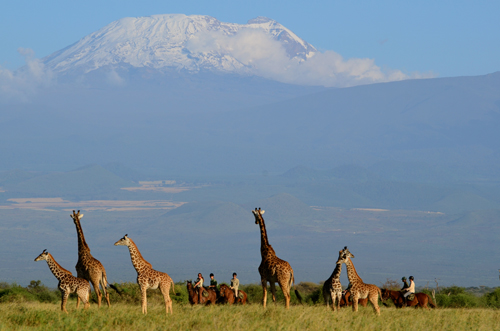
Kilimanjaro National Park
At 5,895 m, Kilimanjaro is the highest point in Africa. This volcanic massif stands in splendid isolation above the surrounding plains, with its snowy peak looming over the savannah. The mountain is encircled by mountain forest. Numerous mammals, many of them endangered species, live in the park.
Selous Game Reserve
Large numbers of elephants, black rhinoceroses, cheetahs, giraffes, hippopotamuses and crocodiles live in this immense sanctuary, which measures 50,000 km2 and is relatively undisturbed by human impact. The park has a variety of vegetation zones, ranging from dense thickets to open wooded grasslands.
Serengeti National Park
The vast plains of the Serengeti comprise 1.5 million ha of savannah. The annual migration to permanent water holes of vast herds of herbivores (wildebeest, gazelles and zebras), followed by their predators, is one of the most impressive natural events in the world.
Ngorongoro Conservation Area
The Ngorongoro Conservation Area spans vast expanses of highland plains, savanna, savanna woodlands and forests. Established in 1959 as a multiple land use area, with wildlife coexisting with semi-nomadic Maasai pastoralists practicing traditional livestock grazing, it includes the spectacular Ngorongoro Crater, the world’s largest caldera. The property has global importance for biodiversity conservation due to the presence of globally threatened species, the density of wildlife inhabiting the area, and the annual migration of wildebeest, zebra, gazelles and other animals into the northern plains. Extensive archaeological research has also yielded a long sequence of evidence of human evolution and human-environment dynamics, including early hominid footprints dating back 3.6 million years.
Source: https://whc.unesco.org/en/statesparties/tz
|
|

|
|
|
|