|
On our Hidden Trails riding tours we usually indicate what tack is being used during your vacation. Please, keep in mind that even when we indicate "English" on our riding tours - usually it is a subcategory such as "endurance" or a variation of a "McClellan" saddle that is based on a light military saddle with a split back. It is not likely that you will be riding any dressage saddle on any of the riding tours.
Click on the different types on the left to see an image of the saddle type.
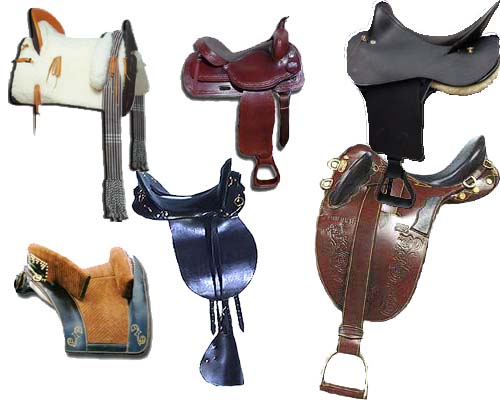
The Early History of Horse Saddles
The first horseback riders rode bareback, in fact for hundreds of years they traveled, hunted for food and even waged war with their enemies, all while riding without a saddle.
In 365 AD, a tribe called the Sarmations is thought to have invented not only the first saddle, but also the first metal stirrups and spurs. The Sarmations were known as serious horsemen, using their horses in battle and sacrificing them to their gods. The Huns invading from Central Asia brought the Sarmation’s saddles and metal stirrups to Europe, the Europeans finding the metal stirrups great for mounting, as well as aiding the riders balance. Riders now could use the weapons of war of the time, swords, axes and lances, with more skill and efficiency. The next major improvements in saddles would wait for the medieval knights.
The saddle we now know as the western saddle is actually an evolved version of the Spanish Vaquero’s saddle used by the working cowboys in Mexico. Things from the areas of New Mexico, Mexico-New Spain, and Texas in the early 19th century were often referred to as Spanish, and the saddle that we now know as the western saddle would in fact have been referred to as a Spanish saddle.
Early History of Western Horse Saddles
The Western Horse Saddle, that we know today, was greatly influenced by the Spanish Vaquero (cowboy). The following is a condensed excerpt from a highly informative and beautifully detailed article that documents the history of the Cowboy. Historians are aware that America's story owes something of significance to the "western Horse Saddle," ergo the metaphor - what the motorcar was to the American 20th century traveler, or working employee, (who used a motor vehicle to make a living), the saddle was to the early American travelers and cowboys. What was under the hood, be it horses or horsepower did not change much. Rather, it was the drivers' seat and all its appearances that we have obsessed about. Henry Ford invented the first motorcar and the Spanish Vaquero invented the first western cowboy Horse Saddle.
Military Influence on Horse Saddles
While more utilitarian than civilian models, the military Horse Saddle was nonetheless affected by cultural influences. Some periods were more ornate, some less, reflecting then-current fashions, concepts of national identity, and prevailing views of the military. The Horse Saddle reflected a much more significant influence as well. In the early days of the nation, the American military Horse Saddle was a dead ringer for English and French gear. During the expansion West though, concepts of cavalry changed, as did the conditions and needs of the fighting man, at the same time that Americans were making increased contact with the outposts of the Spanish empire. Spanish saddles and techniques learned from the Moors in ancient wars, and well adapted to use on the vast expanses of the new world, were far better suited to frontier conditions. The practical men of the fledgling United States picked them up rather quickly beginning in the first quarter of the 19th century, both in terms of a series of military saddle designs, and in the evolution of what we now call the "western" or "cowboy" saddle. The shapes of the saddles changed, as did concepts of equitation. In the first half of the 20th century, free of the demands of Indian warfare, and without much other fighting to do, the cavalry drifted back to English and French-influenced equipment and techniques, in search of European style and finesse.
|