|
|
 |
|
|
Hwange Big Five Safari
Hwange Park
Zimbabwe
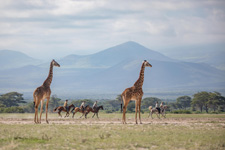
This magnificent Big Five horse back safari is the first of its kind situated in a "Big 5" National Park amongst a multitude, and great diversity of wildlife.
Hwange National Park is 14600sq. km of unbridled wilderness stretching across the Kalahari sands of Zimbabwe, to the south of, and not far from the mighty Victoria Falls. Over 105 mammal species including 19 large herbivores and 8 large carnivores call this home.
You will explore winding animal trails, canter beneath the acacia canopies and open vleis or swim in a muddy pan after the elephant. The safaris are only for experienced riders and this rare opportunity allows your spirit to be one with your horse and nature. The wildlife viewing is spectacular and truly magnificent. A combination of luxury tented camps, mobile tented camps, fine cuisine and friendly staff will make this your most memorable African experience!
You will find Zimbabweans have not lost their humour or resolve. Those who visit the country can expect royal treatment. While the world’s media focuses on the government of Zimbabwe, visitors will see a very different image of the country. From the absolute wilderness of Mana Pools National Park, the ruins of Great Zimbabwe and the mountains looking over Mozambique in Eastern Zimbabwe, to fine dining in Harare or bungee jumping over Victoria Falls, Zimbabwe offers something for everyone.
Our guides are James and Janine. James is recognized as one of Zimbabwe's top professional guides and Janine is an avid animal lover, conservationist and horsewoman. Their combined experience, passion for the bush and their horses will leave you in very capable hands.
|
Meeting:
|
Hwange
|
|
Airport:
|
Victoria Falls
|
|
Transfer:
|
Victoria Falls
|
|
Riders:
|
Min
2 riders
Max
6 riders
|
|
Trip Rating
|
|
|
|
Rates and Dates for 2009 | 2010
Rates include:
Accommodations - 5 nights in tent camps and 2 nights in safari lodges - hot bucket showers in camp, three meals a day, drinks, 6 riding days, English speaking guide, laundry service
| A | 2009 | 8 day trip, AP | 8d / 7n | $2895 |
| Small group supplement (1 only) | $1138 |
| Single supplement - waived for 2009 | $0 |
| Park Fees | $65 |
Transfer Option:
|
2009
|
Road transfer from Victoria Falls per car return (1-6 pass)
This is a "Group Rate"
|
$510
|
Best to arrive in Victoria Falls on Day 1 at 11 AM on SA40 from Johannesburg. This will allow for lunch and an activity in Hwange that afternoon.
|
Available any time from mid March to December with 2+ riders.
|
Day one
Guests arrive before lunch at Ivory Lodge, Hwange, from either a road transfer or air charter. Ivory Lodge is a private concession a few miles outside of Hwange National Park in well wooded Terminalia, Zimbabwe Teak, Miombo and Acacia woodlands. Accommodations are in separate tree houses with views over a permanent waterhole. There is electricity here with a spacious living and bar area, ideally suited for a relaxed beginning to the safari to come.
Time to settle into the lodge and meet the guide. After lunch it is a half hour road transfer into Hwange National Park to Main Camp, the park head quarters. Here guests will sign in and pay the necessary Park entry and camping fees for their whole safari duration. We then proceed into the park area to where the horses and grooms will be waiting.
The professional guide leading the safari will give an introduction to the horses that are to be used on this safari and a safety briefing on what to expect and do’s and don’ts of riding in this wildlife area. There will be time for a short ride of perhaps two hours to acclimate to the area and get to know ones horse and tack. Riders will be observed for their riding ability and knowledge with some possibility of encountering some wildlife.
Once done with the short ride, guests and guides are on a game drive back to Ivory Lodge in time for drinks around the fire, a hot shower and three course dinner. Over-night in the very comfortable tree houses of Ivory Lodge.
Day two
An early wake up call to prepare for the adventure ahead. Early starts are a must on the horse safaris! Guests will need to pack all belongings and then go for a sumptuous breakfast before once again returning to the Park. Again meet at the horses and prepare for several hours of riding. Water, food, first aid kits and guests personal items for the day will be loaded onto the horses. All other luggage will go with the support crew to the camp-site.
The safari is led by a qualified Professional Guide who carries first aid equipment, a heavy calibre rifle, hand gun, compass, maps and GPS. These rides are of an exploratory nature with the possibility of routes having never been ridden before by humans or horses! The terrain is very flat with little horizon so good navigation by the guide is vital. Also accompanying the ride is one of our very skilled grooms and a National Parks ranger.
The ride will start at the eastern boundary of the Park and lead into the Park. Riding is usually from waterhole to waterhole or open areas along well worn elephant paths. The pace will vary from walking to cantering through varied habitats of open waterhole areas, beautiful Zimbabwe Teak woodlands, thorn and teak scrub and stunning Camel thorn Acacia groves.Various varieties of wildlife can be encountered along the way including mammals and birds of various species. The region is particularly good for elephant, giraffe, zebra, sable, Roan antelope, kudu and steenbok to name a few. Lion can be encountered as with buffalo and white rhino.
The direction and duration of riding is entirely dependant on many factors such as distance to the campsite, weather, time of year, wildlife sightings, rider’s abilities and vegetation conditions. Generally we plan to have a light packed lunch somewhere in the bush, giving the horses a rest. Camp is reached before dark. The horses are settled in, fed and watered. Guests are expected to assist with un-tacking and watering their horse. The horses ‘camp’ is an area enclosed by a high ‘wall’ of canvas sheeting and the whole camp is surrounded by a portable electric fence to keep the horses – and people – safe from lion and hyena.
Cold or hot drinks are available around the camp fire, along with snacks and stories of the day!|
Hot bush bucket showers are set by the staff to refresh one before a tasty three course bush dinner under a canopy of leaf or stars. The tents are comfortably spacious for a mobile expedition, with camp sleeping cots, mattresses, pillows, sheets and duvets. Extra blankets are available for the very cold months of May through mid August. This camp will either be up for two or three nights depending on various ‘bush’ factors. This is a bush camp – no electricity, generators, phones, newspapers, walls or windows!
Day three, four, five, six
Another early wake up – with tea and coffee by the fire – most welcome on the sometimes below zero Hwange mornings! The day may start with a reasonable breakfast and then we will ride out the whole day from camp, or a light breakfast for a half day ride before coming back to camp for brunch. This again depends on the time of year, weather, riding abilities and decision of the guide. In hot times it is normal to ride out as early as possible to be back in camp for the heat of the day. During cooler months we generally leave camp slightly later but ride out the whole day.
Exploring the areas and trying to approach wildlife from horse-back is the focus. Often in the hot times when water is in the waterholes, we may wade or swim with the horses. Often good elephant viewing can be done at these times of the year due to the still plentiful grasses and water. As the bush changes throughout the seasons, so does the type of riding in response to where the wildlife moves to and that many elephant paths offer wonderful opportunities for trotting and cantering. Wildlife encounters can be very close and sudden and thus riders must be very competent and confident to control their horses and themselves. Being in areas never ridden before, most wildlife will never have seen horses; this is the exciting attraction of this area.
These days follow a similar routine, but short walks with the guide are also possible as he is licensed to conduct walks in these Park areas. In this time, the camp will move location to one other area. Whilst the camp is being moved, guests will ride with a packed lunch and water to the next site, reaching there in the late afternoon. Many of these finer details will be discussed with the guests by the guide during the safari. Due to the nature of the area and activities, a certain amount of flexibility of daily program needs to be realised as these are real safaris.
Please note – all litter is carried out of campsites and in the hot dry months bathing water is limited as area is semi desert, limited laundry can also be done. Drinking water is from clean borehole sources. All effort is made by our staff to completely clear the campsites to an absolutely natural state. Firewood is used by permission of the National Parks Authority.
Day seven
On this day we will be riding from our mobile tented bush camp to the beautifully appointed and classy bush chic tented camp of Somalisa. Riding time will depend on our mobile camp distance from Somalisa and also to what time we arrive into the camp. Somalisa is also on an extensive private concession area inside the National Park, although there are no fences or big cutlines surrounding the concession. The camp is situated on the Masumamalisa Vlei, an ancient drainage line bordered by a variety of Teak, Terminalia, Red Syringa, Combretum and big Camel thorn groves. There is water available for the wildlife in font of the camp which can provide for some amazing experiences.
Somalisa only has 12 beds and is a very naturally laid out bush camp with privacy and an exceptional intimacy with nature. The staff being excellent and the meals of a very high standard, this is the perfect end to some days of wilderness riding. If the we get to camp by lunch, there will be an opportunity to take a drive in the area to visit some of the waterholes nearby for some excellent wildlife viewing. The support staff from the mobile will set up the horse enclosure near to Somalisa and have the guest’s luggage at Somalisa. As always drinks around the fire, hot showers, comfortable beds and a wonderful dinner await in the evening.
Day eight
The last early morning wake up to the sounds of the African bush, hot tea and coffee by the campfire overlooking the waterhole and discussions of the night sounds mark the transition of the riding safari onto fresh adventures.
Breakfast is served, farewells are said and then it is a road transfer through the Park with wildlife viewing to meet with guests onward transfer vehicle at Main Camp, a couple of hours away.
Depending on onward connections of flights or transfers, there may still be an opportunity for a quick drive or walk and farewell to the horses before departing from Somalisa.
itinerary subject to change
Meeting:
Hwange
Airport:
Victoria Falls
Transfer:
Victoria Falls
Distance:
115 miles
Best to arrive in Victoria Falls on Day 1 at 11 AM on SA40 from Johannesburg. This will allow for lunch and an activity in Hwange that afternoon.
|
Tack:
|
|
Predomatiely English saddles, leather and synethic but also a selection of Australian Stock Saddles - local Mclennan Saddles as well as handmade South African Trail Saddles.
Most of the horses are ridden in a snaffle bridle.
|
|
Horses:
|
|
Thoroughbred cross
|
|
Pace:
|
|
Moderate with trots, canters and some gallops, 5-8 hours daily.
|
Walk |
Trot |
Canter |
Gallop |
|
|
Level:
|
|
(3.5
to
3
out of 5) Strong Intermediate
|
|
Age:
|
|
Min
18
|
Max
80
|
|
Weight:
|
|
Max
180 lbs
|
|
Riders:
|
|
Min
2 riders
|
Max
6 riders
|
|
Passport and Visa Requirements:
Passports Passport valid for at least six months beyond date of departure required by all nationals referred to in the chart above. Three blank pages are needed. Passport Note All visitors to. more
Zimbabwe has one of the world's best climates! Temperatures are never very extreme making for very comfortable riding.
January to mid March – often heavy rains and strong winds, temperatures can go up to 40C / 104F, often many biting flies, very green, lots of surface water, excellent birding, frogging and insects, wildlife viewing difficult, storms however are SPECTACULAR!!
Non – riding season.
Mid March through April – hot with temperatures as above, mornings can drop to 10C / 50F, some chance of rain, vegetation still thick, wildlife viewing not easy due to surface water in many places and thick bush. The riding is good but not the best time for wildlife viewing. Birding always excellent. Night time / early morning temperatures very comfortable, sometimes requiring a warm jacket.
May through mid August – dry season starts so nearly zero chance of rain. Vegetation starting to thin out / lose leaves and surface water reduces, therefore coming into the better times for wildlife viewing. Most migrant birds will go north now. Day time temperatures around 20 – 30C / 68 -86F and generally clear skies, mild breezes. Sometimes can be cloudy and cooler. Night time to early morning can be FREEZING!! Can go below -10C / 14F and most mornings are at least below 0C or 32F. Riding starts are often around 08h00 as can ride all day.
Mid August to end October – this is the dry season and peak game viewing. Temperatures rising again to over perhaps 45C / 113F in October, generally high 30’s / 90s, very little cloud, sometimes rain in October, very dry, little shade and only the pumped waterholes have water. Some tree species are producing flowers, fruit and new leaf during this period so botanically very interesting. Large wildlife concentrations often at waterholes or nearby woodlands. Riding starts very early with long mid-day rest for horses and riding again in the afternoons. Many very big elephant tracks opened up by all the wildlife use so excellent for cantering or long trots.
November through December – very hot, start of the rains so often big storms. Early morning temperatures back up again, but still advisable to have a jacket. Vegetation becoming green again, all bird migrants back, wildlife dispersing across the Park so harder to view. Depending on the rains and flies, there can still be some good riding into December.
Specifics of clothes can be advised for different times of year i.e. wet / dry, hot / cold and also for weight limits if on air charters, so all listed items do not need to be carried. All camps can do at least some laundry so minimise the weight of clothes.
It is important to note that the Hwange region is at an average altitude of 1000 metres / 3300 feet, and indeed most African safari areas are over this altitude, and therefore temperatures can often be surprising cool to cold. Therefore no matter what time of year, it is advisable to always have a warm jacket. Sometimes air charter flights can be cold. Many Northern hemisphere travelers have been caught out thinking that Africa is only boiling hot…….don’t be fooled!!
Air charters usually limit luggage to 12kg / 26lb, but can be more if guests paying for private charter, depends on aircraft type and passenger number.
REMEMBER if you do or may suffer MOTION / AIR SICKNESS, please speak to your doctor / physician about bringing medication, preferably non-drowsy meds!!!!!
Torches and fresh batteries, recommend with LED bulbs and small headlight i.e. Petzl, Black Diamond, Energizer – this is a MUST bring item to be carried in hand luggage!
Car charger with 12volt adaptor for torch and camera batteries,
Camelback backpack rehydration system – the 2 litre ones are good as can carry limited day items, i.e. small personal first aid, spare batteries / camera cards, tissues etc
Sunscreen, lip moisturizer, hat, sunglasses x 2 with cord (to keep glasses on when cantering or going through thick bush!)
Long sleeved shirts for sun and thorn protection – clothes often get torn,
Half chaps,
Riding boots/shoes
Hat with string
Riding gloves for cold, sun and thorns,
Shorts for walking or zip-off pants,
Long trousers for cold nights,
Light fleece for warm to hot months,
Heavy weight fleece for cold months,
Thermal underwear can be of great use in very cold months,
One of the following - Beanie, woolly cap, scarf, head warmer in very cold months,
Light weight quick dry sports shirts for hot, wet months,
Light weight walking shoes/sandals for walking/after riding/in camp
Light weight but strong binoculars preferably 8 powers, ideally waterproof as these are more rugged for the tough, dry or wet conditions,
Hard Hat if you want to ride in one.
Jodhpurs or jeans
Sarong handy for around camp.
Camera – compact waterproof digitals are ideal for riding, SPARE BATTERIES!
SAFETY - HARD HATS TO WEAR OR NOT TO WEAR
Your safety, and that of our horses and staff is our first concern while you are on safari with us. Whilst Africa has not reached the lofty heights of legalities that pertain to the "developed" world, you will not be forced to wear a hard hat while on safari with us though we do encourage it. The terrain we ride through is very challenging, rugged mountains. We operate in a very remote, pristine, wild, part of Africa.
On occasions you will be riding on winding elephant trails through thick bush with sheer precipices on either side of you. Whilst the horses are conditioned to this environment (you will be amazed at where they can go) anything can happen even to the best of riders.
You should be aware that if you do come off and can not remount, it will mean a pole and dagga evacuation on foot and depending on where we are it could take some days to get you back to the nearest airstrip for medic air vac. We carry a comprehensive first aid kit with us and your professional guide has been trained to a high level in first aid and even with the added precaution of carrying a satellite phone there are just no options for a plane to land in the mountains.
We have a selection of hard hats available but if you have your own please bring it.
Sorry, no video is currently available for this tour.
*Important Notice: The following ratings have been submitted by guests and do not necessarily represent the views of Hidden Trails, its partners or employees.
Every care is taken to ensure accuracy but Hidden Trails is not liable for any errors or omissions.
** No trip reports found
with the tour ID you provided.
|
..view other reports for different trips
This trip includes
some wine with dinner
and can accommodate special dietary requests.
|
Tack:
|
|
Predomatiely English saddles, leather and synethic but also a selection of Australian Stock Saddles - local Mclennan Saddles as well as handmade South African Trail Saddles.
Most of the horses are ridden in a snaffle bridle.
|
|
Horses:
|
|
Thoroughbred cross
|
|
Pace:
|
|
Moderate with trots, canters and some gallops, 5-8 hours daily.
|
Walk |
Trot |
Canter |
Gallop |
|
|
Level:
|
|
(3.5
to
3
out of 5) Strong Intermediate
|
|
Age:
|
|
Min
18
|
Max
80
|
|
Weight:
|
|
Max
180 lbs
|
|
Riders:
|
|
Min
2 riders
|
Max
6 riders
|
|
Passports
Passport valid for at least six months beyond date of departure required by all nationals referred to in the chart above. Three blank pages are needed.
Passport Note
All visitors to Zimbabwe must be in possession of return tickets (or funds in lieu) and sufficient funds to support themselves. The granting of a visa is not a guarantee of entry.
Visas
Required by all nationals referred to in the chart except the following:
(a) 1. nationals of Cyprus, Ireland and Malta;
(b) passengers continuing their journey to a third country within 6 hours by the same or connecting flight, provided holding tickets with reserved seats and documents for onward travel and not leaving the transit area.
2. Nationals of the following countries may obtain visas valid for up to 90 days on arrival in Zimbabwe, provided holding tickets and documents for return or onward travel and sufficient funds for their stay: Australia, Austria, Belgium, Canada, Denmark, Finland, France, Germany, Greece, Italy, Luxembourg, The Netherlands, Poland, Portugal, Spain, Sweden, Switzerland, UK and USA.
Note: Due to the current political situation and ever changing regulations - we do recommend to aquire a visa in advance - it will save you time at the entry.
Note: Nationals not referred to in the chart are advised to contact the embassy to check visa requirements (see Contact Addresses).
Types of Visa and Cost
Visa at port of entry: cost dependent on nationality, British nationals £36 or US$55 single-entry, US$70 double-entry; contact consular section at embassy for further details.
Validity
Six months from date of issue.
Applications to:
Embassy; see Contact Addresses. For multiple-entry visas, travellers must apply direct to the Chief Immigration Officer in Harare, Zimbabwe.
Working Days Required
Seven.
| Passport Required? |
| British |
Yes |
| Australian |
Yes |
| Canadian |
Yes |
| USA |
Yes |
| Other EU |
Yes |
| Visa Required? |
| British |
2 |
| Australian |
2 |
| Canadian |
2 |
| USA |
2 |
| Other EU |
1/2 |
| Return Ticket Required? |
| British |
Yes |
| Australian |
Yes |
| Canadian |
Yes |
| USA |
Yes |
| Other EU |
Yes |
This information is not being updated on a regular basis. Hidden Trails does not
take any responsibility for the accuracy of the above information. Please, consult
the embassy or consulate for updated info.
|
 |
|
|
Hwange Big Five Safari
Tour Code: IT-ZMRT10
8 days /
7 nights
~$2,895.00
Difficulty :
Lodging:
Introduction
Day to Day Itinerary
Rates |
Dates
Accomodation
Tack:
Predomatiely English saddles, leather ...
Horses:
Thoroughbred cross
Pace:
Moderate with trots, canters and some ...
Walk, Trot, Canter, Gallop,
Airport:
Victoria Falls
Google Map
Image Gallery
Image Slide Show
Customer Trip Rating
Climate
What To Bring
|