Oasis of Tafilalelt
Morocco Morocco: (PG-MRTL)
URL: https://www.hiddentrails.com/tour/morocco_tafilalelt.aspx
Introduction
Morocco
Morocco
Across the sand dunes of Erfoud to the Oasis of Tafilalelt: a riding adventure in mysterious Morocco!
Ride across sand dune over 150 meters high on this exciting expedition into the remote regions of southern Morocco. Enjoy endless gallops over the Moroccan sands, ride under desert palm trees, through oases and lonely valleys of dry river beds. This is a dream come true for those who long for the unique landscape of the desert!
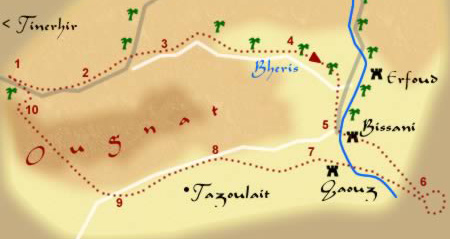
This ride traverses the black mountain passes of Jebel Saghro, which appear inhospitable at first but offer unparalleled views of the desert. You will learn to spot natural springs by the telltale signs of small bursts of green and identify lonely Tamarisk and Acacia trees. On this ride the desert is only broken by a few ancient towns, Merzouga and Rissani, and the titular oasis: the Oasis of Tafilelt. All of these are steeped in significance and history: Merzouga is a tiny village that symbolizes the beginning of the Sahara and Rissani is where the reigning Alawite dynasty was born. Here, Moulay er Rachid started his 1666 war in a bid to conquer Morocco and overthrow the Saadians. The Mausoleum of Moulay Ali Cherif is also here. The Oasis of Tafilalelt, for which the whole valley is named, is the largest palm grove in the world with over 800,000 trees. This ‘sea of palm trees’ is roughly triangular, 12km across and 20km long, and is crossed by the Ziz and the Rheris, two rivers that rarely flow. Their convergence marks a wide plain planted with Acacia trees. In the middle of the desert lush greenery awaits – it is a sight to be seen!
Come and experience this unique combination of desert versus abundance, riding on strong Berber stallion and mares and spending the evenings relaxing in comfortable camps and unique Moroccan hotels!
Accomodation
Accommodations
This is a wilderness ride, so nights will be a mixture of hotels and camping.
Description
15-day expedition: 4 nights in hotels and 10 nights camping
7-day trip (only first week of 15-day expedition): 1 night in hotels and 5 nights camping
9-day trip (only second week of 15-day expedition): 2 nights in hotels and 6 nights camping
Accommodation Itinerary - subject to changes based on availability
Night 1 & 14: Hotel in Ouarzazate
Night 2: Camping near Tawrirt N’Ghlil
Night 3: Camping in Tinejdad
Night 4: Camping in Ksar Touroug
Night 5: Camping in El Jorf
Night 6: Hotel in Rissani
Night 7 & 8: Camping in Hassi la Bied (or Hotel in Hassi la Bied)
Night 9: Camping in Ksar Tinegherass
Night 10: Camping near Mecissi
Night 11: Camping near Alnif
Night 12: Camping in Ait El Farsi
Night 13: Hotel in Tinghrir
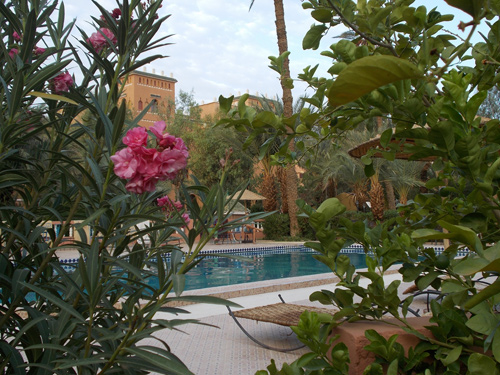
Hotel in Ouarzazate
Since 2005, the hotel welcomes guests in a warm and friendly atmosphere. It offer 31 air-conditioned rooms, all fitted with a private bathroom, WIFI access and a balcony. The hotel also has a beautiful outdoor pool and a small garden with palm trees and flowers.
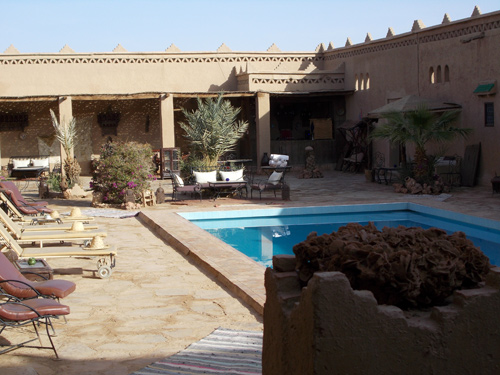
Hotel in Rissani
This charming hotel displays a traditional Moroccan architecture and offers simply furnished bedrooms that come with air conditioning, mosquito net, a patio and private facilities with free toiletries. Hotel amenities include an outdoor pool, a terrace, and hammam where guests can relax. Free Wi-Fi access is provided at this property.
Hotel in Hassi la Bied
This authentic guesthouse offers simple rooms, all with private bathrooms with hot water. Free WIFI is available at this property.
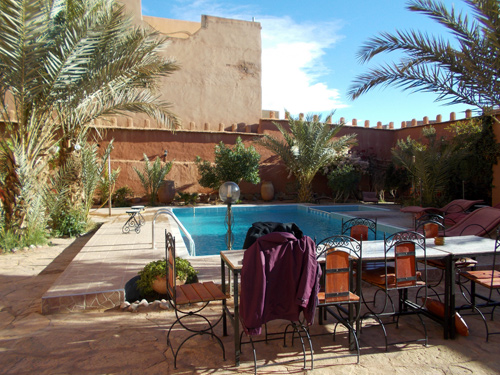
Hotel in Tinghrir
Once a former Kasbah, this historic property was turned into a hotel while keeping the original structure and design of the building. The rooms all feature an ensuite bathroom with climate control and Wi-Fi access. It has an outdoor terrace, a floral garden, and an outdoor swimming pool.
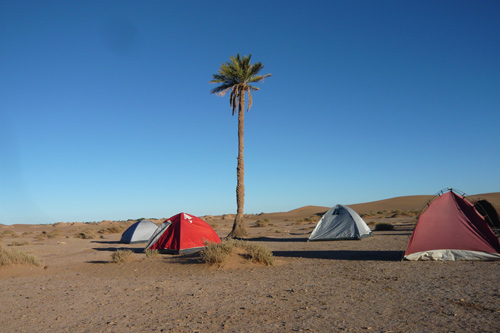
Camping
You will overnight in comfortable dome tents with ground mats. There are rustic portable toilets (no flush) on site and no showers. There will be some rivers along the ride where you can bathe and wash up. Make sure to being your own sleeping bag!
Room Occupancy
Single supplement is mandatory if we are unable to find another rider to share.
Meals
All meals are included except for lunch on day 14.
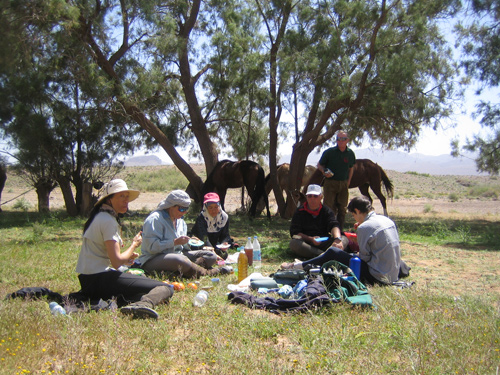
You will enjoy a mix of food: some "western food" and some very good local specialties!
Some days a car will meet us for lunch and on some days we will have a picnic on the trail - you will take the food with you in your saddle bags.
Drinks in hotels or restaurants and alcoholic drinks on the ride are not included.
Dietary Restrictions
We can cater to dietary restrictions if given prior notice.
This trip includes
and can accommodate special dietary requests.
Riding
Horses
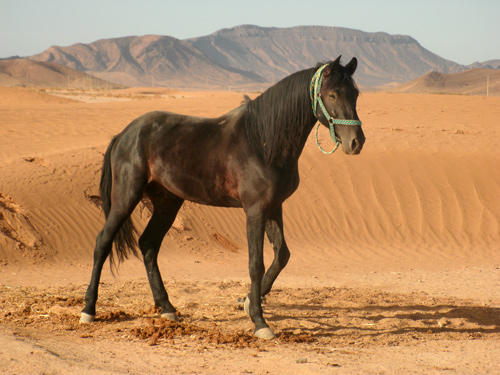
You will ride small but very surefooted Arabian Berber horses with a great courage and stamina. Mares and stallions go together on the ride. Stallions and mares go well together, but some of the stallions need extra space when two are in the same area. A whip is suggested for the stallions, as they need strict orders. This does not make them difficult to ride, they just require more firm direction and more attention. These horses can get very attached to their riders and are always ready to please.
Tack
Mostly English and some military tracking saddles. Some people bring their own gel-cushion or sheep-skin cover to put over the saddle since we ride for long hours.
Staff
Driss and Rena have been organizing treks on horseback in Morocco since 1982.
Rena, once a schoolteacher in Switzerland, came to Meknes in the year 1984 to realize her dream of living in harmony with horses and nature. In love with Morocco and its inhabitants, she will help you discover another Morocco, away from the beaten track, authentic and enchanting, as your guide on the treks.
Driss is a riding instructor who used to work for the National Studfarm of Meknes. He has more than 25 years of experience with horses and he has taught a great many students (a lot of them French) who for the most part have gone on to be high level riders).
Itinerary
Sample Itinerary - subject to changes
Day 1 (Sunday): Arrival in Ouarzazate
Arrival in Ouarzazate. Welcome dinner.
Meals included: Dinner
Overnight at Hotel in Ouarzazate
Day 2 (Monday): First Ride
In the morning we travel over Boumalne Dadaes to Tinghir where we meet our horses. Along the way we get our first glimpses of the desert countryside. Driving along the Valley of a Thousand Kasbahs, you pass through many villages, although many of the khasbas are today ruins. After a picnic in Tinghir we meet our horses and enjoy a three hour ride that brings us to the camp where we spend the night.
Meals included: Breakfast, Lunch & Dinner
Overnight camping near Tawrirt N’Ghlil
Day 3 (Tuesday): Ride to Tinejdad
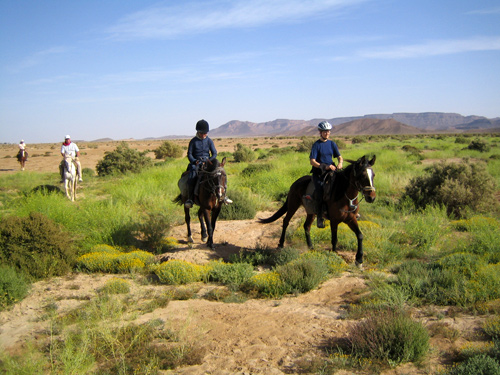
Today we follow the dry river valley, on one side seeing the endless grey-blue mountain ranges of the Jebel Saghro, on the other side the High Atlas Mountains which are often covered with snow in the winter months. Wherever we go, we see springs and green shoots peeking up. Beside such a ‘garden’ we enjoy a picnic lunch in the shade of Tamarisk trees. In the afternoon, we ride over the hill of Shebel Saghro. We stop a salt spring where animals often drink so there might be a chance to see camels or goats of the nomads. We enjoy long canters until we reach the camp.
Meals included: Breakfast, Lunch & Dinner
Overnight camping near Tinejdad
Day 4 (Wednesday): Tinejdad to Ksar Touroug
Today we ride over sandy plains between palm groves. One large spring provides water for the whole oasis of palms. We cross aver a empty river valley and will find our picnic place under palm trees. In the afternoon, we follow a dry river course into the mountains. On this plane you can gallop for miles. As the plain meets a river bed we slow our pace and follow the trails through black mountains. Suddenly a tooth-like, black mountain rises before us; at its feet some palms and oleander grow. There is even a small well here, making this an ideal campsite.
Meals included: Breakfast, Lunch & Dinner
Overnight camping near Ksar Touroug
Day 5 (Thursday): Ksar Touroug to El Jorf
We leave the stony plateau and gallop over sandy plains and the impressive desert that seems infinite. Often, we see herds of camels converge on lonely wells. We have lunch in an old abandoned fort which was a former military base. The lone structure is still in good condition with typically shaped windows and ornaments. We continue our ride by passing green gardens. We travel over small sand dunes and through palm trees. Tonight we camp close to a well that provides water for this whole oasis.
Meals included: Breakfast, Lunch & Dinner
Overnight camping near El Jorf
Day 6 (Friday): El Jorf to Rissani
The today's palm gardens belong to the Oasis of Tafilalelt. Beside them the desert stretches away and in the distance isolated mountains rise. In some places we find again rows of innumerable, small earth hills that cover a waterway system. Many long gallops bring us to the city of Rissani. In the afternoon we visit this small desert town. There is the Mausoleum of Moulay Ali Cherif, a king of the Alaouiten Dynasty. In the center, there is a small Souk, some cafes and little shops. Three times a week there is a bigger market so we may get lucky!
Meals included: Breakfast, Lunch & Dinner
Overnight at a Hotel in Rissani
Day 7 (Saturday): Rissani to Hassi la Bied
After a good breakfast we leave for a long ride towards the sand dunes of Merzouga. We follow little ways trough the palms. Sometimes, we cross villages where many children follow us. A short gallop brings us again to the solitude of the oasis, but it doesn’t last long. Soon, we are out of the palm trees and an immense plain opens up in front of us. If the weather is clear, we can already see the rose colored sand dunes from far away. This infinite flat expanse littered with small black stones has no vegetation. Our camp is at the feet of the dunes. There is a spring which brings water for the whole region so many green gardens are just beside the sand dunes. In the afternoon we can walk up the sand dunes and enjoy the beautiful view. These impressive dunes reach up to 150 meters in height. We can stroll through the green gardens or travel to the nearby village for a coffee.
Meals included: Breakfast, Lunch & Dinner
Overnight camping near Hassi la Bied
**In case you are doing only the portion of the trip only, you are transferred back to Ouarzazate on that day (hotel night not included).
Day 8 (Sunday): Visit of Hassi la Bied (no riding)
Today is a resting day. We can visit Merzouga by car.
Meals included: Breakfast, Lunch & Dinner
Overnight camping near Hassi la Bied
Day 9 (Monday): Hassi la Bied to Tinghras
In the morning we leave the camp by the sand dunes. If there has been a big rain we find a lake near Merzouga. Many birds flock to this lake when the water is in; sometimes we even spot pink flamingos. Around the lake a few green stalks grow and camel herds come there to eat the grass. Soon, we gallop over a big black plane – it seems to be endless when in front of us the black plain joins the blue sky. Later, we cross an empty river valley that we follow as white sandy plains replace a black and stony ground. In the evening, we find the hill of Tinghras, famous for its use in Hollywood desert scenes. Our camp will be just under this beautiful mountain.
Meals included: Breakfast, Lunch & Dinner
Overnight camping near Ksar Tinegherass
Day 10 (Tuesday): Tinghras to Mecissi
Today is a long riding day so we leave early in the morning. Small sand dunes cross our path before we reach another plain and begin to gallop once again. From time to time, a little village shows up, but before long, there are no people anywhere and we follow lonely valleys. The mountains are covered with red sand and the black stone shines through the golden sand. One lonely valley follows the other. Finally we find a well in the middle of the desert. The horses are very thirsty after this long day. We rest and rehydrate before crossing another big valley to find our camp next to a well.
Meals included: Breakfast, Lunch & Dinner
Overnight camping near Mecissi
Day 11 (Wednesday): Mecissi to Alnif
Plentiful of gallops bring us through Acacia trees this morning. We then follow a river valley along which many villages are based. The water is pumped out of wells and many green fields grow along the valley. We enjoy a picnic in a lonely spot under palm trees. We spend the afternoon following the same river valley and more villages and people cross our path. However, camp is still isolated tonight as we sleep outside a palm oasis.
Meals included: Breakfast, Lunch & Dinner
Overnight camping near Alnif
Day 12 (Thursday): Alnig to Ait El Farsi
This morning, we cross over a mountain range. In these mountains, people have found fossils over 500 million years old. Often, we encounter herds of sheep and goats. In between the brown and yellow mountains, there is one very black mountain. We will stop for lunch in a small Oasis village. The children are often curious about the horses.
In the afternoon, we follow a canyon, crossing the mountains on small mule tracks. There is a beautiful view over the Jebel Saghro mountain range.
We set up camp in the following plain.
Meals included: Breakfast, Lunch & Dinner
Overnight camping near Ait El Farsi
Day 13 (Friday): Ait El Farso to Tinghrir
Today is our last riding day. We ride along the Jebel Saghro, a black colored mountain range. On the other side are yellow and brown desert mountains. We have a chance to gallop over fine stones on the ground. From time to time, we find a little well where the horses can drink. The nomads always leave a rope and a bucket by each well so anyone who comes can reach the water. In a little palm oasis we stop for lunch. Some last gallops bring us to the camp near Tinghrir. We leave the horses and the crew and drive to the hotel in Tinghrir. If there is enough time we have the possibility of visiting the Gorge of Tinghrir. Dinner and overnight in a hotel.
Meals included: Breakfast, Lunch & Dinner
Overnight at a Hotel in Tinghrir
Day 14 (Saturday): Sightseeing on the way to Ouarzazate
Today we drive back to Ouarzazate. On the way we will visit the gorge of Boulmane Dadés. On the way through the gorges you will see plenty of greenery, mostly figs and almond trees, interspersed with an array of kasbahs and ksours. In some places, you can see very bizarre rock formations. In the afternoon we arrive in Ouarzazate with enough time to visit the souks.
Meals included: Breakfast & Dinner
Overnight at a Hotel in Ouarzazate
Day 15 (Sunday): Departure
A fond farewell before departure.
Meals included: Breakfast
Note: It is possible to ride for only the first (SU-SU) or only the second half (SA-SU) of the trip with us.
Rates and Dates for Oasis of Tafilalelt
Rates include:
Accommodations - 4 nights hotel and 10 nights camping, meals and 11 riding days.
* prices are per person based on double/twin occupancy
Transfer and Other Charges:
|
2012
|
Transfer from Ouarzazate included
|
Dates Note:
Rates do not include:
Drinks at hotel and alcoholic beverages at camp. Tips for hotel porters and grooms.
Other Info
Meeting: Ouarzazate
Airport: Ouarzazate Airport (OZZ)
Transfer: Ouarzazate
Climate:
Errachidia area
|
Month
|
Jan
|
Feb
|
Mar
|
Apr
|
May
|
Jun
|
Jul
|
Aug
|
Sep
|
Oct
|
Nov
|
Dec
|
|
Average High Temperature (°F)
|
60
|
64
|
71
|
78
|
85
|
94
|
102
|
100
|
90
|
79
|
68
|
61
|
|
Average Low Temperature (°F)
|
37
|
42
|
48
|
55
|
62
|
71
|
78
|
77
|
68
|
58
|
47
|
39
|
|
Average High Temperature (°C)
|
16
|
18
|
22
|
25
|
29
|
35
|
39
|
38
|
32
|
26
|
20
|
16
|
|
Average Low Temperature (°C)
|
3
|
5
|
9
|
13
|
17
|
22
|
25
|
25
|
20
|
14
|
8
|
4
|
Source: NOAA
Seasons
Winter is usually bright and crisp, while autumn brings delicious fresh produce in the markets. Nights can be cold around that time.
Spring sees the Atlas Mountains covered in flowers, while the summers are hot.
The average annual precipitation is less than 102 millimeters (less than 4 inches) in the Sahara.
What To Bring:
Sunny weather all year! Isn't that great!? Actually, you can expect warm to hot weather with a nice breeze in the open country. At noon, we typically siesta to stay out of the hottest sun. Expect sunny weather most of the time, so bring light yet comfortable clothes with you. The most comfortable clothes in warm environments are covering your body yet are light and airy to make sure that the air can circulate.
Nights can be chilly however, so be sure to take some warm clothes as well. Any moment of the year you may have a thunderstorm - so better you bring a rain coat with you too!
Morocco is a country where almost everybody is Muslim. They are very welcoming towards foreigners, but still it might be better to dress modestly and not to show a lot of uncovered skin, especially when you're a woman.
Recommended equipment
- Warm sleeping bag
- Comfortable riding clothes
- Flashlight
- Multipurpose shoes (riding and walking)
- Non-revealing city clothes for occasional visits to towns and hotels
- A warm sweater and coat
- Raincoat
- Sunhat
- Sunscreen
- Swimsuit
- Towel
- Water bottle
- Pocket knife
Note that old clothes and riding equipment you no longer need are very welcome.
|
|