Banff Lodge Ride
Alberta Canada: (RTAB17)
URL: https://www.hiddentrails.com/tour/ab_banff_lodge_ride.aspx
Introduction
Alberta
Canada
Snow-capped peaks, glistening glaciers and sweeping vistas are the allure of Banff National Park.
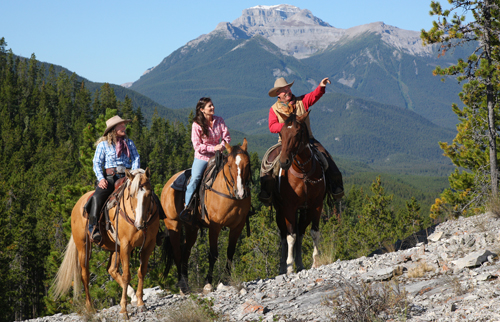
Step out into the Canadian wilderness and enter the home of some of North America's wildest creatures: grizzly bears, black bears, caribou, elk and wolves. Conquer on horseback the rugged back-country trails during the day and return to a rustic, yet cozy, mountain lodge each evening. Here you will learn all about the lifestyle in the West as the cowboys will guide you through Banff National Park, the photographers haven of the Canadian Rockies. These pack trips take fellow adventurers deep into the heart of the rugged Rocky mountain range to explore some of the most spectacular landscapes.
The horses, chosen especially to meet your needs and experience, will win you over with their charming personalities and amaze you with their versatility and trail abilities. You will no doubt form a "partnership" during your ride and come to respect your new friend immensely! This is a wilderness trip for folks who are looking to have a touch of backcountry luxury. Sundance and Halfway Lodges provide just the right combination. Days are spent riding and exploring on horseback, while evenings are spent in the cozy lodges. Meals are always an event and the cooks ensure you are well fuelled for the day's adventures.
We call that roughing it the civilized way!
Accomodation
Accommodations
This is a progressive ride, so nights will be spent in different locations.
Description
Both cabins offer basic amenities in shared room (3 beds per room) with shared bathrooms. There are no sleeping bags or camp stoves here, you will be sipping from wine glasses, dining on food prepared by a skilled chef in a professional kitchen and sleeping in a comfortable bed. Your lodge host will cater to your every need and make you feel welcome, like you are a guest in their home.
Please, note that both the Sundance lodge and Halfway lodge are off grid and have no access to electricity, meaning there will be no opportunity to charge devices or be connected to the internet.
6-day trip Accommodations Itinerary - subject to changes
Night 1: Sundance Lodge
Night 2, 3, & 4: Halfway Lodge
Night 5: Sundance Lodge
4-day trip Accommodations Itinerary - subject to changes
Night 1: Sundance Lodge
Night 2: Halfway Lodge
Night 3: Sundance Lodge
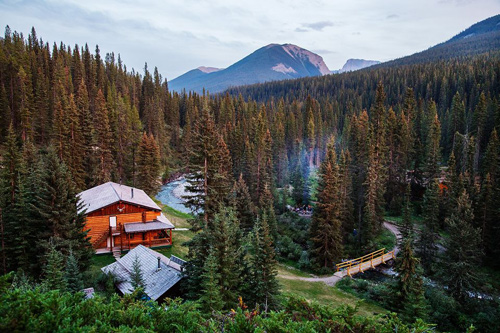
Sundance Lodge
The lodge is the perfect balance of comfort and authenticity – giving you the Wild West Explorer feeling without having to rough it. Completed in 1991, Sundance Lodge now sits on the original site of the horse corral for Ten-Mile cabin, built by Canadian Pacific Railway back in the 1920's. The cabin itself remains standing and was declared a historical site in 1990. It was used as a refuge for mountain guides and packers traveling to Mount Assiniboine, whose names you can still see carved into the logs. Sundance Lodge sits alongside a gentle curve on Brewster Creek, with the Sundance mountain range as a backdrop. Built entirely with fir logs, the lodge has 10 sleeping rooms, a large country kitchen, and a cozy living room area where you can curl up by the wood stove and lose yourself in a good book. And although it is a remote back-country lodge, we decided to add what we felt was an important comfort from home - hot showers! (Please note that, for environmental reasons, showers are restricted to one per stay). The lodge is powered by solar and heated by burning wood and there are indoor washrooms and heated showers onsite. Private sleeping arrangements are possible depending upon trip size, but are not guaranteed. Sundance has 10 sleeping rooms with 3 beds in each room; rooms are designated on a 'choose your own' basis once at the lodges. Each room contains coat hooks, lantern, small desk, chair, beds, and bedding. The lodge can hold up to 34 people.
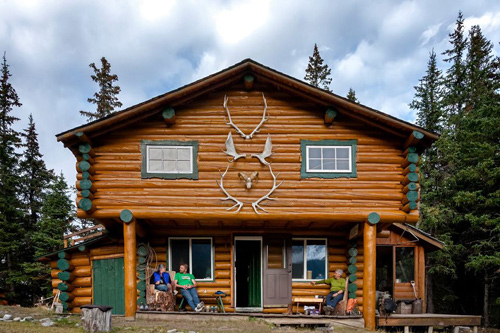
Halfway Lodge
Surrounded by the beauty of towering peaks, Halfway Lodge has been a welcome haven for over 80 years. Rich in tradition, this cabin was used back in the late 1920's by mountain guide Erling Strom as a stopover for his guests traveling from Banff to Mount Assiniboine. Then a single storied cabin, Strom's wranglers spent the night sleeping in tents while the guests found floor space within. Halfway has remained pretty much as originally built, with the exception of a second story added in 1967 when a bear made an appearance through an unexpected entrance - the roof! Thanks to the bear, Halfway now sleeps a maximum of 14 guests in four rooms (single beds only). The lifestyle at this rustic backcountry cabin remains much the same as it was 80 years ago - simple. Propane lanterns and candles provide the lighting, and a wood stove keeps the water hot and the cabin warm and cozy. There are two shared outhouses and an outdoor shower onsite.
Room Occupancy
The single supplement fee applies if we are unable to find another rider to share.
Meals
All meals are included in this trip from lunch on Day 1 to lunch on your last day.
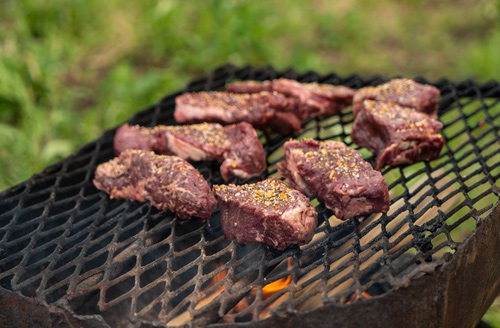
Backcountry cooks prepare sophisticated, hearty meals from braised beefshort ribs and Creme Brûlée Cheesecake on one night, to grilled salmon with bumbleberry pie the next.
Limited wine and beer is available for purchase.
Dietary Restrictions
Although we can cater to some specialty diets, we do not cater specifically to vegetarian diets. There are always plenty of meat-free options available. However we do not offer a “vegetarian” main course.
This trip includes
and can accommodate special dietary requests.
Riding
Riding Experience
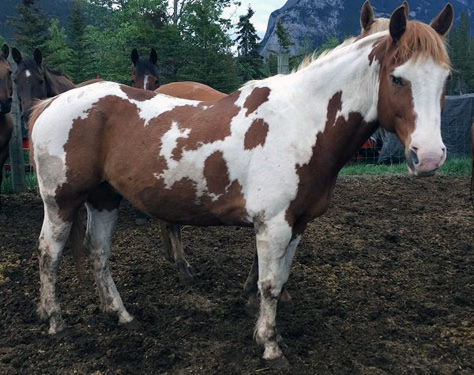
With about 300 horses in our stables, we’re able to pinpoint the absolute perfect horse for any rider. That means if you’ve never been riding before, we’ll be sure to pair you with the most mild-mannered horse available so you can enjoy the experience. Both beginners and experienced riders are welcome to enjoy the beauty of the trails!
You will learn to “trust your horse” as these sure-footed beasts carry you safely down even the most difficult backcountry trails. Our horses are steady, responsive and can be counted on to cross any terrain, from forest paths to boulder-strewn creeks. One of the aspects of our tours that past guests rave about is the deep connection that they form with their hooved companions. At the end of the trip, you will have a new four-legged best friend.
You don't need to assist with tacking up the horse, your guide will do everything for you. If you would like to learn, please ask! Tack is western only and the horses are neck reigned.
Pace
Each of the trips includes approx. 4 - 6 hours of riding each day. We ride for approx. 2 ½ to 3 hours in the morning, stop for lunch on the trail and ride another 2 ½ to 3 hours in the afternoon. The rides are all done at a walk in order to take full advantage of the scenery and wildlife viewing and due to the rugged mountain terrain of the region!
For every 6 riders we’ll have 1 guide.
July is generally the busiest month, with the Stampede in Calgary.
Itinerary
6-day Sample Itinerary - subject to changes
Day 1: Backcountry ride to Sundance Lodge
Riders meet at 9:30 a.m. at Warner Stables. Make your way to our backcountry check in area in the large barn. For those with a vehicle, free parking is available at the stables for the duration of the trip. Here you will meet your fellow riders and your guides for your trip. Slickers and saddlebags will be handed out if required and you will have time to organize your gear and ask any questions you may have.
Your guides will then introduce you to your horse, which has been specifically picked for you. Once you are comfortable you will mount up for the 10-mile ride to Sundance Lodge via the glacier-fed waters of the Bow River, Healy and Brewster Creeks. Half-way to the lodge, you will stop and enjoy a hot lunch by the Bow River. After lunch, we will continue along the trail into Sundance Lodge. You will saunter into Sundance Lodge at around 4:30pm, where you will be greeted by the friendly lodge host and shown to your room where you can freshen up with a warm shower and settle in. Your lodge host will cater to your every need and make you feel welcome at the lodge, like you are a guest in their home. This is no simple, basic lodge – you will be pampered in backcountry luxury, sleeping in a comfortable bed and dining on gourmet cuisine whipped up by your talented host in the professional kitchen. You will be surrounded by the beautiful backcountry of Banff, yet you will still enjoy the luxuries of life.
Riding approx. 10 miles (5-6 hours)
Meals included: Lunch & Dinner
Overnight at Sundance lodge
Day 2: Ride the Erling Strom Trail to Halfway Lodge
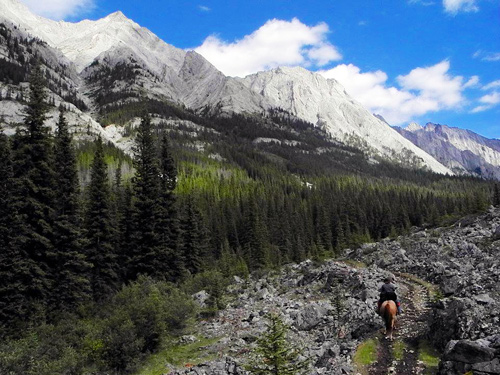
The adventure continues as you journey 9 miles southward to Halfway Lodge. The rugged peaks of the Sundance Range loom over the eastern horizon as you follow the winding historic Erling Strom Trail. You will be following in the footsteps that the early explorers of the Canadian Rockies took nearly a century ago. We will stop along the way for a picnic in the fresh air of an open mountain meadow. Tonight we will stay at Halfway Lodge. Located at the midway point between Banff and Assiniboine Mountain where weary riders have been stopping to rest since the 1920s. As you approach you will notice the trees start to thin out and the mountains peeking up above the tree line all around you. It is tucked into a postcard-perfect setting, with a striking cauldron of mountains all around it. This lodge was constructed by Erling Strom in the 1920s as a stopover spot for the guests he lead on trips from Banff to Mount Assiniboine. With propane lanterns and candles providing lighting and a woodstove providing warmth, it has not changed much in the last 80 years.
Riding approx. 9 miles (5-6 hours)
Meals included: Breakfast, Lunch & Dinner
Overnight at Halfway lodge
Day 3: Climb Allenby Pass on horseback to 8,100 feet
After a hearty breakfast you can leave your belongings at the lodge and set off on another adventure. Today you will make the thrilling climb up Allenby Pass on horseback, an elevation of 8,100 feet. For many this is the highlight of the trip, as you will get a breathtaking view of the jagged rock formations, the enormous amphitheater of mountains stretching out all around you. It is mind-boggling to imagine that Allenby Pass was a seafloor millions of years ago. If you look closely, you can still spot fossils of sea creatures visible among the rocks. At the end of the day, you will return to your familiar room at Halfway Lodge, where you already feel comfortable and at home. As the sun sets behind the mountains, you can sit back and relax, drink wine and share stories and photos with your fellow adventurers.
Riding approx. 3-5 miles depending on time of year and trail conditions (4-6 hours)
Meals included: Breakfast, Lunch & Dinner
Overnight at Halfway lodge
Day 4: Rest time to enjoy the backcountry
Today is a rest day at the Lodge. An optional hike to a shimmering glacial fed lake at the end of the valley, where you can enjoy views of the valley below, can be organized. However, if you would rather relax, there is no pressure. This lodge is a lovely place to find some quiet time, far away from the pinging of notifications and the pressure of your endless to-do list. It is a chance to relax, perhaps by sitting on the deck while getting lost in the pages of a good book. You may even take some time to groom your horse, who has no doubt become your best friend by this point.
No riding
Meals included: Breakfast, Lunch & Dinner
Overnight at Halfway lodge
Day 5: Follow Brewster Creek to Sundance Lodge
Say goodbye to the lovely staff at Halfway Lodge. It is time to hit the winding trail along Brewster Creek back to Sundance Lodge. Be warned: you will not want to leave Halfway Lodge once you have experienced this gorgeous retreat in the Rockies. Your guide will lead you through the backcountry on a scenic and exciting trail, crisscrossing the valley in the historic footsteps of the early pioneers and stopping for lunch along the way. You will arrive back at Sundance Lodge again, a luxurious retreat you will have fallen deeply in love with. Pamper yourself after your ride with a warm shower and a glass of wine, then enjoy another delicious meal prepared by your professional chef lodge host.
Riding approx. 9 miles (5-6 hours)
Meals included: Breakfast, Lunch & Dinner
Overnight at Sundance lodge
Day 6: Return to Warner Stables
It is your last morning at Sundance Lodge, which by now will feel like home due to the warm hospitality of your host. Wake up in your comfortable bed one last time, gather around for a delicious breakfast and wave goodbye as you begin the journey back to Banff. It is your final day on the trail – a gentle 9 mile ride from Sundance back to Warner Stables. Your guide will lead you through the backcountry along winding river trails and through the thick pine forests, with the jagged peaks of the Rockies always standing proudly on the horizon. You will stop along the banks of Healy Creek for a lunch of fresh sandwiches, baked goods and fruit. You will return at approximately 4:30 pm, with plenty of great tales from the backcountry to tell your family and friends.
Riding approx. 10 miles (5-6 hours)
Meals included: Breakfast & Lunch
4-day Sample Itinerary - subject to changes
Day 1: Backcountry ride to Sundance Lodge
We will begin our journey at 9:30am at the stables at the backcountry check-in area of the large barn (please do not arrive any earlier than 9:30am). There is plenty of free parking at the stables and you can park your vehicle here for free during the trip. We will hand out your slickers and saddlebags and introduce you to the horse that we has specifically picked just for you. Things happen on “Western Time” here so we may not leave right on the dot and you will have time to get to know your horse and ask any questions.
Saddled up and ready to ride, we will hit the trail for the 10-mile journey to Sundance Lodge. On this backcountry adventure, we will take you along a route that the early explorers of the Canadian Rockies blazed nearly a century ago. We will follow the trail alongside the rushing glacier-fed waters of the Bow River, Healy Creek and Brewster Creek. Along the way, we will stop for a simple, hearty cowboy-style hot lunch on the banks of the river.
We will arrive at Sundance Lodge late afternoon, where your lodge host will greet you. Sundance is the ideal place for those who want to marvel at the beauty of the Banff backcountry, while still being swaddled in comfort. Settle into your room and freshen up from your day on the trail, then gather around the table for a gourmet meal prepared by your talented host. By the end of this trip, you will have plenty of new friends from around the world.
Riding approx. 10 miles (5-6 hours)
Meals included: Lunch & Dinner
Overnight at Sundance lodge
Day 2: Ride the Erling Strom Trail to Halfway Lodge
The adventure continues as you journey 9 miles southward to Halfway Lodge. The rugged peaks of the Sundance Range loom over the eastern horizon as you follow the winding historic Erling Strom Trail. You will be following in the footsteps that the early explorers of the Canadian Rockies took nearly a century ago. We will stop along the way for a picnic in the fresh air of an open mountain meadow. Tonight we will stay at Halfway Lodge, located at the midway point between Banff and Assiniboine Mountain where weary riders have been stopping to rest since the 1920s. As you approach you will notice the trees start to thin out and the mountains peeking up above the tree line all around you. It is tucked into a postcard-perfect setting, with a striking cauldron of mountains all around it.
This lodge was constructed by Erling Strom in the 1920s as a stopover spot for the guests he lead on trips from Banff to Mount Assiniboine. With propane lanterns and candles providing lighting and a woodstove providing warmth, it has not changed much in the last 80 years.
Riding approx. 9 miles (5-6 hours including lunch time)
Meals included: Breakfast, Lunch & Dinner
Overnight at Halfway lodge
Day 3: Follow Brewster Creek back to Sundance Lodge
Today you will leave your peaceful haven at Halfway Lodge and take the meandering trail along Brewster Creek back to Sundance Lodge. You will spend another night here, relaxing in pure backcountry comfort. Be warned: you will not want to leave Halfway Lodge once you have experienced this gorgeous retreat in the Rockies.
After you wake up in comfort and enjoy a hearty breakfast at Halfway Lodge, you will hit the trail. Your guide will lead you through the backcountry on a scenic and exciting trail, crisscrossing the valley in the historic footsteps of the early pioneers and stopping for lunch along the way. You will arrive back at Sundance Lodge again, a luxurious retreat you will have fallen deeply in love with. Pamper yourself after your ride with a warm shower and a glass of wine, and then enjoy another delicious meal prepared by your talented chef lodge host.
Riding approx. 9 miles (5-6 hours including lunch time)
Meals included: Breakfast, Lunch & Dinner
Overnight at Sundance lodge
Day 4: Return to Warner Stables
It is your last morning at Sundance Lodge, which by now will feel like home due to the warm hospitality of your host. Wake up wrapped in your warm down duvet one last time, gather around for a delicious breakfast and wave goodbye as you begin the journey back to Banff. Breathe the crisp, pine-scented air as you depart for one more day on the trail with your fellow riders – whom you have no doubt become good friends with by now. Your guide will lead you through the backcountry along winding river trails and through the thick pine forests, with the jagged peaks of the Rockies always standing proudly on the horizon. You will stop along the banks of Healy Creek for a lunch of fresh sandwiches, baked goods and fruit. You will take the gentle 9-mile ride from Sundance back to Warner Stables, arriving at around 4:30pm. You may be leaving the backcountry, but the memories you have made will stay with you for a long time.
Riding approx. 9 miles (5-6 hours)
Meals included: Breakfast & Lunch
Rates and Dates for Banff Lodge Ride
Rates include:
Overnights in two backcountry lodges, all meals from lunch on Day 1 to lunch on last day, 6 riding days on the 6 day trip.
GST (VAT): 6% (12% for Canadian Resident)
* prices are per person based on double/twin occupancy
GST (VAT) 6% (12% for Canadian Resident)
Dates Note:
Rates do not include:
Park User Fee, saddle bag
Other Info
Meeting: Stables in Banff for 9:30am
Airport: Calgary International Airport (YYC)
Transfer: --
Climate:
Banff area
|
Month
|
Jan
|
Feb
|
Mar
|
Apr
|
May
|
Jun
|
Jul
|
Aug
|
Sep
|
Oct
|
Nov
|
Dec
|
|
Average High Temperature (°F)
|
23
|
32
|
40
|
49
|
58
|
65
|
73
|
72
|
62
|
50
|
33
|
23
|
|
Average Low Temperature (°F)
|
6
|
11
|
18
|
27
|
34
|
41
|
45
|
44
|
36
|
29
|
17
|
7
|
|
Average High Temperature (°C)
|
-5
|
0
|
4
|
9
|
15
|
18
|
23
|
22
|
17
|
10
|
1
|
-5
|
|
Average Low Temperature (°C)
|
-15
|
-12
|
-8
|
-3
|
1
|
5
|
7
|
6
|
2
|
-2
|
-8
|
-14
|
|
Average Precipitation (days of rain)
|
5
|
4
|
5
|
6
|
7
|
9
|
8
|
8
|
7
|
5
|
4
|
4
|
Source: NOAA
Seasons
It is no coincidence that visitor activities available in Banff National Park are as varied as the park's climate. A year in Banff National Park would give a visitor a taste of everything in terms of weather and recreation. The summer sees sunny, warm days for such things as horseback riding, hiking, biking, camping, and climbing. The winter brings crisp, snowy days for tracking, skating, and alpine and nordic skiing.
The relative dryness of the air in Banff, however, makes even extreme temperatures more bearable.
Likely the most reliable characteristic of the weather in Banff National Park is its variability. The weather at one point in the park may be quite different from that of other points relatively near by. At one specific location the weather can vary considerably from year to year, and from day to day, so be prepared!
Even if it is warm and sunny, always take rain gear and a sweater. You might need them by the time you reach your destination.
The weather can also change dramatically throughout the day. The dryness of the air causes temperatures to vary considerably from night to day. The temperature on a summer night can drop to a few degrees above freezing even if daytime temperatures climbed into the upper twenties (80's F).
Vacationing in such a variable climate means thinking ahead and having a sense of adventure!
What To Bring:
Below is a list of items you NEED to bring with you. We have had many years of personal experience dealing with Mother Nature up here, so please take our list to heart.
Average Temperatures
Month/ High/ Low
June 19C / 66F 5C / 41F
July 22C / 71F 7C / 45F
August 22C / 70F 7C / 44F
September 16C / 60F 3C / 38F
These are average temperatures at an elevation of 4,538 feet. Temperatures will drop at higher elevations.
When packing your gear, please keep in mind it is being packed out and our animal’s comfort is very important to us. By following these guidelines you can help us ensure that we’re taking care of all our animals.
What to pack your gear into
You must pack your gear in soft-sided, cloth or nylon bag. It can not have any hard edges, frames or wheels. Your luggage is restricted to a total maximum weight of 30lbs. If you do not have a water-resistant bag, it is a good idea to line the inside with garbage bags in the event of rain. Saddlebags, rain gear and other essentials that you will need during the day (camera, sunscreen, bug spray, lip balm, extra sweater, water bottle, etc) that you are taking on your horse with you are not included in the 30lb weight restriction.
Daypacks, backpacks or other bags are not allowed, but your rain gear will travel with you on the horse and your guide will help you attach it to the saddle. If you would like to bring saddlebags please fill them with only those essential items that you would need during the day. Fanny packs (a small pack that ties around the waist) also work well. We have a limited supply of saddlebags available free of charge which are available for pick up upon check-in (sorry, no earlier).
The length of your trip will alter what you need to bring. This list is ideal for a 6 day trip.
Essential Items
1. Bags/luggage: Waterproof bags are the best option. Drysacks, favoured by canoers, or a gym bag lined with garbage bags work well.
2. A warm coat and warm layered clothing: Essential to ward off chilly nights or a windy day. Also bring a heavy sweater (wool is a great insulator) or fleece jacket. Clothing that is easily layered works the best. You can always remove what you don’t need, but you still have it just in case. Also, bring your most comfortable gear — this is not the time to break-in new boots or a new hat.
3. Rain gear: A rain coat and rain pants, and if possible, coverings for your boots and hat. Please DO NOT bring rain ponchos, they flap in the wind and can scare the horses. If you have one, we recommend a slicker. We have a limited supply of full-length waterproof slickers (traditional cowboy rain coat) available. These are available for pick up upon check in based on a first come first served basis.
4. Shirts: Long sleeve and t-shirts to your preference and length of trip.
5. Jeans: A cowboy classic.
6. Riding boots: A boot with a heel that can easily slip in and out of stirrups. Alternatives would be a narrow style of hiking boot or solid sneaker. For safety reasons, clunky hiking boots are not recommended. Water (rain) resistant boots are recommended.
7. Sneakers: Or an extra pair of shoes for wearing inside the lodge, an extra pair of DRY socks is also recommended.
8. Toiletries: Biodegradable shampoo, toothbrush, toothpaste, disposable razors, etc. Please note that the lodges do not have any electricity. We supply toilet paper, handsoap, towels and face cloths at both lodges.
9. Hat: A cowboy hat offers the most protection from the elements. Baseball caps or canvas type hats are also fine. Please ensure that your hat fits snug or ties on and will not blow off in the wind. Chin straps are recommended. If you prefer to wear a riding helmet, we have them available upon check in. Please note that riders that are 17 years and under are required to wear a helmet while on horseback on the backcountry trips.
10. Gloves: Lined leather or suede gloves provide protection from the elements and a sure grip on the reins (bring two pair just in case one gets wet).
11. Scarf: A silk or cotton scarf is recommended for extra warmth.
12. Sunscreen: And sunglasses and mosquito repellent.
13. Your camera : Don’t forget extra batteries.
14. Flashlight: Remember to check your batteries!
15. Please do not bring liquor: The lodges are licensed and so under Alberta Law we cannot allow self brought alcohol to be consumed. We do have alcohol for sale at reasonable prices.
16. Water bottle: For refreshment while you are riding.
17. Cellular phones: Do not work in the areas you’ll be riding in so leave them somewhere safe. If you will be using the camera on your phone, please note there is no charging station in the backcountry.
18. Saddlebags: You are welcome to bring your own; please fill them with only those essential items that you would need during the day, such as lip balm, your camera, sunscreen, etc. We reserve the right to limit the amount of gear in the saddlebags for weight. Daypacks, backpacks or other bags are NOT allowed — they are hard on your back and hard on the horse’s back, and do not tie properly to the saddle.
19. Cash: You may want to bring some cash to purchase liquor or leave a gratuity for your cooks. You can also use credit cards to purchase liquor.
|
|