|
Horseback riding tours
Rides in
Tanzania
Intro to Tanzania
----------------------------
Kenya Ethiopia
|
|
|
|
|
|
Migration Riding Safari
Tanzania
Tanzania
The Experience of your Lifetime – watch the Great Wildebeest Migration from horseback!
This mass migration in Eastern Africa comprises of the largest movement of land animals on the entire planet. Welcome to Tanzania's oldest and most popular national park, the Serengeti, which is famed for its annual migration when some six million hooves pound the open plains as more than 200,000 zebra and 300,000 Thomson's gazelle join the 1.2 million wildebeest in search of quality pastures. Where we ride you will have a chance to see some of these migrating animals. - you may see herds of some hundreds or a thousand at a time - all a relatively small portion of the incredibly expansive migratory herd of over a million which wander across the Serengeti in a search for survival.
Live your dream – join us in this extraordinary experience!
Depending on the movements of the animals our ride will take place in various private concession areas, Wildlife Management Areas near to the Serengeti, Ngorongoro Crater, Lake Manyara or Amboseli, all popular national parks and reserves. We normally either ride within the area of Lake Manyara, inside a WMA (Wildlife Management Area) adjacent to the national park (for TARANGIRE Migration) or in the Longido WMA (for AMBOSELI/Meru/Kilimanjaro Migration).
Let’s follow and track them!
The wildebeest migration is an authentic tale of life and death on the African plains. The migration is all about food; the wildebeest migrate to follow the seasonal rains and thus the supply of fresh nutrient rich savannah grass. The migration begins in Tanzania in March with the birth of the new calves; once they are strong enough the long trek north begins. Then they move into the Masai Mara. October to November is when the short rains begin to fall in the south and east Serengeti, so the herds start to leave the Masai Mara, crossing the Mara River yet again, bringing all the same perils as before. They head slowly back to the Serengeti's eastern plains.
|
Camping Ride with vehicle support Safari Ride
|
|
Meeting:
|
Moshi
|
|
Airport:
|
Kilimanjaro
|
|
Transfer:
|
Kilimanjaro International Airport (JRO)
|
|
Riders:
|
Min
2 riders
Max
6 riders
|
|
Trip Brochure (PDF)
Trip Rating
|
|
|
|
Rates and Dates for 2013
Rates include:
Accommodationat the farm and along the trail in luxury tent camps and safari camps, all meals and drinks, luggage transfers where necessary, English & German speaking guide
| A | 2013 | 8 day trip, AP South-Amboseli or Lake Manyara | 8d / 7n | €3700 | $4810 |
Transfer and Other Options:
|
2013
|
Transfers are included from Kilimanjaro or Moshi
|
€
0
|
$0
|
|
2013
|
Single room supplement
|
€
300
|
$390
|
|
2013
|
Extra night at farm w/ meals + activities
|
€
395
|
$515
|
|
2013
|
Mandatory conservation fees
|
€
480
|
$625
|
|
2013
|
4-night Chimpanzee Tour Option (includes charter flight)
|
€
3,320
|
$4,315
|
|
2013
|
4-night Chimpanzee Tour - single room supplement
|
€
455
|
$590
|
Tour Dates for 2013
Check here for details and availability
|
| A |
2013
|
06/15
- 06/22
|
8d / 7n
|
8 day trip, AP South-Ambosel...
|
2
/6
|
Reserve
|
| A |
2013
|
07/13
- 07/20
|
8d / 7n
|
8 day trip, AP South-Ambosel...
|
2
/6
|
Reserve
|
| A |
2013
|
08/10
- 08/17
|
8d / 7n
|
8 day trip, AP South-Ambosel...
|
2
/6
|
Reserve
|
| A |
2013
|
09/07
- 09/14
|
8d / 7n
|
8 day trip, AP South-Ambosel...
|
2
/6
|
Reserve
|
| A |
2013
|
10/12
- 10/19
|
8d / 7n
|
8 day trip, AP South-Ambosel...
|
2
/6
|
Reserve
|
| A |
2013
|
11/09
- 11/16
|
8d / 7n
|
8 day trip, AP South-Ambosel...
|
2
/6
|
Reserve
|
| A |
2013
|
12/07
- 12/14
|
8d / 7n
|
8 day trip, AP South-Ambosel...
|
2
/6
|
Reserve
|
|
|
Rates do not include:
Flights, tips and gratuities, laundry and phone calls, other items of a personal nature.
Sample Itineraries:
Please note that all scenarios are dependent on the movement of the game which will be influenced by the rains. Therefore there is not one but a few different itineraries of the Migration Rides we offer. We are always trying to foresee the seasons in order to assess the migration schedules to the best of our ability and for your enjoyment.
Option 1: Lake Manyara
The migratory scheme provides usually good herds in the Lake Manyara area between beginning December to June although as everywhere the migrations are mostly depending on rains in the surrounding areas.
Different to the Serengeti-Migration this is not ONE huge migratory herd with thousands of animals, as this is the dispersed game from Tarangire and Manyara National Parks that are migrating through in good numbers. During previous rides at Lake Manyara area we encountered plain animals, zebra, elands and wildebeest (in herds of 100 to 300 animals), Thompson gazelles (herds up to 100 animals), further giraffe, ostrich, some small predators and loads of birds.
There is no big game like elephant or buffalo. Basically most of the game is here when it is wetter than the surrounding areas.
Day 1: Arrival the farm
Pick-up from Kilimanjaro Airport and transfer to thge farm. Here you will meet the horses and we will help you to choose one to fit your requirements. Every effort is made to join you with the horse most suitable for your requirements. Afterwards we start for a ride to test horses and tack. Return for a sun-set drink on the veranda and enjoy the view of the magnificent mountain in front or our doorstep – Mt. Kilimanjaro.
Day 2: Lake Manyara
The horses will be transferred to Lake Manyara early morning and we will follow by vehicle after a relaxed breakfast. We will meet the horses on the way and start our adventure – the ride starts close to Tarangire National Park and we will arrive at our camp at Lake Manyara late afternoon.
Day 3 to Day 6:
For the next 4 nights we will use a mix of permanent tented camps (probably 2 nights) and fly-camps (another 2 nights) – however, the exact program will depend mostly on the rains and expected movement of the game. We will ride over the plains with Rift Valley in sight, often along the lake shores of Lake Manyara. By day 6 we will reach the boundary of Lake Manyara National Park.
We will spend the night at a permanent camp with great view over the plains, Lake Manyara and into the National Park. As this is outside of the park the scenery is very varied – herds of zebra, wildebeest and giraffe mix with Masai and their herds.
Day 7: Lake Manyara National Park
After a morning ride you will visit Lake Manyara National Park on a game drive. This is where you will see species we have not met on horseback – buffalo, elephant and hippo. In the afternoon you will drive back to the farm.
After the morning ride horses will be transferred back. In the evening you will arrive at Makoa where you spend your last night. We celebrate the adventures of your ride and later you will be surprised by the lush environment and the sounds of the gallery forest close to your cottage.
Day 8: Farm and departure
Depending on your ongoing schedule there might be time for an extended ride through the coffee plantation. Others may decide to visit the smallholder farms of the tribe that populates Mt. Kilimanjaro to get some insight in life of Chagga village. Or, you may take the chance for a visit of Moshi town to get some souvenirs.
Later transfer to Kilimanjaro Airport or start your ongoing journey.
Option 2: South-Amboseli Trail
This option is a trail with longer routes and therefore offers most of the riding, but also change of landscapes und usually really good game. We will ride along the Ngasurai Plains where the migratory herds from Amboseli pass through on their way to Kilimanjaro and Arusha National Park. The area is famous for the herds of elephants and many old bulls can be met here amongst other game. During previous rides we encountered elephant herds of up to 60 animals (last December there even gathered about 250 elephants in a really small area), also lots of zebra, wildebeest, giraffe, eland and other antelopes in small herds.
Part of this route we ride during our Big Game Trail but the South Amboseli Trail will reach much further which means that we will meet more and a wider variety of game. This route is only done for the migration program as it requires motivated riders that do not get tired easily. For the migration rides the requirements on the riders ability is higher than for other rides and for this reason most groups consist of motivated riders that thoroughly enjoy it!
Day 1: Arrival at the farm
Arrival at Kilimanjaro Airport and transfer. Meet the horses and start your introductory ride on the farm. Overnight.
Day 2: Ndarakwai Ranch
After breakfast you will be transferred to West Kilimanjaro. We will find the horses at the meeting point and start the ride from here. A part leads over the Narco Plains where we will encounter the first plain animals. Later afternoon we will arrive at Ndarakwai Camp, a permanent tented camp where we will stay for the next two nights.
Day 3: Game Rides at Ndarakwai Ranch
A whole day of riding in this private game reserve. We are likely to encounter elephant, zebra, wildebeest and many other antelopes (Elands, Thomson, Grant and Impala), occasionally buffalo. We will return for a lunch break, in the afternoon there is the option to watch animals from the elevated tree house next to the water hole. Those interested in local culture may join the visit of a Masai Boma, this is how a settlement of a Masai Clan is called.
Day 4: Sinya/Ngasurai Plains
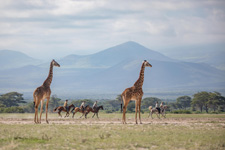
Today we leave Ndarakwai and continue to the Ngasurai Plains. After the first rains of the rainy season this vast plain all of a sudden gets very populated and there are big migratory herds wandering through feeding on the fresh short grasses. The area is perfect for canters with wildebeest or zebra herds – or what about a gallop with giraffe…
You will be awaited with a camp fire in our mobile camp and have a Gin &Tonic to enjoy the warm sunset colors.
Day 5: Kambi ya Tembo (Kisw.: Elephant Camp)
We continue north towards the Kenyan border. After the plains we will climb onto a rift with a permanent camp set up perfectly with a view over the plains towards the Rift Valley. This area is popular for the population of elephants and old bulls can be found here. Often we can watch a herd of elephants or giraffe passing next to the camp. After a delicious meal you might go to bed with the roaring of a lion in the distance.
Day 6: Sinya Mines
A day ride will lead us up to the Kenyan border close to Amboseli National Park. By now the landscape changed completely and you will be surprised how many animals populate the area which seems to consist out of chalk – this is where the “Meerschaum” has been mined many years ago. Depending on the weather we will choose a place close to the numerous springs or ponds to have picnic, or if it is hot we will stay a bit further away under a shady tree. By late afternoon we reach Kambi ya Tembo again, just in time for a sunset drink in the warm colors over the plains.
Day 7: Out of Africa
After breakfast we leave for a long route for today. Carefully we will wind our way through Acacia bush and over savannah. This area is not accessible by vehicle so we will carry some snacks in our saddle bags. We will arrive for a late lunch at our Mgunga Fly Camp, you will feel yourself brought into “Out of Africa”. The view over rolling grass fields and bush, with Mt. Meru at one side, Mt. Kilimanjaro behind you and the mountains Longido and Namanga to the other side will make you feel that this is the place where you’d like to stay…
The afternoon is for leisure and relaxation; the more active might climb Mgunga Hill to enjoy the wonderful sunset from there.
Day 8: Back to the Farm
You will feel it difficult to leave, however this will be a last exiting day on horseback. First we head towards Mt. Meru, when we reached Narco there will be some last exhilarating canters over the plains. We will meet the vehicle for a picnic, afterwards load the horses and drive back to the farm.
The last sunset drink will be on the veranda of our farm house, with a hopefully clear view of Mt. Kilimanjaro. Later depart for your ongoing journey or opt to stay for another night for a more relaxed pace.
Important: This is a demanding ride and the riding experience of the clients is an important consideration for planning an itinerary and to mix a group well. Please find the information sheet for riding safaris attached, this includes a questionnaire for the rider details. For any reservation we will require these details so that we can make sure to arrange a suitable program for them and to pre-book suitable horses.
The main considerations for a decision between the two options:
- Amount of riding required:
Long riding routes in South Amboseli might be tiring for riders not used to long hours in the saddle. Shorter riding routes and time in Lake Manyara make it easier to chill out if required, e.g. afternoon at the pool. South Amboseli is a much more demanding ride.
- Amount of game:
Difficult to say, on previous rides the biodiversity was higher on the South Amboseli route whereas the numbers of animals counted within one herd was higher at Lake Manyara. However, on any of the programs we encountered herds of giraffe to up to 20 animals (important as by mail from the clients).
- Landscapes:
Fascinating but not changing landscape during the whole ride at Lake Manyara along the Rift Valley. Beautiful and changing landscapes during the South Amboseli Route.
- Additional activities: For both options we will arrange a night game drive and a visit of a Masai Boma. To meet tribal people is an experience everyone enjoys!
Meeting:
Moshi
Airport:
Kilimanjaro
Transfer:
Kilimanjaro International Airport (JRO)
Distance:
35 km
|
Tack:
|
|
Quality trail saddles include (‘Trailrider’), 'Startrekk' and treeless saddles (‘Barefoot’ and ‘Torsion’)
Bitless bridles like Sidepull and Hackamore
|
|
Horses:
|
|
Variety of Thoroughbred, Warmbloods and Mix of both, Arabian Mix, Australian Brumby, Achal-Tekke
|
|
Pace:
|
|
Extended trots and fast canters, about 4-6 hours in the saddle - 45 to 60 km daily - varies as the idea of the ride is to emphasize game viewing and scenery in remote areas.
|
Walk |
Trot |
Canter |
Gallop |
|
|
Level:
|
|
(3.5
to
4
out of 5) Strong Intermediate +
|
|
Age:
|
|
Min
12
|
|
|
Weight:
|
|
Max
200
|
|
Riders:
|
|
Min
2 riders
|
Max
6 riders
|
|
Suitable for experienced riders only, this is an outstanding riding experience for riders up to the challenge! Riders must be able to post
to the trot for extended periods and be able to use skilled leg aids to
control a horse. Good balance & state of fitness is required!
We will be riding in corridor areas where animals migrate in order to find new pastures. Especially close to the rainy seasons is when animals congregate and migrate in herds between Amboseli, Mt. Kilimanjaro and Mt. Meru. Important to note, this is not the infamous Serengeti Migration, as horse riding is not allowed within those national park boundaries, therefore our rides take place in areas outside of the central 'herd.' Did you ever dream to canter side by side with the herds of plains game? This is the chance to live your dream!
We offer our guests an intimate and personal horse riding holiday, affording them the best that East Africa has to offer in terms of the African 'Bush'. Our horseback safaris are highly personalised, very much ‘off the beaten track’ and away from human settlement. You will be accompanied on all rides and activities by your hosts ensuring that your riding holiday will be a truly memorable one. Your hosts, are both veterinarians, and they ensure the condition of their horses is top quality. Even in challenging circumstances in the bush the condition of their horses are superb. The horses are Warmbloods, some Arabs and Thoroughbreds, and some crossbreds, bred from their own professional safari horse lines so they retain their ! All are ridden with bitless tack in a loose rein and in a relaxed style. There are approximately 20 great horses available for all riders' preferences! Forward and fast or solid and
steady, let them know what you like!
This is a trail with long riding routes, at all paces where the terrain permits, and offers stunning changes of landscapes and great game viewing. Depending on season and game movements we might ride along Lake Manyara where the herds from Tarangire pass through on their way to Lake Manyara National Park. Or we will choose the South Amboseli Route over the Ngasurai Plains with herds moving between Amboseli, Kilimanjaro and Arusha National Park. The South Amboseli area is famous for the herds of elephants and many old bulls can be met here amongst other game. You may encounter elephant herds, sometimes there gather up to about 250 elephants in huge herds. Expect to meet herds of zebra, wildebeest, giraffe, eland and other antelope.
Weight Limit: 200 lbs
Your Safety: Every ride will be accompanied by one of the owners as
guide and a back-up rider. They will be equipped with a GPS, first aid
kit, mobile phone and radio-call.
Passport and Visa Requirements:
Passport valid for at least six months required by all nationals referred to in the chart.Required by all nationals referred to in the chart above except: 1. nationals of Cyprus and Malta for stays of. more
The climate in Lake Manyara, Tanzania is warm to hot year round due to the close proximity to the equator, with rainy seasons occurring in November and December and again from March to May. Minimum temperatures for this region are 12 C / 59 F and the maximum is 40 C / 104 F. Peak heat is normally in January and February.
The climate in the Amoseli region of Tanzania is hot all year round. The average maximum temperature is normally around 33 C / 91 F and the average minimum temperature is normally around 27 C / 80 F, however, like Lake Manyara, this area has two rainy seasons, first from April to May and then later in November and December.
Please note: Don't bring your new or favorite clothing and equipment on safari as they can and will get very dirty or damaged, unless you are prepared to accept this fact!
|
… this list is only a guideline for you
|
|
|
|
Travel documents and Voucher
|
|
Flight tickets
|
|
Passport
|
|
Visa (check with your consulate)
|
|
|
|
RIDING GEAR
|
|
Riding pants or Jodhpurs
|
Important: FULL chaps are recommended, leather or synthetic, to protect you from thorns of trees and bushes!
|
|
Light-weight, short style riding shoes which are comfortable for walking. We will dismount every hour for 10 minutes and walk, and sometimes the horses will be led over difficult terrain.
|
|
Riding helmet - light-weight and breathable! Wearing a helmet is purely your decision on this ride, not mandatory. Our recommendation, however, is to confirm with your insurance this is OK as some insurances will require the rider wearing a helmet for coverage!
|
|
Riding gloves
|
|
Wide-brim hat with strap & scarf for sun protection
|
|
Bush color riding clothes (not white or bright colors)
|
|
|
|
PERSONAL CLOTHING
|
|
A jersey, fleece or multi pocketed waistcoat
|
|
Long sleeve cotton shirts
|
|
Jeans
|
|
Shorts
|
|
Underwear and socks
|
|
Pyjama
|
|
A lightweight, waterproof windbreaker jacket
|
|
Trekking boots/ comfortable shoes
|
|
Swimsuit
|
|
|
|
ADDITIONAL THINGS TO BRING
|
|
Personal Toiletries
|
|
Insect repellent which prevents ticks *
|
|
Personal medications
|
|
Sore cream (for an emergency)
|
|
Sewing kit
|
|
Handkerchiefs
|
|
Rehydration salts
|
|
Torch or head lamp
|
|
Camera, binoculars on a strong shoulder strap, preferably in a waterproof pouch to be secured to belt- extra film and batteries
|
|
Malaria pills
|
|
Biodegradable soap and shampoo
|
|
Sun glasses with strap
|
|
Sun tan lotion and lip balm
|
*Some tick sprays can be used for clothes and shoes only, and you can treat your clothes at home for prevention that will last for the whole safari period.
Sorry, no video is currently available for this tour.
*Important Notice: The following ratings have been submitted by guests and do not necessarily represent the views of Hidden Trails, its partners or employees.
Every care is taken to ensure accuracy but Hidden Trails is not liable for any errors or omissions.
..view other reports for different trips
There are two different accommodation options:
1. Overnights in permanent tent camps
Luxurious lodgings in various landscapes and good diversity of game, the permanent camps are equipped with beds and an en suite bathroom with shower. Meals are
taken in the mess tent. In the Mountain-Forest Camp (1 night) you stay
in small dome tents with mattresses on the ground. There is also a mess hall
tent and a separate tent with bathroom facilities.
2. Overnights in our mobile tent camp
Comfortable tent camps that have more flexibility to move to wherever the migration is headed. For 1 night you can sleep under the stars (with mosquito net), or for those who prefer we will set up a dome tent. The mobile tent camp has individual spacious tents with sleeping mattress, community solar shower, and portable outhouse.
The Food at Camp:
All meals are prepared fresh and most of the ingredients are produced on the farm. This includes most vegetables, meat, milk and milk products. There will be fresh home-baked bread on your table every morning. There will also be home-made confectionary available in the afternoon. Depending on the schedule, lunch will be served in camp or under a shady tree as a picnic.
This trip includes
some wine with dinner
and can accommodate special dietary requests.
|
Tack:
|
|
Quality trail saddles include (‘Trailrider’), 'Startrekk' and treeless saddles (‘Barefoot’ and ‘Torsion’)
Bitless bridles like Sidepull and Hackamore
|
|
Horses:
|
|
Variety of Thoroughbred, Warmbloods and Mix of both, Arabian Mix, Australian Brumby, Achal-Tekke
|
|
Pace:
|
|
Extended trots and fast canters, about 4-6 hours in the saddle - 45 to 60 km daily - varies as the idea of the ride is to emphasize game viewing and scenery in remote areas.
|
Walk |
Trot |
Canter |
Gallop |
|
|
Level:
|
|
(3.5
to
4
out of 5) Strong Intermediate +
|
|
Age:
|
|
Min
12
|
|
|
Weight:
|
|
Max
200
|
|
Riders:
|
|
Min
2 riders
|
Max
6 riders
|
|
Suitable for experienced riders only, this is an outstanding riding experience for riders up to the challenge! Riders must be able to post
to the trot for extended periods and be able to use skilled leg aids to
control a horse. Good balance & state of fitness is required!
We will be riding in corridor areas where animals migrate in order to find new pastures. Especially close to the rainy seasons is when animals congregate and migrate in herds between Amboseli, Mt. Kilimanjaro and Mt. Meru. Important to note, this is not the infamous Serengeti Migration, as horse riding is not allowed within those national park boundaries, therefore our rides take place in areas outside of the central 'herd.' Did you ever dream to canter side by side with the herds of plains game? This is the chance to live your dream!
We offer our guests an intimate and personal horse riding holiday, affording them the best that East Africa has to offer in terms of the African 'Bush'. Our horseback safaris are highly personalised, very much ‘off the beaten track’ and away from human settlement. You will be accompanied on all rides and activities by your hosts ensuring that your riding holiday will be a truly memorable one. Your hosts, are both veterinarians, and they ensure the condition of their horses is top quality. Even in challenging circumstances in the bush the condition of their horses are superb. The horses are Warmbloods, some Arabs and Thoroughbreds, and some crossbreds, bred from their own professional safari horse lines so they retain their ! All are ridden with bitless tack in a loose rein and in a relaxed style. There are approximately 20 great horses available for all riders' preferences! Forward and fast or solid and
steady, let them know what you like!
This is a trail with long riding routes, at all paces where the terrain permits, and offers stunning changes of landscapes and great game viewing. Depending on season and game movements we might ride along Lake Manyara where the herds from Tarangire pass through on their way to Lake Manyara National Park. Or we will choose the South Amboseli Route over the Ngasurai Plains with herds moving between Amboseli, Kilimanjaro and Arusha National Park. The South Amboseli area is famous for the herds of elephants and many old bulls can be met here amongst other game. You may encounter elephant herds, sometimes there gather up to about 250 elephants in huge herds. Expect to meet herds of zebra, wildebeest, giraffe, eland and other antelope.
Weight Limit: 200 lbs
Your Safety: Every ride will be accompanied by one of the owners as
guide and a back-up rider. They will be equipped with a GPS, first aid
kit, mobile phone and radio-call.
Passports
Passport valid for at least six months required by all nationals referred to in the chart.
Visas
Required by all nationals referred to in the chart above except:
1. nationals of Cyprus and Malta for stays of up to three months and issued with a visitor's pass on arrival, but may still need entry permit clearance. It is possible for British nationals to obtain a tourist visa for single entry at any one of the main port of entries to Tanzania, subject to the fulfillment of all immigration requirements. All other visitors must obtain visa prior to travelling to Tanzania.
Visa Note
(a) The high commission does not issue multiple entry visas for tourist or business purposes. All multiple entry visas should be applied for at the Immigration Head Office in Dar es Salaam through your host. (b) Nationals not referred to in the chart above are advised to contact the embassy or high commission to check visa requirements (see Contact Addresses).
Types of Visa and Cost
£38 per single-entry (prices are for application at high commission in London). US visas: US$100 (single or double-entry, six months); US$120 (express service).
Validity
Tourist single-entry: three months from date of issue; Business single-entry: two months.
Applications to:
Consulate (or consular section at high commission or embassy); see Contact Addresses.
Working Days Required
Normally three. Up to 10 for postal applications. 24-hour service is available at an extra charge of £5.
| Passport Required? |
| British |
Yes |
| Australian |
Yes |
| Canadian |
Yes |
| USA |
Yes |
| Other EU |
Yes |
| Visa Required? |
| British |
Yes |
| Australian |
Yes |
| Canadian |
Yes |
| USA |
Yes |
| Other EU |
Yes/1 |
| Return Ticket Required? |
| British |
Yes |
| Australian |
Yes |
| Canadian |
Yes |
| USA |
Yes |
| Other EU |
Yes |
This information is not being updated on a regular basis. Hidden Trails does not
take any responsibility for the accuracy of the above information. Please, consult
the embassy or consulate for updated info.
|
|
|
|
Migration Riding Safari
Tour Code:
IT-TZRT06M
8 days /
7 nights
~$4,810.00
Dates :
February to December
Trip Rating :
Difficulty :
Riding Level Explained | A | Beginner  | Beginner A rider who has limited experience, is unable to post the trot and does not canter. | | B | Novice
 | Novice A rider who is capable of mounting and dismounting unassisted, capable of
applying basic aids, comfortable and in control at the walk, moderate length posting
trots, and short canters. | | C | Intermediate
 | Intermediate A rider who has a firm seat, is confident and in control at all paces
(including posting trots, two point canters and gallops), but does not ride regularly. |
| D | Strong Intermediate
 | Strong Intermediate An intermediate rider who is currently riding regularly and is comfortable in the saddle for at least 6 hours per day. | | E | Advanced
 | All of the above, plus an independent seat, soft hands, and capable of handlinga spirited horse in open country. |
Lodging:
Introduction
Day to Day Itinerary
Rates | Dates
Accomodation
Tack:
Quality trail saddles include (‘Trailr...
Horses:
Variety of Thoroughbred, Warmbloods an...
Pace:
Extended trots and fast canters, about...
Walk,
Trot,
Canter,
Gallop,
Airport:
Kilimanjaro
Location on Google Map
Image Gallery
Image Slide Show
Customer Trip Rating
Climate
What To Bring
Download tour PDF
|