|
|

|
|
|
|
Horseback riding vacations in
Dominican Republic
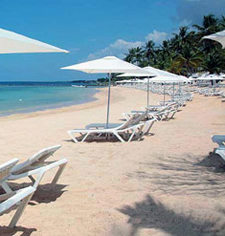 The Dominican Republic is known for its white sandy beaches, towering palm trees, luxurious resorts, fascinating history, vibrant culture and adventure tourism. This combination makes the Dominican Republic an excellent location for a horse riding vacation. Horse enthusiasts can easily fill a whole Dominican Republic holiday with horseback riding, whilst others may wish to combine fantastic horse riding with adventure tours or seaside retreats. The Dominican Republic is known for its white sandy beaches, towering palm trees, luxurious resorts, fascinating history, vibrant culture and adventure tourism. This combination makes the Dominican Republic an excellent location for a horse riding vacation. Horse enthusiasts can easily fill a whole Dominican Republic holiday with horseback riding, whilst others may wish to combine fantastic horse riding with adventure tours or seaside retreats.
Horse Riding in the Dominican Republic
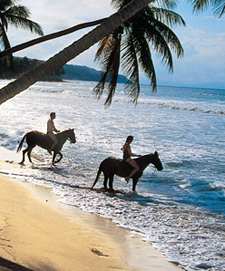 On a horseback riding vacation in the Dominican Republic we explore remote villages, hidden waterfalls and some of the country's most beautiful beaches. Get to know the daily life of Dominican People, taste their local cuisine and make new friends. Our program includes overnights in a delightful Ecolodge with stunning views over the mountains and the ocean. Whatever your taste, our magical Full Moon, Beach and Mountain Riding Adventure is sure not to disappoint. On a horseback riding vacation in the Dominican Republic we explore remote villages, hidden waterfalls and some of the country's most beautiful beaches. Get to know the daily life of Dominican People, taste their local cuisine and make new friends. Our program includes overnights in a delightful Ecolodge with stunning views over the mountains and the ocean. Whatever your taste, our magical Full Moon, Beach and Mountain Riding Adventure is sure not to disappoint.
Dominican Republic History and Culture
Before the arrival of Christopher Columbus on December 5, 1492 the Dominican Republic was inhabited by Taino Indians. The colonial history the Dominican Republic is marked by Spanish and French cultures. Slaves brought in elements of Black African cultures to complete the national identity. In 1822 the country was invaded by Haitian troops. This domination lasted 22 years until on February 27, 1844 independence was proclaimed by Juan Pablo Duarte and his followers. It was lost again in 1861 with the annexation to Spain and regained in August 1863.
Dominican Republic Weather and Climate
The weather in Dominican Republic is tropical year round, with slight variations dividing it into basically two seasons, summer and winter. The average annual temperature is around 25°C (77°F).
Explore more Central America Horse Riding Vacations
|
|
Holidays on horseback in Dominican Republic
See Mini Country Guide
|
Below is a list of our trips in this area with video clips.
 Click on the 'watch video' icon

to view a video clip,
Dominican Republic
Travel restrictions
The Dominican government allowed the resumption of commercial aviation effective July 1st 2020.
As of April 23rd 2022, all passengers and crew members do not need to present a COVID-19 Vaccination Card, PCR, or antigen test to enter the Dominican Republic or to enter tourist centers, any establishments or to receive services such as excursions.
Random COVID-19 testing for passengers and crew upon arrival in the Dominican Republic will no longer be performed. However, when required, random testing operations may be performed. Passengers who present their Vaccination Card will be exempted from random testing.
All foreign and Dominican passengers entering or leaving the Dominican Republic on commercial flights must complete the free electronic entry and exit form, which combines the Traveler’s Health Affidavit, Customs Declaration and International Embarkation/Disembarkation forms. The form is available in English, Spanish, French, Italian, German, Portuguese and Russian and can be accessed through the following link: https://eticket.migracion.gob.do
Measures taken by the government
As of October 11th 2021, Dominican authorities lifted the State of Emergency and associated curfew in the Dominican Republic for all provinces.
On February 16, 2022, the Dominican Republic ended all COVID-19 public health restrictions.
Testing
Both PCR and antigen testing are available from a variety of private laboratories and facilities. The U.S. Embassy has prepared a list of private testing providers in the Dominican Republic: https://do.usembassy.gov/embassy/u-s-citizenship-services/covid-19-testing-in-the-dominican-republic/
Local service providers can administer a COVID-19 test, with results typically available within 72 hours. However, turnaround could be impacted by the increased demand – particularly for PCR tests.
Some resorts and hotels may offer testing onsite as well as some clinics or labs on this list may offer “home visits” at an additional cost.
Test results are typically provided in both written and electronic form.
Emergency number (related to COVID-19) while visiting the country
A national hotline for questions relating to COVID-19 if you have been exposed or are experiencing severe symptoms has been created.
Call *462 for further instructions, but note that English-speaking operators are limited.
Source:
US Embassy in Dominican Republic https://do.usembassy.gov/covid-19-information/
Published on October 2022 (checked on April 5th 2023)
Dominican Republic Ministry Of Tourism: Latest Updates https://www.godominicanrepublic.com/newsroom/coronavirus/
Published on March 8th 2023 (checked on April 5th 2023)
For more information please visit our COVID-19 Updates page at https://www.hiddentrails.com/article/covid19update.aspx
|
|
Dominican Republic
At A glance
Capital City: Santo Domingo
Land size: 48,320 sq km
Population: 10,694,700 (2022 est.)
Official language: Spanish
Currency: Dominican peso ($ / DOP)
UNESCO properties and sites: Colonial City of Santo Domingo
Source: https://www.cia.gov/the-world-factbook/countries/dominican-republic/
The Dominican Republic offers a perfect blend of relaxation, adventure, and cultural exploration. Discover breathtaking white-sand beaches that stretch for miles, fringed by swaying palm trees and crystal-clear turquoise waters. Nature lovers will find themselves in awe of the country's diverse landscapes, from lush rainforests and majestic waterfalls to towering mountain ranges.
Explore the captivating beauty of Puerto Plata’s white-sand beaches on horseback, feeling the soft ocean breeze as you ride along the turquoise waters. Discover hidden trails through dense tropical rainforests, where the rhythmic sounds of nature guide your journey and colorful birds accompany your ride. Canter through the picturesque countryside, passing by sugar cane fields and rural villages, witnessing the authentic Dominican way of life.
The Dominican Republic's diverse landscapes offer endless opportunities for unforgettable horse riding experiences, from coastal trails to mountainous terrains.
Brief History
The Taino - indigenous inhabitants of Hispaniola prior to the arrival of Europeans - divided the island into five chiefdoms and territories.
Christopher COLUMBUS explored and claimed the island on his first voyage in 1492 and the country became a springboard for Spanish conquest of the Caribbean and the American mainland.
In 1697, Spain recognized French dominion over the western third of the island, which in 1804 became Haiti. The remainder of the island, by then known as Santo Domingo, sought to gain its own independence in 1821 but was conquered and ruled by the Haitians for 22 years.
It finally attained independence as the Dominican Republic in 1844. In 1861, the Dominicans voluntarily returned to the Spanish Empire, but two years later, they launched a war that restored independence in 1865.
Juan BOSCH was elected president in 1962 but was deposed in a military coup in 1963. In 1965, the US led an intervention in the midst of a civil war sparked by an uprising to restore BOSCH.
In 1966, Joaquin BALAGUER defeated BOSCH in the presidential election. BALAGUER maintained a tight grip on power for most of the next 30 years when international reaction to flawed elections forced him to curtail his term in 1996. Since then, regular competitive elections have been held in which opposition candidates have won the presidency.
Former President Leonel FERNANDEZ Reyna (first term 1996-2000) won election to a new term in 2004 following a constitutional amendment allowing presidents to serve more than one term, and was later reelected to a second consecutive term.
Source: https://www.cia.gov/the-world-factbook/countries/dominican-republic/
Cultural Insights
The main meal is served at midday and can last up to two hours. La bandera (the flag) is a popular national dish; the white rice and red beans remind people of the flag colors, hence the name. The third ingredient is stewed meat, and it is usually served with fried plantain and a salad. Another favorite dish is sancocho, a meat, plantain, and vegetable stew. On the coast, fish and conch are enjoyed, and coconut is used to sweeten many seafood dishes. Food is generally not spicy.
Dining out is popular and restaurants in Santo Domingo are superior and reasonably priced. The Hotel Lina has been voted one of the ten best restaurants in the world. Even the food sold by street vendors, such as grilled meat or tostones (fried plantain patties), is delicious.
Politeness is a very important aspect of social interaction. When you enter a room or begin a conversation, it is polite to make a general greeting such as buenos días, which means "good day." Handshakes are another friendly gesture.
Personal appearance is important to Dominicans and they do their best to look neat and clean. Men wear long pants and stylish shirts except when at the beach or doing manual labor. Professional men wear business suits or the traditional chacabana, a white shirt worn over dark trousers. Rural women wear skirts or dresses, but in urban areas jeans and short skirts are acceptable. Bright colors and shiny fabrics are favored. Children are often dressed up, especially for church or visiting. Short pants are not allowed in government buildings and shorts and tank tops are not worn in church.
Older and more prominent people may be addressed as Don (for men) or Doña (for women), with or without their first names. Most women ride sidesaddle while on the backs of motorcycles, because sitting with the legs apart is considered unladylike.
Personal space is limited, touching is normal, and crowding, particularly on public transportation, is common.
Dominicans are animated and often make gestures and use body language. To hail a taxi or bus, one wags a finger or fingers depending on the number of passengers in need of a ride.
Men shake hands firmly when they greet and close friends embrace. Most women kiss each other on both cheeks, and a man who trusts a woman will also kiss her.
Source: https://www.everyculture.com/Cr-Ga/Dominican-Republic.html
Transportation
By Air
The Dominican Republic has eight international airports. Because this is such a large and diverse island, it is important to choose your arrival airport to coincide with the final destination of your stay.
SANTO DOMINGO
Las Américas International Airport (SDQ) –also known as José Francisco Peña Gómez International Airport–is located 30 minutes from the capital of Santo Domingo, and is the city’s main point of entry for international air arrivals.
La Isabela International Airport (JBQ) –also known as Dr. Joaquín Balaguer International Airport– is located north of Santo Domingo, and handles flights to Haiti, Cuba, and select neighboring Caribbean islands.
PUNTA CANA
Punta Cana International Airport (PUJ) offers direct flights from over 28 countries and 96 cities around the world, this is the busiest airport in the Dominican Republic and the second busiest in the Caribbean region, with nearly 3.5 million international passenger arrivals every year.
PUERTO PLATA
Gregorio Luperón International Airport (POP) is conveniently located 20 minutes from the north coast city of Puerto Plata.
LA ROMANA
La Romana International Airport (LRM)–also known as the Casa de Campo International Airport–is strategically located on the southeastern coast, less than two hours’ drive from Santo Domingo, and less than an hour’s ride from Punta Cana.
SAMANÁ
El Catey International Airport (AZS) – also known as Juan Bosch International Airport –sits half an hour away from the city of Santa Barbara de Samaná.
SANTIAGO
Cibao International Airport (STI) is 15 minutes from bustling Santiago, the second largest city in the Dominican Republic. It can also be a second gateway option if you are staying in Puerto Plata–just ensure additional transportation time before your return flight.
By Sea
The Dominican Republic boasts the highest number of cruise destinations in the Caribbean. In 2017, 533 cruise ships and more than 1,100,000 passengers visited from Miami, Tampa, and Fort Lauderdale, among other hubs.
SANTO DOMINGO
The world-class Santo Domingo Port has a privileged geographic location, nestled at the mouth of the Ozama River, where it meets the Caribbean Sea. The entrance leads into this first-ever colonial settlement in the Americas via two state-of-the-art terminals: Don Diego and Sansoucí.
LA ROMANA
Two cruise port facilities benefit the east coast, where the Romana River meets the Caribbean Sea. The modern and picturesque Casa de Campo Port is located near Casa de Campo Resort, and the anchoring facilities of Catalina Island, where passengers are transported to the island to enjoy the breathtaking white sand beaches, and world-renowned Pete Dye-designed golf courses.
SAMANÁ
A short distance from Miami, the Samaná Peninsula–the DR’s secluded beach haven–is conveniently located along the route of major Caribbean cruises. Making it a port of call gives cruise lines great flexibility in scheduling vessels along the eastern and southern Caribbean’s often crowded routes. The Samaná Peninsula’s cruise terminals are located on Cayo Levantado, and in the Bay of Samaná.
PUERTO PLATA
Located on the north coast, along the scenic Bay of Maimón, the Amber Cove Cruise Center sits in the heart of the ecotourism and water sports hub of Puerto Plata. Its easy access and proximity to surrounding destinations and attractions make it a popular cruise destination pick.
PUNTA CANA
Visitors to Marina Cap Cana, located in the popular Punta Cana area of the Dominican Republic, get to enjoy the east coast’s clear coastal waters, renowned for golf, deep sea sports fishing and diving. The marina and nearby hotels also offer plenty of entertainment, from gourmet restaurants to upscale boutiques.
Source: https://www.godominicanrepublic.com/travel-to-dr/air-sea-travel/
Money
Only exchange money at banks or official exchange offices (casas de cambio).
Foreign credit cards and debit cards will usually work in ATMs. Take great care when withdrawing cash at an ATM and where possible withdraw money inside a bank branch, shopping centre or supermarket, rather than an ATM on the street.
Credit card cloning and identity theft are a risk in the Dominican Republic. You should avoid letting your payment card out of your sight when paying, or pay in cash instead.
Source: https://www.gov.uk/foreign-travel-advice/dominican-republic
Health
If you need emergency medical assistance dial 911 and ask for an ambulance. Outside Santo Domingo 911 is also used; however, there is not 100% coverage across the country, so if you cannot contact, call the tourist police (1-809-200-3500). You should contact your insurance/medical assistance company promptly if you are referred to a medical facility for treatment.
Ambulances are not present or reliable in most areas of the country. They are more reliable and available in Santo Domingo, Santiago, Punta Cana, and Puerto Plata.
The training and availability of emergency responders may be below U.S. standards.
Medical staff may speak little or no English.
Public medical facilities in Dominican Republic are generally limited. Private hospitals offer good standards of care, although they can be expensive. Hospitals and doctors require payment “up front” prior to service or admission. Private hospitals usually require advance payment or proof of adequate insurance before admitting a patient.
Make sure you have adequate travel health insurance and accessible funds to cover the cost of any medical treatment abroad and repatriation. In some cases, if visitors are not able to pay their hospital bills, they have been prevented from leaving the country until the debt is settled.
A good range of medicines is available. Pharmacies are available across the country, including in many shopping malls, and can be identified by a cross sign outside.
Always carry your prescription medication in original packaging, along with your doctor’s prescription.
Source: https://www.gov.uk/foreign-travel-advice/dominican-republic
https://travel.state.gov/content/travel/en/international-travel/International-Travel-Country-Information-Pages/DominicanRepublic.html
Electricity
The Dominican Republic operates on a 110V supply voltage and uses type A and B plugs.
The Type A electrical plug (or flat blade attachment plug) is an ungrounded plug with two flat parallel pins. Although the American and Japanese plugs appear identical, the neutral pin on the American plug is wider than the live pin, whereas on the Japanese plug both pins are the same size. As a result, Japanese plugs can be used in the US but often not the other way around.
The Type B electrical plug has two flat parallel pins and a round grounding (or earth) pin. The earth pin is longer than the other two so that the device is grounded before the power is connected. As with the type A plugs, the American and Japanese versions vary slightly.
The pins on Type A and Type B plugs have a hole near the tip that fits into ‘bumps’ found on the contact wipers of some sockets, so that the pins are gripped more tightly allowing for better contact and also to prevent the plug from slipping out of the socket. Some sockets have spring-action blades that grip the sides of the pins, making the holes obsolete.
Source: https://www.iec.ch/world-plugs
Communication
Time zone in the Domincan Republic: Atlantic Standard Time (GMT-4)
International country code – 1
The Dominican Republic remains behind most of its counterparts in the Latin American region, especially in terms of fixed-line network coverage.
The limited coverage of fixed-line broadband networks makes mobile the first, if not only, choice for most people in the country. (2021)
Source: https://www.cia.gov/the-world-factbook/countries/dominican-republic/
Phrasebook
| English |
Spanish |
| Hello! |
Hola |
| Goodbye |
Adiós |
| Good morning |
Buenos días |
| Good evening |
Buenos tardes |
| Good night |
Buenas noches |
| Please |
Por favor |
| Thank you |
Gracias |
| Yes |
Sí |
| No |
No |
Source: https://www.linguahouse.com/phrasebook/english-spanish/basic-words-and-phrases/basic-words-and-phrases
Entry Requirements
Most visitors arriving to the Dominican Republic–including those from the United States, Canada, United Kingdom, the European Union, Russia, Ukraine, Kazakhstan, Mexico, many South American countries, Central America, Japan, Israel, etc. do not need a visa to enter the country.
All foreign citizens who enter the Dominican Republic, exclusively for tourism purposes, must have a valid passport during their stay and departure from the country.
Click on the link below to check if your country requires a tourist visa.
https://mirex.gob.do/condiciones-para-extranjeros-ingresar/
Source: https://www.godominicanrepublic.com/travel-to-dr/getting-here/
Embassies and Consulates
U.S. Embassy in Santo Domingo
Av. Republica de Colombia # 57
Santo Domingo
Phone: (809) 567-7775
Embassy of Canada in Santo Domingo
Av. Winston Churchill 1099
Torre Citigroup en Acropólis Center, 18th Floor Ensanche Piantini
Santo Domingo
Phone: (809) 262-3100
Office of the Embassy of Canada in Punta Cana
Carretera Veron- Bavaro, km 2.5
Amstar Business Center, Building 5, Suite 521
Punta Cana
Phone: (809) 455-1730
Consulate of Canada in Puerto Plata
Calle Villanueva No 8
Edificio Abraxas
Puerto Plata
Phone: (809) 586-5761
Source: for USA https://www.usembassy.gov/
For Canada: https://travel.gc.ca/assistance/embassies-consulates
UNESCO Sites
Colonial City of Santo Domingo
After Christopher Columbus's arrival on the island in 1492, Santo Domingo became the site of the first cathedral, hospital, customs house and university in the Americas. This colonial town, founded in 1498, was laid out on a grid pattern that became the model for almost all town planners in the New World.
Source: https://whc.unesco.org/en/statesparties/do
|
|

|
|
|
List of Tours
![]() Belize Belize
|