|
|

|
|
|
|
Horseback riding vacations in
Zimbabwe
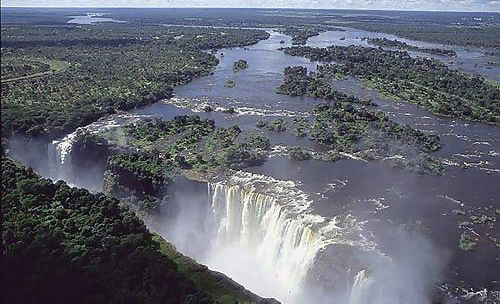
Zimbabwe boasts some amazing natural sites. The Victoria Falls are without a doubt one of the world’s grandest natural spectacles and every viewpoint reveals something new. Running from northeast to southwest down the center of the country, and connecting its two largest cities, is the Highveld, a chain of low mountains and Zimbabwe’s most populous area. Hidden Trails offers several amazing Zimbabwe horse riding holidays, showcasing the beauty of this exquisite country.
Horse Riding in Zimbabwe
Zimbabwe offers some of the best wildlife parks in southern Africa.
Hidden Trails’ Zambezi Safari ventures on horseback deep into the back country to track big game. You will also visit the stunning Victoria Falls and finally relax at wonderful safari lodges.
We also offer riding safaris in the Hwange and Mana Pools National Parks. These wildlife rich areas are amazing riding country with great flat plains and no fences.
Zimbabwe
Yes, Zimbabwe has its political problems, but the areas around Victoria Falls are untouched from the turmoil of Harare and the agricultural lands. We have been selling horseback tours and general safari trips to Zimbabwe without one single incident. Today more than ever the people of Zimbabwe need the support from the tourism industry. Much of the local population depend on it and any boycott will directly affect them – and not the ones it is intended for. This special political situation makes Zimbabwe one of the best deals in southern Africa.
The Limpopo forms Zimbabwe’s southern border with South Africa, while to the north is the Zambezi (the fourth largest of Africa’s rivers after the Nile, Congo, and Niger). The land climbs from the hot parklands of these two river valleys, with their big game populations, up through small farming areas to a central plateau of msasa and mopane savanna woodland which covers a quarter of the country. It is on this fertile, well-watered land that the country’s granary and main towns are situated.
The central watershed is a garden of balancing rocks that tower above the surrounding woodlands and open grass plains. These in turn are interspersed with huge whale-back granite domes the color of kudu hides - down which the water pours during the rains.
There are three sets of mountains delineating the central ridge: the Mvurwi range in the tobacco-growing north, the Matobo Hills in the southwest, with the Mashava Hills in the center, near Ngezi Recreational Park and the town of Kwekwe.
The highest land runs from Harare to the mountains of Nyanga and Chimanimani on the border of Mozambique. Everywhere there are the remains of Shona stone walled villages, and from earlier times, the exquisite, rare paintings of the San hunter-gatherers. Thirty-five percent of Zimbabwe is lowveld country, which fringes the country’s borders and the prime wilderness areas of Kariba and Gonarezhou, and mostly lies below 915m (3000ft). A feature of the lowveld is the cream of tartar, or umkhomo in Ndebele, a massive tree with a circumference of up to 28m (90ft). Better known as the Baobab, it looks as if God planted it upside down, roots sticking in the air. Safari game conservancies, the country’s best beer, ‘Hunters’, and cattle all come from the lowveld area stretching from the Shashe-Limpopo rivers and Thuli safari area in the southwest round to Gonarezhou and the Save River in the southeast. The heart of this area centers on Chiredzi and Triangle where sugar cane is grown. Two main roads from Bulawayo and Harare converge through the lowveld, heading for Beitbridge and South Africa.
Mountains and Rivers
The southeast and the northwest of Zimbabwe are laced with rivers, each join the two big ones, the Limpopo and the Zambezi. The Zambezi frames practically the entire northern edge of Zimbabwe, and encompasses the upper rapids, Victoria Falls, Lake Kariba and Mana pools. Dinosaurs used to walk its valley floor 150 million years ago. The river’s upper section may once have flowed south into what is now the Makgadikgadi Pans of Botswana. Rising in northwest Zambia, the Zambezi crosses into Angola, collecting rivers along its course, which further downstream include the Chobe in Botswana, the Sanyati in Lake Kariba, the Kafue and Luangwa in Zambia, and the Shire from Malawi and Mozambique. Mupata, on the Zambezi near Mana Pools, was at one time being considered as a site for another hydroelectric scheme but has since been shelved in favor of the Batoka gorge (thus saving the wildlife in the Zambezi flood plain). The decision to go ahead with the new site will, unfortunately, end much of the white-water rafting. In spite of the Zambezi and Limpopo’s two great river systems, water often poses a problem in Zimbabwe. The rainy season is short, with brief heavy storms and rapid run-off, thus drought is always a possibility. Although some 7000 dams have been constructed, the second largest city, Bulawayo, is still in great need of an adequate and reliable supply. There is some hope of using the Zambezi in the future.
Plant Life
Most distinctive are the country’s vast tracts of indigenous trees such as msasa a munondo, prevalent on the highveld, and the butterfly-leaved mopane in Matabeleland and the lowveld. The msasa, in particular, is exceptionally beautiful when it forms a filigreed silhouette against a blood-red sky, or in spring, when new leaves kaleidoscope from fawn to claret, often providing a carpet of fire against a hillside of through a mountain valley. The highveld also has exotic species that have been introduced, such as pine, wattle and gum. The country’s indigenous forest areas incloude the great teaks and mukwas (bloodwoods) seen around Hwange, while the montane forests of the Eastern Highlands, with their heavy rainfall, feature red mahoganies near Chipinge, and also support a rich array of birdlife. As the woodlands and forests are under continuous pressure of encroachment and the local population’s immediate need for firewood, great efforts have been made to conserve these tracts. National tree-planting days, the building of rural dwellings from brick, the use of coal in tobacco-curing furnaces, and the extension of electricity to rural areas have all helped towards preserving this natural heritage - but it is an ongoing struggle. Also characteristic of Zimbabwe’s varied habitats are the tall grasslands between the trees and granite out crops; the grasses are often used for fencing and hut thatching. The country has over 5000 species of flowering plants and ferns, 400 of them wildflowers (often tiny). Many are used for medicinal or other purposes and have vernacular names. Flame lilies (the country’s national flower), save stars, the blood lily (which has spectacular red puff-ball blooms), aloes and a variety of orchids and cycads are particularly attractive.
Conserving Zimbabwe's Wildlife Heritage
Thousands of years ago, far from Harare at Charewa, in a high kopie cave, a Stone Age San hunter - gatherer painted a picture of a rhino hunt. These rhinos will have died to enable the little people to survive. Today, however, man is not motivated by survival or the balance of nature, but by greed. In 1984, Zimbabwe had 3000 black rhino, the continent’s largest herd. Ten years later poachers, particularly in the Zambezi valley, had reduced this number to 300. And this in spite of so many rhinos already having been dehorned, as well as a ferocious defense action in which 200 poachers were killed. Unfortunately, rhino horn is an essential ingredient to traditional medicine in China and the Far East, a demand that refuses to be suppressed by Western scepticism or law -enforcement. Attempts have been made to stop the slaughter of rhino by applying diplomatic pressure on the traditional medicine nations and by banning the trade. They have, over the last two decades, failed miserably. Some success has been achieved in relocating rhino to game ranches far from Zimbabwe’s vulnerable borders for tourism purposes, others have been transported to over-seas countries for captive breeding, and some to intensively protected wildlife areas. The real answer - if the Far East chemists’ needs are to be met and the rhino to be saved - is controlled legal trade, which would pull the carpet out from under the profiteering middlemen. This applies to ivory too. It is only fair to say that equally powerful arguments favor a total ban of horn and ivory trading, and it is here that the last battle is being waged. The rhino has a right to survive in the wild, but time is running out; tough, clear-headed decisions need to be made soon, otherwise Zimbabwe and the rest of Africa will lose the last of these magnificent mega herbivores.
Explore more Southern Africa Horse Riding Holidays
|
|
Holidays on horseback in Zimbabwe
See Mini Country Guide
|
Below is a list of our trips in this area with video clips.
 Click on the 'watch video' icon

to view a video clip,
Zimbabwe
Travel restrictions
As of December 1st 2020, international travel has resumed.
On April 1st 2022, the Cabinet resolved that it is no longer mandatory for a negative PCR certificate on arrival at ports of entry for both returning residents and visitors who are fully vaccinated.
Unvaccinated travelers need to show proof of a negative COVID-19 PCR test taken within 48 hours of their departure to Zimbabwe.
All departing travelers must show a negative PCR test to leave Zimbabwe regardless of the requirements of their destination.
Quarantine after international travel to Zimbabwe is not required for those who are fully vaccinated.
Measures taken by the government
Masks and social distancing are mandatory. People must wear face masks in public.
A curfew is in place from midnight to 5:30AM.
Restaurants, bars, and nightclubs may operate from 8AM to 10PM and offer sit-in service to vaccinated customers only.
Testing
PCR and/or antigen tests are available for travelers in Zimbabwe. Test results are reliably available within 72 hours.
The Government of Zimbabwe has authorized the following list of labs to provide official COVID-19 testing. Tourists will need to pay for tests, which cost on average $65-$75.
Test results are most commonly returned by text message or email, but some labs will provide a physical copy upon request.
Government Laboratories: National Microbiology Reference Laboratories, National TB Reference Laboratory, Plumtree District Hospital, Gwanda Provincial Hospital, Beitbridge District Hospital, St Luke’s Mission Hospital, Victoria Falls Hospital, Gutu Mission Hospital, Masvingo Provincial Hospital, Gweru Provincial Hospital, Chinhoyi Provincial Hospital, Kadoma General Hospital, Marondera Provincial Hospital, St Alberts Mission Hospital, Bindura Provincial Hospital
Rusape General Hospital, Mutare Provincial Hospital, Chipinge District Hospital, Sally Mugabe Central Hospital, Parirenyatwa Central Hospital, National Virology Reference Laboratory, Chitungwiza Central Hospital, Chikurubi Maximum Prison, Thorngrove Hospital Laboratory, Beatrice Road Infectious Diseases Hospital & Josiah Tongogara Magama.
Private Laboratories: Lancet laboratories, PSMI Harare Branch, Cimas Harare laboratory, Diagnopath laboratory Harare, Klosad Laboratory Harare, Mater Dei Hospital Laboratory (DLS), Multi Tech, Flow Cytometry, Haematology Centre, Bioexpress Laboratory, Genau Laboratory, Pathology Laboratory & Unki Mine Laboratory.
Emergency number (related to COVID-19) while visiting the country
Information not available.
Source:
US Embassy in Tanzania https://tz.usembassy.gov/covid-19-information/
Published on April 3rd 2023 (checked on April 5th 2023)
For more information please visit our COVID-19 Updates page at https://www.hiddentrails.com/article/covid19update.aspx
|
|
Zimbabwe
At A glance
Capital City: Harare
Land size: 386,847 sq km
Population: 15,121,004 (2022 est.)
Official languages: Shona (official; most widely spoken), Ndebele (official, second most widely spoken), English (official; traditionally used for official business) and 13 minority languages (official; includes Chewa, Chibarwe, Kalanga, Koisan, Nambya, Ndau, Shangani, sign language, Sotho, Tonga, Tswana, Venda, and Xhosa)
Currency: Zimbabwe dollar ($ / ZWL)
UNESCO properties and sites:
- Great Zimbabwe National Monument
- Khami Ruins National Monument
- Matobo Hills
- Mana Pools National Park, Sapi and Chewore Safari Areas
- Mosi-oa-Tunya / Victoria Falls
Source: https://www.cia.gov/the-world-factbook/countries/zimbabwe/
Zimbabwe's diverse landscapes, iconic wildlife, and vibrant culture offer endless opportunities for unforgettable vacations. Journey to the pristine wilderness of Mana Pools, a UNESCO World Heritage Site, and catch a glimpse of hippos, crocodiles, and a variety of birdlife. Immerse yourself in the warm hospitality of the Zimbabwean people, experiencing their rich traditions and savoring their flavorful cuisine.
Zimbabwe’s untamed beauty and rich heritage form the perfect backdrop for a wonderful horse riding vacation. Begin your journey in Victoria Falls, one of the world's most spectacular natural wonders, and experience the thrill of riding along the Zambezi River. Discover the iconic wildlife of Hwange National Park from the back of a horse, where encounters with elephants, lions, and buffalo create unforgettable memories.
Brief History
The hunter-gatherer San people first inhabited the area that eventually became Zimbabwe. Farming communities migrated to the area around A.D. 500 during the Bantu expansion, and Shona-speaking societies began to develop in the Limpopo valley and Zimbabwean highlands around the 9th century. These societies traded with Arab merchants on the Indian Ocean coast and organized under the Kingdom of Mapungubwe in the 11th century. A series of powerful trade-oriented Shona states succeeded Mapungubwe, including the Kingdom of Zimbabwe (ca. 1220-1450), Kingdom of Mutapa (ca. 1450-1760), and the Rozwi Empire. The Rozwi Empire expelled Portuguese colonists from the Zimbabwean plateau but was eventually conquered in 1838 by the Ndebele clan of Zulu general MZILIKAZI during the era of conflict and population displacement known as the Mfecane.
In the 1880s, colonists arrived with the British South Africa Company (BSAC) and obtained a written concession for mining rights from Ndebele King LOBENGULA. The king later disavowed the concession and accused the BSAC agents of deceit. The BSAC annexed Mashonaland and subsequently conquered Matabeleland by force during the First Matabele War of 1893-1894 to establish company rule over the territory. BSAC holdings south of the Zambezi River were annexed by the UK in 1923 and became the British colony of Southern Rhodesia. The 1930 Land Apportionment Act restricted Black land ownership and established structural racial inequalities that would favor the White minority for decades. A new constitution in 1961 further cemented White minority rule.
In 1965, the government under White Prime Minister Ian SMITH unilaterally declared its independence from the UK. London did not recognize Rhodesia’s independence and demanded more voting rights for the Black majority in the country. International diplomacy and a liberation struggle by Black Zimbabweans finally led to biracial elections in 1979 and independence (as Zimbabwe) in 1980. Robert MUGABE, who led the uprising and became the nation's first prime minister, was the country's only ruler (as president since 1987) from independence until his forced resignation in November 2017.
Source: https://www.cia.gov/the-world-factbook/countries/zimbabwe/
Cultural Insights
Zimbabwean tribes and communities are traditionally collectivistic. People tend to put their group or family’s interests before their own, receiving support, protection and a sense of belonging in return.
Zimbabweans are often observed as being very warm, welcoming and engaging. They are also quite formal and non-confrontational. People generally seek to appease and avoid any disagreement or friction that could offend someone’s honour.
The values that underpin the norms of etiquette vary between cultures. Hence, native Zimbabweans often think that ‘varungu’ (white people) do not have hunhu/ubuntu; this is because people outside of Zimbabwe often do not follow the same social rules that constitute tsika. For example, the English-speaking West doesn’t give the same amount of reverence and respect to people based on their age. Someone who does not act according to the Zimbabwean code of politeness and social appropriateness is considered to be without manners – ‘hanna tsika’.
Source: https://culturalatlas.sbs.com.au/zimbabwean-culture/zimbabwean-culture-core-concepts
Transportation
By Air
Zimbabwe has three International Airports in three major cities. In Harare there is Robert Mugabe International Airport, Joshua Mqabuko Nkomo International Airport in Bulawayo and Victoria Falls International Airport in Victoria Falls.
There are also 17 domestic airports in the country for the convenience of tourists that prefer flying to their tourist attraction places other than travelling by road.
Source: https://zimbabwetourism.net/gettingtozimbabwe/
Money
Zimbabwe’s economic situation remains unpredictable. Whilst the primary legal tender in Zimbabwe is the Zimbabwe dollar (ZWL), it is currently possible for tourists to transact using the US Dollar at the official exchange rate. There are some bureaux de change which will accept and change foreign currency, particularly US dollars.
Prices and transactions will mainly be in Zimbabwean dollars but US dollars are widely accepted. You should check before making a transaction whether the price quoted is in Zimbabwean or US dollars as the symbol for both is $. It is recommended to check exchange rates prior to any transaction.
You should check in advance what payment methods a restaurant, hotel or tour operator will accept. Some businesses, including some medical providers, may not accept payment by credit or debit card.
Zimbabwe is currently experiencing a shortage of cash. Cash withdrawals can be made at some ATMs and bank branches with an international bank card but availability cannot always be guaranteed. Credit and debit cards are increasingly being used for transactions. You should always ensure that you are being charged in the correct currency.
It’s illegal to leave Zimbabwe with more than USD $2,000 (or equivalent) in cash, unless it is left over from funds which you have brought in yourself and declared on arrival. You should keep the proof of declaration to avoid problems with officials on exit. It’s illegal to exchange foreign currency anywhere other than at officially licensed dealers (e.g. banks or bureau de change). Carry small denomination notes as change is rarely available.
Source: https://www.gov.uk/foreign-travel-advice/zimbabwe
Health
The provision and quality of health care is variable and can be especially poor outside of the major cities.
Provincial hospitals in rural areas are rudimentary and not equipped to care for serious injuries. Serious illnesses or injuries require medical evacuation to South Africa.
There’s a shortage of drugs and trained medical staff in hospitals, making it difficult for hospitals to treat certain illnesses including accidents and trauma cases.
Private clinics will not treat patients until they pay and often require large amounts of cash before they will admit even emergency cases. An increasing number of businesses in Zimbabwe will only accept US dollars in cash, rather than credit or debit cards.
Even if payment is available some of the best hospitals are often too full to admit patients. Medical costs, particularly for evacuation, can be high. Make sure you have adequate travel health insurance and accessible funds to cover the cost of any medical treatment abroad and repatriation.
If you are on medication, bring sufficient supplies of your medication to cover the period of your stay. Pharmacies may not be able to provide you with the appropriate drug prescribed by your doctor.
For emergency services in Zimbabwe dial 999 for medical.
If you need emergency medical assistance during your trip, Econet subscribers should dial 112, NetOne subscribers should dial 114 and those using landlines should dial 0800 3222 911. You should contact your insurance/medical assistance company promptly if you’re referred to a medical facility for treatment.
Malaria risk is high from November to June, in areas below 1200m including the Zambezi Valley and Victoria Falls. There is low to no risk at all in Harare , Bulawayo, Midlands and the district of Matabeleland South.
Malaria precautions are essential. Avoid mosquito bites by covering up with clothing such as long sleeves and long trousers especially after sunset, using insect repellents on exposed skin and, when necessary, sleeping under a mosquito net.
Zimbabwe is not a yellow fever zone! This means you do not need a yellow fever vaccination to visit Zimbabwe.A Yellow Fever vaccination certificate is only required for travellers 9 months of age and older coming from - or who are in airport transit for more than 12 hours within - a country with risk of Yellow Fever transmission.
Source: https://www.gov.uk/foreign-travel-advice/zimbabwe
https://travel.state.gov/content/travel/en/international-travel/International-Travel-Country-Information-Pages/Zimbabwe.html
https://zimbabwetourism.net/health-and-safety/
Electricity
Zimbabwe operates on a 220V supply voltage and uses type D and G plugs.
The Type D electrical plug has three large round pins in a triangular pattern. Type M plugs are often used alongside Type D plugs for larger appliances and as a result, some sockets work with both Type D and Type M plugs.
The Type G electrical plug has three rectangular blades in a triangular pattern and has an incorporated fuse (usually a 3 amps fuse for smaller appliances such as a computer and a 13 amps one for heavy duty appliances such as heaters). British sockets have shutters on the live and neutral contacts so that foreign objects can’t be introduced into them.
Source: https://www.iec.ch/world-plugs
Communication
Time zone in Zimbabwe: Central Africa Time (GMT+2)
International country code – 263
Zimbabwe’s telcos continue to be affected by the country’s poor economy; this has been exacerbated by the significant economic difficulties related to the pandemic.
LTE networks have expanded steadily, though services remain concentrated in urban areas.
The expansion of 3G and LTE-based mobile broadband services has meant that most of the population has access to the internet.
The government has started a national broadband scheme aimed at delivering a 1Mb/s service nationally by 2030.
Source: https://www.cia.gov/the-world-factbook/countries/zimbabwe/
Entry Requirements
Zimbabwe’s visitor visa regime is split into 3 categories. Each category has different visa/entry requirements for the nationals within the categories. The specifics of the categories are:
Category A – visa not required to have a visa to travel to Zimbabwe
Category B – visa issued on arrival in Zimbabwe (fees apply)
Category C – visa to be obtained before travel to Zimbabwe
You can check to which category you belong by clicking the link below: https://www.evisa.gov.zw/regime
Source: https://zimbabwetourism.net/visas-and-immigration/
Embassies and Consulates
U.S. Embassy in Harare
2 Lorraine Drive, Bluffhill
Harare
Tel: +263 867 701
Embassy of Canada in Harare
45 Baines Avenue
Harare
Tel: +263 86 7700 8600
Source: for USA https://www.usembassy.gov/
For Canada: https://travel.gc.ca/assistance/embassies-consulates
UNESCO Sites
Great Zimbabwe National Monument
The ruins of Great Zimbabwe – the capital of the Queen of Sheba, according to an age-old legend – are a unique testimony to the Bantu civilization of the Shona between the 11th and 15th centuries. The city, which covers an area of nearly 80 ha, was an important trading centre and was renowned from the Middle Ages onwards.
Khami Ruins National Monument
Khami, which developed after the capital of Great Zimbabwe had been abandoned in the mid-16th century, is of great archaeological interest. The discovery of objects from Europe and China shows that Khami was a major centre for trade over a long period of time.
Matobo Hills
The area exhibits a profusion of distinctive rock landforms rising above the granite shield that covers much of Zimbabwe. The large boulders provide abundant natural shelters and have been associated with human occupation from the early Stone Age right through to early historical times, and intermittently since. They also feature an outstanding collection of rock paintings. The Matobo Hills continue to provide a strong focus for the local community, which still uses shrines and sacred places closely linked to traditional, social and economic activities.
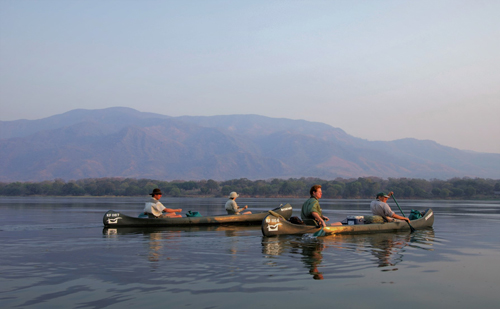
Mana Pools National Park, Sapi and Chewore Safari Areas
On the banks of the Zambezi, great cliffs overhang the river and the floodplains. The area is home to a remarkable concentration of wild animals, including elephants, buffalo, leopards and cheetahs. An important concentration of Nile crocodiles is also be found in the area.
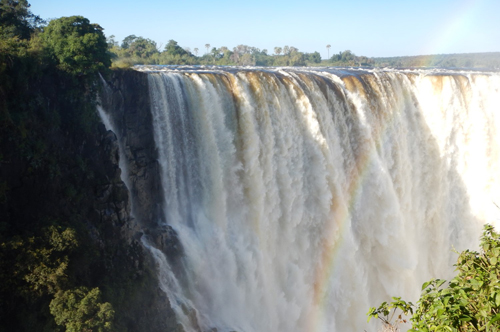
Mosi-oa-Tunya / Victoria Falls
These are among the most spectacular waterfalls in the world. The Zambezi River, which is more than 2 km wide at this point, plunges noisily down a series of basalt gorges and raises an iridescent mist that can be seen more than 20 km away.
Source: https://whc.unesco.org/en/statesparties/zw
|
|

|
|
|
|