|
|

|
|
|
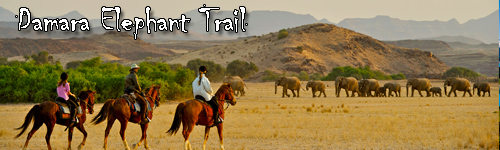
Damara Elephant Trail to Skeleton Coast
Namibia
Namibia
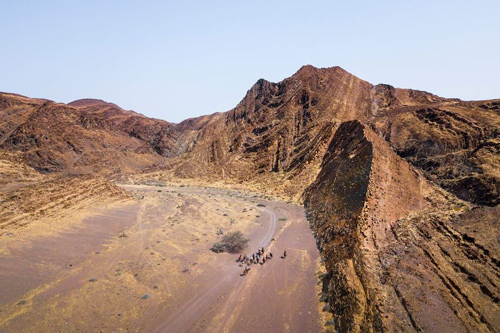
Damaraland is a very spectacular part of the country, almost inaccessible, with amazing colours and vast open spaces that will blow your mind, ancient craters and remnants from prehistoric times, not to mention the forbidding Skeleton Coast. This is the quintessential ride for those who can identify with escaping day-to-day city life and becoming one with a horse in the wilderness. The ride begins in northern Damaraland - wild, desolate, sparsely inhabited and breathtakingly beautiful, challenging horses and riders across vast, ancient flood plains and through deep, silent canyons, across a great desert to a hostile coast. In a waterless land, you’ll come to understand the challenges of the terrain and the environment. Riding between 20 and 50 km per day at all paces, the ride covers approximately 290 km to the Atlantic Ocean’s Skeleton Coast over 11 days.
For the intrepid adventurer who seeks out the last of earth’s true wildernesses, this is truly an exceptional riding experience.
On this journey, you'll encounter ancient Namibia - Petroglyphs and rock art, thousands of years old, that depict great hunts, animals and the locations of sub-terrestrial water. Once the pathways of mighty glaciers, boulder strew flood plains give way to soft grass covered valleys trimmed by gentle sand dunes, watched over by range upon range of purple hued mountains - a true wilderness. ...and then, to the sea and the endless beach where the flotsam and jetsam tell a story of a wild sea on a wild coast! The cold Benguela current brings cool, plankton and fish-rich waters all the way from Antarctica and moderates the temperatures in the region - but this is a Namibian story for another time!
Unique Attractions
- Twyfelfontein rock engravings & cultural village
- Dramatic landscapes
- Real wilderness area
|
Camping Ride with vehicle support
Safari Ride
Meeting:
Windhoek
Airport:
Windhoek
Transfer:
Windhoek airport
|
|
|
|
Rates and Dates for 2025 | 2026
Rates include:
All accommodations, All meals with drinks in camp, 7.5 riding days, Half day sightseeing of the Twyfelfontein Rock Engravings & Transfers
| A | 2025 | 11 day trip | 11d / 10n | £6200 | $7935 |
Minimum Deposit:
50 %
Transfer and Other Charges:
|
2025
|
Transfer from/to Windhoek Airport included
|
£
0
|
$0
|
|
2025
|
Single supplement - if requested only
|
£
275
|
$355
|
|
2025
|
Over 85 kg (extra horse charge)
|
£
1,065
|
$1,365
|
Rates do not include:
Drinks and refreshments at lodges/restaurants, Insurance (mandatory) & Gratuities
 Sample Itinerary- subject to changes
Days begin at sunrise with the delightful aroma of freshly brewed coffee wafting through camp followed by breakfast. Departure is generally by 8am with 4 – 5 hours riding before lunch. Lunch breaks are an hour to 2 hours followed by another 2 – 3 hours riding in the afternoon.
Day 1: Arrival
Arrive Windhoek’s Hosea Kutako Airport – preferably by 5 pm. Overnight in Windhoek.
Day 2: Windhoek to Twyfelfontein
After an early breakfast next day, we journey north (about a 7-hour transfer including a lunch stop en route) through some spectacular Namibian landscapes to our camp at Twyfelfontein (Doubtful spring) where you will meet the horses and crew. Overnight at Aba Huab camp.
Days 3: Huab
Your first ride is in the Aba Huab watershed, where good going invites a few brisk canters, allows you to get more acquainted with your horse and the terrain. We return to camp for lunch after which we visit the San Rock Engravings ending with a sundowner with a panoramic view of this wild magnificence. Overnight at Aba Huab camp.
Days 4, 5, 6, & 7: Huab & Ugab River systems
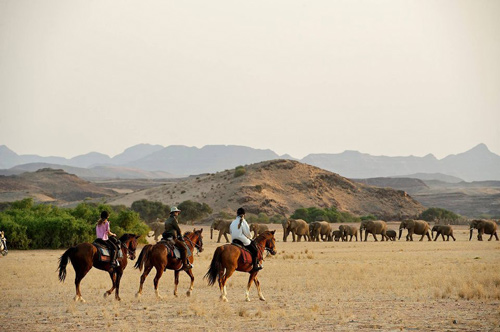
With the rising sun at our backs, we begin our westward journey to the distant Atlantic. In these ephemeral river systems the cycles of rainfall dictate the seasonal movement of game which is not concentrated, but we can encounter Elephants, Rhino, Oryx, Springbok, and other desert-adapted game. Here huge glacial valleys, impressive Tableland mountains, exhumed by erosion, and folds and fractures resulting from cataclysmic eruptions present a well preserved snapshots of a land of great antiquity.
Days 8, 9, & 10: The Great Plains
Leaving the river valleys we now cross the vastness of open plains with the striking massive of the Brandberg (burning mountain) forming a dramatic backdrop. Here endless plains allow for some fast-paced riding as we approach the dramatic Messum Caldera, the eroded remains of a massive collapsed volcano. Our last ride takes us to the ocean at last - the spectacularly formidable Skeleton Coast, apparently so called for the wrecked hulks of stranded ships which dot this coastline. The cold upwelling Benguela Current results in some diverse weather conditions from hot desert easterlies to cold south Atlantic westerly’s – a place of extremes! We overnight in the small coastal town of Henties Bay in a private house with the most spectacular view over the Atlantic Ocean. Our last meal together is freshly caught Atlantic Fish done to perfection over the coals.
Day 11: Departure
Departure for Windhoek Airport, arriving in time for flights departing after 3:00 pm (recommended is SA 77 to Johannesburg or Air Namibia’s late flight direct to Frankfurt). There are many other options of course.
|
|
|
Meeting:
|
|
Windhoek
|
|
Airport:
|
|
Windhoek
|
|
Transfer:
|
|
Windhoek airport
We provide ground transfers from and to Windhoek through Windhoek Airport Shuttle and Tours. Meet us at the Windhoek airport on Day 1 Please arrive in Windhoek no later than 17:00 (5:00pm).
At the end of the trip - departure flights should not be before 3:00pm.
|
|
Level:
|
|
 Low Demanding Low Demanding
|
|
|
|
20- 50km (13 to 30 miles)
a day, up to 6 hours in the saddle. You should be a fit and experienced rider. The pace depends upon the terrain and temperatures but there are many long fast trots, canters and gallops.
|
|
Participants:
|
|
Min
4
participants
|
Max
15
participants
|
|
|
|
|
Riding helmets are mandatory for this ride.
|
 Riding Level
Do not underestimate the physical toll living outside take on you- come very fit! You need to be balanced in the saddle and stay off your horse's back without having to hang onto their mouth at all paces. You need to be able to post trot. This ride is not for the feint-hearted as large free-ranging game occurs and we ride through mountainous areas with meandering rivers and huge plains for fast riding.
If you do not ride regularly (2 - 3 times a week), we strongly recommend that you get into practice before joining one of our challenging safaris. This is a challenging ride suitable for confident intermediate riders. Please not, we reserve the right to prevent anyone from riding if we feel they do not fulfill the minimum competence level as indicated or if weight and fitness level do not fall within that recommended for these challenging safaris.
Pace
You will ride in the morning for 4-5 hours, have a lunch break for 1-2 hours, and then continue riding for another 2-3 hours, totaling around 6-8 hours per day in the saddle for 7 days. You will cover 20-60km per day at all paces and over rough terrain. Other days may be less. Pace depends on the terrain and temperatures as well as on fitness and weight of riders with walk, trot, canter and gallop. Because Namibia has such wide-open spaces it is possible to accommodate up to 15 riders on most trails plus 2 - 3 riding guides.
Tack
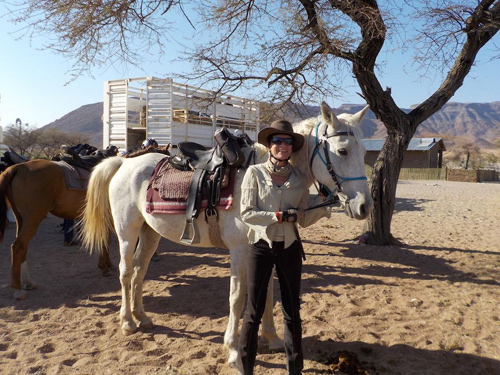
We use skirted endurance type saddles with heavy padding for the comfort of horse and rider. Each saddle is fitted with two specially made water bottle holders (water bottles supplied). If you normally ride with a sheepskin bumnah you may bring your own (western shaped). We use a simple snaffle bridle over the halter
 Horses
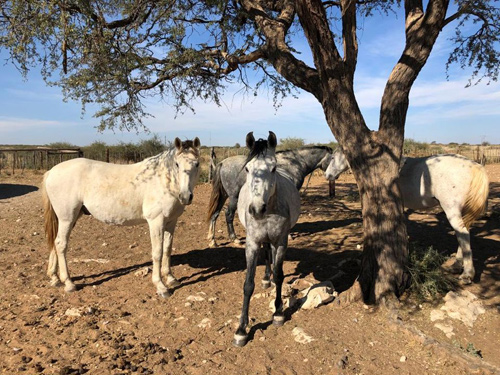
Your horse will be chosen from a mixed herd of many breeds i.e. Arab, Haflinger, Trakehner, ranch horses, they are small to medium-sized (14.3 to almost 16 hands) sure-footed horses raised on rough terrain, some of them with experience in endurance riding, and every one of them a kind, reliable companion that deserves the very best treatment and care.
Each rider is responsible for grooming, regularly checking over, and tacking up their own horse (assistance is given when required). It is this experience that cements the bond between you and the horse you must rely on to carry you across the desert.
Weight Limit
We have a strict weight limit of 85 kg dressed in your riding gear – fit riders heavier than this will need to hire a 2nd horse. Our absolute maximum weight limit is 93 kg.
Hard Hats
Hard hats are obligatory, unless medical insurers acknowledge that you will still be insured, should you choose not to wear a hard hat.
Safety
Your safety and enjoyment are of paramount importance to us while you are our guest. Please alert us to any personal medical condition, allergies included and ensure you have all essential personal medication before arriving in Windhoek.
Children & Non-Riders
Experienced children riders who are accompanied by their parents are welcome – but please remember that these rides can be quite strenuous – so parents must use their judgment as to whether their children are suitable. Anyone unable to keep up with the group may have to travel in the support vehicle at some times. Non-riding companions are also welcome to join the trip and travel with the trucks.
Insurance
Comprehensive medical insurance is required to ride with us. Ensure repatriation is included in your policy. Travel insurance is recommended.
Passport and Visa Requirements:
Passport valid for a minimum of six months after the date of departure from Namibia required by all nationals referred to in the chart above.Not required by nationals referred to in the chart above fo. more
Swakopmund area
|
Month
|
Jan
|
Feb
|
Mar
|
Apr
|
May
|
Jun
|
Jul
|
Aug
|
Sep
|
Oct
|
Nov
|
Dec
|
|
Average High Temperature (°F)
|
71
|
71
|
71
|
71
|
70
|
70
|
68
|
65
|
64
|
65
|
67
|
69
|
|
Average Low Temperature (°F)
|
59
|
60
|
58
|
56
|
53
|
52
|
50
|
49
|
50
|
52
|
54
|
57
|
|
Average High Temperature (°C)
|
22
|
22
|
22
|
22
|
21
|
21
|
20
|
18
|
18
|
18
|
19
|
20
|
|
Average Low Temperature (°C)
|
15
|
15
|
15
|
13
|
12
|
11
|
10
|
9
|
10
|
11
|
12
|
14
|
|
Average Precipitation (days of rain)
|
0
|
0
|
0
|
0
|
0
|
0
|
0
|
0
|
0
|
0
|
0
|
0
|
Source: NOAA
Seasons
This is Africa and the climate reflects it. But just as Namibia is filled with contrasting geography, equivalent climactic differences do apply depending on your location.
Partially covered by the Namib, one of the world's driest deserts, Namibia's climate is generally very dry and pleasant. The cold Benguella current keeps the coast cool, damp and free of rain for most of the year (when it does rain it is between October and April). Inland, all the rain falls in summer (November to April). January and February are hot, but nights are usually cool. Winter nights can be fairly cold, but days are generally warm and quite nice.
Keep in mind that temperatures vary hugely seasonally and geographically – coastal areas much cooler than inland, often subject to fog (10 – 20 degrees Celsius). Day and night temperatures, particularly in winter, vary dramatically (below zero to 30’s). Weather in desert is always highly variable and unpredictable – come prepared to all weather – layering is key to living in a desert.
The bottom line: Namibia is a year-round destination. Just pack accordingly.
An excellent weather report reference can be found on:
www.yr.no/place/Namibia
What to Bring
Place all items in soft luggage, well labeled, and split into 2 bags if over 15kg- lots of pockets help with organizing.
Essential Items
Headlamp
Beanie / Woollen hat
Hat / Baseball
cap
Fleece jacket
Buff / Bandana
Clothing
Long sleeved
cotton shirts for riding x 4 (preferably in subtle colours)
Riding
trousers/jods x 3
Casual trousers x 2 (for travelling and excursion
days)
Shorts x 1 (in summer for around camp)
T-shirt x 2
Long sleeved
shirts for the evenings x 2 (also for lodge nights)
Pullover x 2
Warm
‘Pyjamas’ x 1
Lightweight waterproof jacket (for foggy
mornings)
Lightweight down jacket / vest
Underwear, Socks
Flip
Flops
Comfortable walking shoes / trainers (for around camp, travel
etc.)
Riding Gear
Helmet (recommended not compulsory, but might
be a condition from your insurance – please check!) Sun visor to fit around
helmet or Wide brimmed Hat (with a string)Boots / Chaps - full or
half
Gloves
Seat saver (if
needed)
Accessories
Sunglasses
Sunblock SPF 50 & Lip
balm (with SPF!)
Toiletries (Shampoo, Toothbrush and -paste, wet wipes,
moisturiser)
Personal medication / Pain killers (for sore
muscles)
Camera
Power bank / extra batteries/ spare memory card
Sorry, no video is currently available for this tour.
*Important Notice: The following ratings have been submitted by guests and do not necessarily represent the views of Hidden Trails, its partners or employees.
Every care is taken to ensure accuracy but Hidden Trails is not liable for any errors or omissions.
..view other reports for different trips
Accommodations
This is a wilderness ride, so you will be staying in a mixture of lodges and camping.
Description
You will be staying in a lodge for 2 nights and camp for 8 nights. Consider yourself ‘unplugged’ while on safari – cell-phone reception is minimal at best and internet not at all except in cities and larger towns. Water is a very precious commodity in a desert, so while it is possible to rinse a few smalls things on safari, only lodges and hotels have laundry service.
Accommodation Itinerary - subject to changes based on availability
Night 1: Lodge in Windhoek
Night 2 & 3: Camping in Aba Huab
Night 4 - 7: Camping along Huab River
Night 8 & 9: Camping in Namib Plains
Night 10: Lodge in Henties Bay
 Lodge in Windhoek
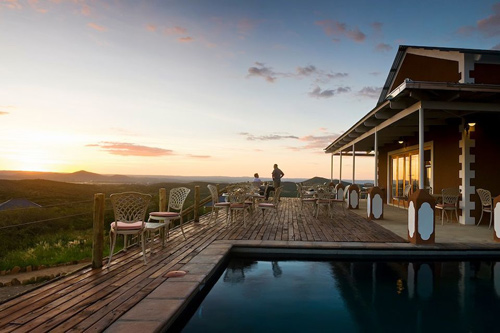
The main lodge building comprises a dining room, a centrally situated bar, a lounge with fireplace, a conference room and a boardroom. Nestled outside, between the lounge and dining area, is the pool (great for swimming lengths – it really is quite long!) The elevated wooden deck offers a fairytale view of Windhoek. The Lodge and the rooms have been designed to emulate old German farm houses – think ‘stoep’ with ‘afdakkie’ and pots of geraniums. The 20 guest chalets consist of 14 twin chalets and 6 double chalets (all chalets have ensuite bathrooms with showers, toilets, and basins). Two of the chalets have been designed with honeymooners in mind and have baths instead of showers. All rooms have feather duvets wrapped in 100% cotton, environmentally friendly guest amenities, and unparalleled service and hospitality. 6 chalets offer views of Windhoek and 14 face east offering superb sunrise views of the Moltkeblick Mountain. You'll also have WIFI available.
Camping
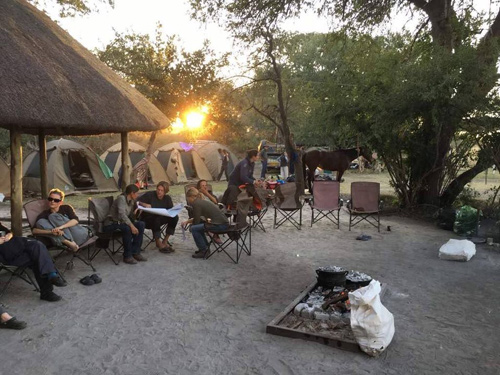
While we do provide tents if needed, generally guests sleep out under the stars on cozy cots with bedding. The cots have bedrolls consisting of an insulating mattress, duck-down double duvet, and pillow - can zip up and has a waterproof cover. Hot bucket showers and chemical loos travel along with us - we endeavor to provide a shower every night but if water is scarce, one night might be shower-less.
Room Occupancy
Single supplement is waived if you are willing to share.
 Meals
Meals
All meals are included from dinner on Day 1 to breakfast on the last day.
Breakfast is typically porridge or cereal, coffee or tea and a hot dish.
On days we are able to meet up with the supply trucks a light lunch is served, where this is not possible, sandwiches are enjoyed under a shady tree.
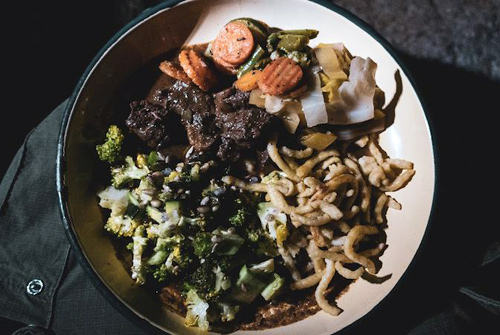
Dinner is a delight of typically Namibian fare; wild Game, free-range beef or Karoo mutton served as braai (grilled over an open fire) or potjie (pot casserole) with vegetables and a surprise dessert also made on the open fire.
Tea, coffee, and juice are always available in camp with chilled drinks, beer, wine, etc. available in the evenings. All drinks are included in the cost whilst on the ride. Only drinks at the first night lodges, guest farms, restaurants, and petrol stations while en-route are not included in the package rate.
Dietary Restrictions
We can easily cater to vegetarians. We cannot fully cater to vegans, so please supply your own snacks.
This trip includes
some wine with dinner
and can accommodate special dietary requests.
|
Tack:
|
|
Skirted endurance-type saddles
|
|
Horses:
|
|
Arab, Haflinger, Lipizzaner, Trakehner, ranch horse, even cross-breeds of the famous
wild horses of the Namib Desert, etc
|
|
Pace:
|
|
20- 50km (13 to 30 miles)
a day, up to 6 hours in the saddle. You should be a fit and experienced rider. The pace depends upon the terrain and temperatures but there are many long fast trots, canters and gallops.
|
Walk |
Trot |
Canter |
Gallop |
|
|
Level:
|
|
 (3.5
to
4
out of 5) Strong Intermediate+
(3.5
to
4
out of 5) Strong Intermediate+
|
|
Weight:
|
|
Max
190 lbs / 85 kg
|
|
Riders:
|
|
Min
4
|
Max
15
|
Riding Level
Do not underestimate the physical toll living outside take on you- come very fit! You need to be balanced in the saddle and stay off your horse's back without having to hang onto their mouth at all paces. You need to be able to post trot. This ride is not for the feint-hearted as large free-ranging game occurs and we ride through mountainous areas with meandering rivers and huge plains for fast riding.
If you do not ride regularly (2 - 3 times a week), we strongly recommend that you get into practice before joining one of our challenging safaris. This is a challenging ride suitable for confident intermediate riders. Please not, we reserve the right to prevent anyone from riding if we feel they do not fulfill the minimum competence level as indicated or if weight and fitness level do not fall within that recommended for these challenging safaris.
Pace
You will ride in the morning for 4-5 hours, have a lunch break for 1-2 hours, and then continue riding for another 2-3 hours, totaling around 6-8 hours per day in the saddle for 7 days. You will cover 20-60km per day at all paces and over rough terrain. Other days may be less. Pace depends on the terrain and temperatures as well as on fitness and weight of riders with walk, trot, canter and gallop. Because Namibia has such wide-open spaces it is possible to accommodate up to 15 riders on most trails plus 2 - 3 riding guides.
Tack
We use skirted endurance type saddles with heavy padding for the comfort of horse and rider. Each saddle is fitted with two specially made water bottle holders (water bottles supplied). If you normally ride with a sheepskin bumnah you may bring your own (western shaped). We use a simple snaffle bridle over the halter
Horses
Your horse will be chosen from a mixed herd of many breeds i.e. Arab, Haflinger, Trakehner, ranch horses, they are small to medium-sized (14.3 to almost 16 hands) sure-footed horses raised on rough terrain, some of them with experience in endurance riding, and every one of them a kind, reliable companion that deserves the very best treatment and care.
Each rider is responsible for grooming, regularly checking over, and tacking up their own horse (assistance is given when required). It is this experience that cements the bond between you and the horse you must rely on to carry you across the desert.
Weight Limit
We have a strict weight limit of 85 kg dressed in your riding gear – fit riders heavier than this will need to hire a 2nd horse. Our absolute maximum weight limit is 93 kg.
Hard Hats
Hard hats are obligatory, unless medical insurers acknowledge that you will still be insured, should you choose not to wear a hard hat.
Safety
Your safety and enjoyment are of paramount importance to us while you are our guest. Please alert us to any personal medical condition, allergies included and ensure you have all essential personal medication before arriving in Windhoek.
Children & Non-Riders
Experienced children riders who are accompanied by their parents are welcome – but please remember that these rides can be quite strenuous – so parents must use their judgment as to whether their children are suitable. Anyone unable to keep up with the group may have to travel in the support vehicle at some times. Non-riding companions are also welcome to join the trip and travel with the trucks.
Insurance
Comprehensive medical insurance is required to ride with us. Ensure repatriation is included in your policy. Travel insurance is recommended.
Passports
Passport valid for a minimum of six months after the date of departure from Namibia required by all nationals referred to in the chart above.
Visas
Not required by nationals referred to in the chart above for stays of up to 90 days except:
1. nationals of Bulgaria, Cyprus, Czech Republic, Estonia, Greece, Hungary, Latvia, Lithuania, Malta, Poland, Romania, Slovak Republic and Slovenia who do require a visa.
Note: Nationals not referred to in the chart above are advised to contact the consulate or high commission for visa requirements (see Contact Addresses).
Types of Visa and Cost
Tourist, Business and Transit: US$50.
Validity
Valid up to three months from date of issue for stays of up to three months from date of entry. Extensions for a further three months are available from the Ministry of Home Affairs in Windhoek.
Applications to:
Consulate (or consular section at high commission); see Contact Addresses.
Working Days Required
Three to four.
| Passport Required? |
| British |
Yes |
| Australian |
Yes |
| Canadian |
Yes |
| USA |
Yes |
| Other EU |
Yes |
| Visa Required? |
| British |
No |
| Australian |
No |
| Canadian |
No |
| USA |
No |
| Other EU |
No/1 |
| Return Ticket Required? |
| British |
Yes |
| Australian |
Yes |
| Canadian |
Yes |
| USA |
Yes |
| Other EU |
Yes |
|

|
|
|
Damara Elephant Trail to Skeleton Coast
Tour Code:
PG-NADT
11 days /
10 nights
~$7,935.00
Dates: August to September
Trip Rating :

Level :

Difficulty Levels Explained
|
1. |
Easy
|
Easy pace and an average-to-sedentary level of fitness. You should be in good health and fit enough for full day of normal sightseeing and walking.
|
|
2. |
Easy to Moderate
|
An average level of fitness or some experience with the featured
activity is recommended.
|
|
3. |
Moderate
|
Requires you to have performed the featured activity regularly, with
some periods on challenging terrain. Activities are mandatory and
you may be traveling at high elevations. You need to be in good health and physical condition to enjoy these trips, with adequate muscular strength and cardiovascular endurance.
|
|
4. |
Demanding
|
You must be extremely physically fit and are expected to hike or
ride four to six hours over steep or more rugged terrain. |
|
5. |
Strenuous
|
Prolonged hiking/biking on moderate to difficult terrain (five to nine hours a day).
May include high altitude, rugged terrain etc.. |

Introduction
Day to Day Itinerary
Rates | Dates
Accomodation
Airport:
Windhoek
Location on Google Map
Image Gallery
Image Slide Show
Climate
What To Bring
Download tour PDF 
↑ Back to Top
|