|
Horseback riding tours
Rides in
Morocco
Intro to Morocco
![]() Morocco Morocco
Tunisia
Egypt
Jordan
Oman
------
Africa Overview
Africa North
|

|
|

|
|
|
Tata Akka Expedition
Morocco
Morocco
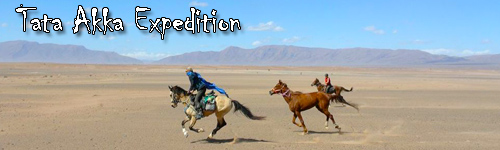
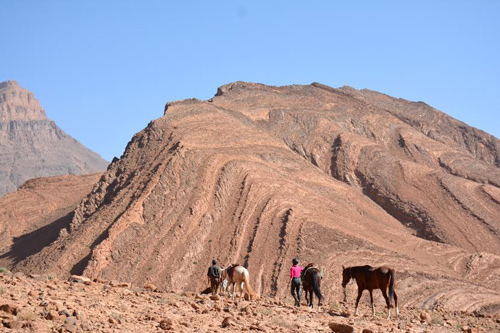
Let your horse guide you through desert sands, endless plains, immense oases of palm trees, salty rivers and mountain chains in orange, red, and brown. Stop to enjoy the scene of the red sand of the Sahara meeting black mountain passes. This ride explores a remote area still unused to tourism and we will see many local people in typical settings.
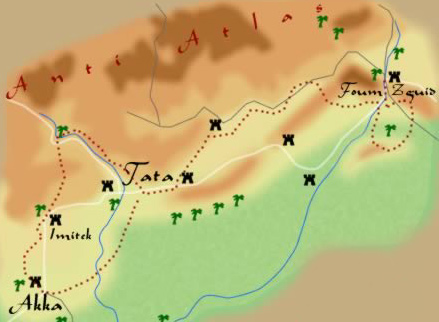
The Tata Akka Expedition departs from Agadir and transfers to our first title city, Tata, situated on the Sahara plain close to the Algerian border. As our journey begins we ride through kasbah villages and canter across white sand. Forward going horses take us deep into the desert to Akka, our second titular city. Akka is an oasis marked by clusters of red houses and villager going about their daily life. This was a stop on an ancient caravan route and subsequently became an area of Jewish settlement in Morocco.
From Akka we travel on to camp on river banks and under palm groves. We venture across mountains, refresh at waterfalls and carefully navigate narrow paths. Chances for quicker paced rides appear as we reach endless sand plains. As we reach the palmary of Foum Zguid, whose remoteness is an attraction in itself, we are satisfied with the Tata Akka Expedition and its wonderful sites and experiences.
Wonderful landscapes!
"Thanks for the great adventure and trip across this beautiful landscape. I'll always remember the long gallops and what it felt like to be a little jockey on the horse (Raouia) who always wants to be the first. What a great first equestrian vacation, and hopefully I'll be able to make it back for another ride one day." -Michelle Carmichael NY USA
|
Camping Ride with vehicle support
Progressive Ride (no camping)
|
|
Meeting:
|
Agadir Airport
|
|
Airport:
|
Agadir-Al Massira Airport (AGA)
|
|
Transfer:
|
Agadir Airport
|
|
Riders:
|
Min
4 riders
Max
9 riders
|
|
Trip Brochure (PDF)  Trip Rating

|
|
|
|
Rates include*:
Accommodations, Most meals, 11 riding days & Pick-up from Agadir airport
| A | 2024 | 15 day expedition | 15d / 14n | €2000 | $2200 |
* prices are per person based on double/twin occupancy
Transfer and Other Charges:
|
2024
|
Pick-up from Agadir airport included. Individual return.
|
€
0
|
$0
|
|
2024
|
Small group supplement (3 pax only), pp
|
€
400
|
$440
|
|
2024
|
Single supplement
|
€
200
|
$220
|
Pick-up is available from Agadir Al Massira Airport (AGA) after 12:00pm on Day 1 of the trip. Check-out on the last day is at 12:00pm. Drop-off transfers are not included on the last day of the trip.
No additional dates for 2011 - back in 2012
|
Rates do not include:
Drop-off transfer, Entrance fees and sightseeings (1-2 Euros per place), Alcoholic beverages, Drinks in hotels, Lunch on Day 7 and 14 & Gratuities for porters (~5-10 Dirham) and grooms (~140 Euros)
 Sample Itinerary- subject to changes
Day 1: Arrival in Ouarzazate
Sample Itinerary- subject to changes
Day 1: Arrival in Ouarzazate
Dinner and overnight accommodation in a hotel.
Meals included: Dinner
Overnight at Hotel in Ouarzazate
Day 2: Introductory Ride
Transfer by car to Tata (approximately 4-5 hours). The horses wait for us in the palm gardens of Tata. In the afternoon we start the first stage of our journey. During a 2-3 hour ride we familiarize ourselves with our horses. We ride along the Kasbah villages and do long gallops across the white sand. A black mountain range rises before us, almost disappearing under the Sahara sand. At a river bed under palm, oleander and tamarisk trees we set up camp for the night.
Meals included: Breakfast, Lunch & Dinner
Overnight camping near Tiiggane
Day 3: Tiiggane to Tata
A white sand plain stretches before us and invites to long gallops. Later the white sand changes to fine black stones. Isolated acacia trees grow here and we arrive into a broad valley framed by black, serrated mountains. At noon, we picnic under a group of palms. We follow the valley in the afternoon, it is dotted with lonely palm trees. Along brownish mountains we ride towards pale plains. Long gallops lead us to the only well in the desert. Here the camp lies under a group of palms.
Meals included: Breakfast, Lunch & Dinner
Overnight camping near Tata
Day 4: Tata to Akka
In the white sandy plain isolated palm trees grow. Soon the soil changes to black fine stones. Here, forgotten acacia trees stand. Closer to Akka the stones get bigger and we advance more slowly. We approach Akka through its extended palm gardens. Possibly we have lunch in a restaurant in this small town, if we find a place where we can tie up the horses. Akka is a newer town, with an important military presence. We camp for the night, next to the river that runs through the palm tree gardens.
Meals included: Breakfast, Lunch & Dinner
Overnight camping near River Akka
Day 5: Akka to Imitek
We ride for a short way along the edge of the palm tree gardens. Behind them lies a more yellowish plain, completely eroded, and riddled with thousand small ravines and valleys. Riding here is like riding in a maze: will we ever find the exit? But soon we can gallop again through a flat, sandy desert valley. We climb over a stony pass with beautiful views into the infinite valleys beyond. Picnic by the roadside. Towards the evening we ride along a brown mountain range with innumerable folding.
Meals included: Breakfast, Lunch & Dinner
Overnight camping near Imitek
Day 6: Imitek to Tata
Along the palm trees we cross the village Imitek. On donkey paths we skirt a mountain range that reflects the sunlight in many different colors from pink to ocher, brown or yellow, depending on the position of the sun. Behind it granite mountains rise high. Hidden in a valley close to the village Agoulouz, we find a small romantic waterfall. Here we have a short picnic, because the afternoon ride promises to be a long one. Narrow mule paths leads us across the mountain range. Finally we reach the edge of Tata. A last long canter brings us to the hotel in Tata.
Meals included: Breakfast, Lunch & Dinner
Overnight at a Hotel in Tata
Day 7: Sightseeing (no riding)
Today the horses have time to rest and we have time to look around this beautiful desert oasis town. Tata is the largest of the Bani oases. The population is very friendly and the place is calm.
Meals included: Breakfast & Dinner
Overnight at a Hotel in Tata
Day 8: Tata to Akka Iguern
Today we rejoin our horses and ride over a large plain where acacia trees grow. The ground is covered partly with stones, partly with fine flints and we advance through a long valley framed by slanted, black-brown mountains. mid-day rest is in the middle of green slate mountains. In the afternoon we pass between the mountains to come into the valley of Akka Iguern. Today our camp lies in an empty river course in the proximity of the village.
Meals included: Breakfast, Lunch & Dinner
Overnight camping near Akka Iguern
Day 9: Akka Iguern to Kasbah el Joua
Over a stony, black plain we ride on to pale brown pyramid-shaped mountains. Between the mountains, through and sometimes over hills we reach our midday camp. In the afternoon we cross a last mountain range and finally reach an endless sand plain. Long canters bring us to the green palm gardens of Kasbah el Joua.
Meals included: Breakfast, Lunch & Dinner
Overnight camping near Kasbah el Joua
Day 10: Kasbah el Joua to Mghirima
Today we gallop over the wide white sands to isolated palms and reach a caved-in black mountain range. Soon follows a yellow plateau with thousands of small eroded canyons. Again we look for a way out of this maze onto the white high plain. After a long gallop we descend down to the river valley where palm trees grow. We follow the river course of clear, blue water. By a ravine we reach the waterfalls of Atiq. At the large natural pool with clear bluish green water we have our midday rest. Here it is even possible to bathe. The water is slightly salty and very cool. In the afternoon we continue our ride in the palm gardens of Tissint. Suddenly a large, white sand plain framed by black rock stretches before us. Here we can canter as much as we like. Soon, we reach the river course again, with bushes and isolated palms. The salty river continues here, its water can be drunk by the animals. Over a black plateau we ride to the palm gardens of Mghirima.
Meals included: Breakfast, Lunch & Dinner
Overnight camping near Mghirima
Day 11: Mghirima to oasis
Today we ride through what was once an artificial lake, though it almost never holds water now. We continue following the drained river course. Despite the absence of flowing water shrubs and bushes still grow here. Soon, many small sand dunes accumulate, and we have a lot of fun riding over them! In the background black, folded mountains half sunk in red sand stretch away. Now a black pebbled plain extends itself before us. Isolated acacias grow here, between them rise small mountains, which are nearly covered with red Sahara sand. Here, we look for a place to picnic. In the afternoon, we ride far in the direction of a tajine-shaped mountain. Towards the evening we enter the broad valley that leads to a no man's land. The ground here is ideally suited for long gallops. In the distance a line of shark fin like mountain rises. The camp is at a lonely palm oasis with springs.
Meals included: Breakfast, Lunch & Dinner
Overnight camping near an oasis
Day 12: Ride across the desert
Today we ride over the large plain towards the shark fin mountains. Other strange mountain forms developed here, like teeth or the tajine mountain. We ride between them and reach an endless sand expanse. We picnic somewhere along the way. In the evening we reach the camp at the foot of the tajine mountain at a desert spring with isolated palms. The nomads bring their camels here to drink.
Meals included: Breakfast, Lunch & Dinner
Overnight camping near the mountains
Day 13: Last Ride
Our last riding day leads us across a sandy plain with small bushes. More and more acacia trees grow here. Stony surfaces alternate with sandy oueds. Finally we reach the palm garden of Foum Zguid. The horses are stabled next to the hotel and we enjoy a good shower.
Meals included: Breakfast, Lunch & Dinner
Overnight at Hotel in Foum Zguid
Day 14: Visit of Foum Zguid
Today we can sleep in again. After a leisurely breakfast we discover the little town Foum Zguid, the gate to the desert. In the afternoon we return to Ouarzazate.
Meals included: Breakfast & Dinner
Overnight at Hotel in Ouarzazate
Day 15: Departure
Departure.
Meals included: Breakfast
Meeting:
Agadir Airport
Airport:
Agadir-Al Massira Airport (AGA)
Transfer:
Agadir Airport
Distance:
25km /15.5 miles
Pick-up is available from Agadir Al Massira Airport (AGA) after 12:00pm on Day 1 of the trip. Check-out on the last day is at 12:00pm. Drop-off transfers are not included on the last day of the trip.
|
Tack:
|
|
English trekking
|
|
Horses:
|
|
Arab, Berber stallions & mares
|
|
Pace:
|
|
Up to 8 hours and up to 50 km. Riders must have at least 5 years experience
|
Walk |
Trot |
Canter |
|
|
Level:
|
|
 (3.5
to
5
out of 5) Strong Intermediate
(3.5
to
5
out of 5) Strong Intermediate
|
|
Weight:
|
|
Max
190 lbs / 85 kg
|
|
Riders:
|
|
Min
4 riders
|
Max
9 riders
|
|
Horses
You will ride small but very surefooted Arabian Berber horses with a great courage and stamina. Mares and stallions go together on the ride. Stallions and mares go well together, but some of the stallions need extra space when two are in the same area. A whip is suggested for the stallions, as they need strict orders. This does not make them difficult to ride, they just require more firm direction and more attention. These horses can get very attached to their riders and are always ready to please.
Tack
Mostly English and some military tracking saddles. Some people bring their own gel-cushion or sheep-skin cover to put over the saddle since we ride for long hours.
Staff
Driss and Rena have been organizing treks on horseback in Morocco since 1982.
Rena, once a schoolteacher in Switzerland, came to Meknes in the year 1984 to realize her dream of living in harmony with horses and nature. In love with Morocco and its inhabitants, she will help you discover another Morocco, away from the beaten track, authentic and enchanting, as your guide on the treks.
Driss is a riding instructor who used to work for the National Studfarm of Meknes. He has more than 25 years of experience with horses and he has taught a great many students (a lot of them French) who for the most part have gone on to be high level riders).
Passport and Visa Requirements:
PassportsPassport valid for at least six months from date of entry required by all nationals referred to in the chart.Passport NoteVisitors should ensure that their passports are stamped when they ent. more
Agadir area
|
Month
|
Jan
|
Feb
|
Mar
|
Apr
|
May
|
Jun
|
Jul
|
Aug
|
Sep
|
Oct
|
Nov
|
Dec
|
|
Average High Temperature (°F)
|
69
|
70
|
73
|
72
|
74
|
75
|
79
|
80
|
81
|
77
|
75
|
70
|
|
Average Low Temperature (°F)
|
46
|
49
|
52
|
54
|
58
|
62
|
65
|
65
|
64
|
59
|
54
|
49
|
|
Average High Temperature (°C)
|
20
|
21
|
23
|
22
|
23
|
24
|
26
|
26
|
27
|
25
|
24
|
21
|
|
Average Low Temperature (°C)
|
8
|
10
|
11
|
12
|
14
|
17
|
18
|
19
|
18
|
15
|
12
|
9
|
Source: NOAA
Seasons
Winter is usually bright and crisp, while autumn brings delicious fresh produce in the markets. Nights can be cold around that time.
Spring sees the Atlas Mountains covered in flowers, while the summers are hot.
Sunny weather all year! Isn't that great!? Actually, you can expect warm to hot weather with a nice breeze in the open country. At noon, we typically siesta to stay out of the hottest sun. Expect sunny weather most of the time, so bring light yet comfortable clothes with you. The most comfortable clothes in warm environments are covering your body yet are light and airy to make sure that the air can circulate.
Nights can be chilly however, so be sure to take some warm clothes as well. Any moment of the year you may have a thunderstorm - so better you bring a rain coat with you too!
Morocco is a country where almost everybody is Muslim. They are very welcoming towards foreigners, but still it might be better to dress modestly and not to show a lot of uncovered skin, especially when you're a woman.
Recommended equipment
- Warm sleeping bag
- Comfortable riding clothes
- Flashlight
- Multipurpose shoes (riding and walking)
- Non-revealing city clothes for occasional visits to towns and hotels
- A warm sweater and coat
- Raincoat
- Sunhat
- Sunscreen
- Swimsuit
- Towel
- Water bottle
- Pocket knife
Note that old clothes and riding equipment you no longer need are very welcome.
Sorry, no video is currently available for this tour.
*Important Notice: The following ratings have been submitted by guests and do not necessarily represent the views of Hidden Trails, its partners or employees.
Every care is taken to ensure accuracy but Hidden Trails is not liable for any errors or omissions.
** No trip reports found
with the tour ID you provided.
|
..view other reports for different trips
 Accommodations
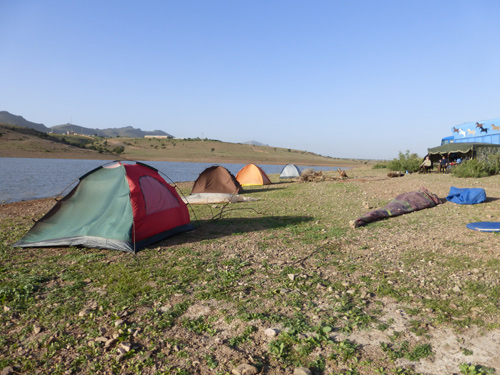
This is a wilderness ride, so nights will be a mixture of hotels and camping.
Description
You will spend 5 nights in hotel accommodations and 9 nights camping.
Accommodation Itinerary - subject to changes based on availability
Night 1 & 14: Hotel in Ouarzazate
Night 2: Camping near Tiiggane
Night 3: Camping near Tata Airport
Night 4: Camping in Oued Akka
Night 5: Camping in Imitek
Night 6 & 7: Hotel in Tata
Night 8: Camping near Akka Inguirene
Night 9: Camping in Kasba-el-Joua
Night 10: Camping near Mrhimina
Night 11 & 12: Camping
Night 13: Hotel in Foum Zguid
Hotel in Ouarzazate
Since 2005, the hotel « Les Jardins de Ouarzazate » welcomes guests in a warm and friendly atmosphere. It offer 31 air conditioned rooms, a pool, an enclosed garden with trees, a large terrace and free Wi-Fi.
Hotel in Tata
This hotel has 27 rooms and 4 well-equipped suites. It is a very simple hotel located in an old building of the city. Parts of the hotel have been renovated and all rooms are offering en-suite bathrooms. WIFI is available in all areas and is free of charge.
Hotel in Foum Zguid
Located within the palm grove of Foum Zguid, this hotel offers a large outdoor swimming pool. Guests can enjoy a terrace offering panoramic views of the surrounding mountains. The air-conditioned guest rooms are bright and have a modern décor. They each have a seating area and an en suite bathroom with a shower and hairdryer. Some rooms offer a private terrace with patio furniture. WIFI is available in public areas and is free of charge.
Camping
You will overnight in comfortable dome tents with ground mats. There are rustic portable toilets (no flush) on site and no showers. There will be some rivers along the ride where you can bathe and wash up. Make sure to being your own sleeping bag!
Room Occupancy
Single supplement is mandatory if we are unable to find another rider to share.
 Meals
Meals
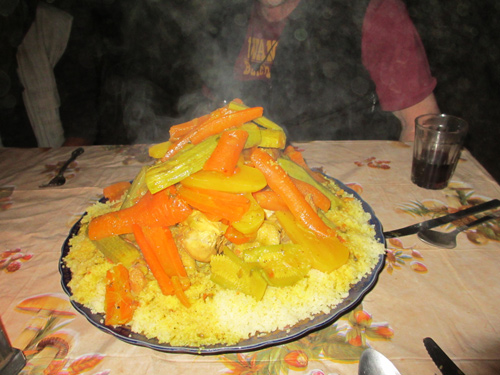
All meals are included on the ride except for lunches on day 7 and 14.
You will enjoy a mix of food: some "western food" and some very good local specialties!
Some days a car will meet us for lunch and on some days we will have a picnic on the trail - you will take the food with you in your saddle bags.
Drinks in hotels or restaurants and alcoholic drinks on the ride are not included.
Dietary Restrictions
We can cater to dietary restrictions if given prior notice.
This trip
can accommodate special dietary requests.
|
Tack:
|
|
English trekking
|
|
Horses:
|
|
Arab, Berber stallions & mares
|
|
Pace:
|
|
Up to 8 hours and up to 50 km. Riders must have at least 5 years experience
|
Walk |
Trot |
Canter |
|
|
Level:
|
|
(3.5
to
5
out of 5) Strong Intermediate
|
|
Weight:
|
|
Max
190 lbs / 85 kg
|
|
Riders:
|
|
Min
4 riders
|
Max
9 riders
|
|
Horses
You will ride small but very surefooted Arabian Berber horses with a great courage and stamina. Mares and stallions go together on the ride. Stallions and mares go well together, but some of the stallions need extra space when two are in the same area. A whip is suggested for the stallions, as they need strict orders. This does not make them difficult to ride, they just require more firm direction and more attention. These horses can get very attached to their riders and are always ready to please.
Tack
Mostly English and some military tracking saddles. Some people bring their own gel-cushion or sheep-skin cover to put over the saddle since we ride for long hours.
Staff
Driss and Rena have been organizing treks on horseback in Morocco since 1982.
Rena, once a schoolteacher in Switzerland, came to Meknes in the year 1984 to realize her dream of living in harmony with horses and nature. In love with Morocco and its inhabitants, she will help you discover another Morocco, away from the beaten track, authentic and enchanting, as your guide on the treks.
Driss is a riding instructor who used to work for the National Studfarm of Meknes. He has more than 25 years of experience with horses and he has taught a great many students (a lot of them French) who for the most part have gone on to be high level riders).
Passports
Passport valid for at least six months from date of entry required by all nationals referred to in the chart.
Passport Note
Visitors should ensure that their passports are stamped when they enter the country.
Visas
Not required by all nationals referred to in the chart above for stays of up to three months.
Visa Note
(a) Visa extensions are possible upon request at the nearest police station. (b) Nationals not referred to in the chart above are advised to contact the embassy to check visa requirements.
| Passport Required? |
| British |
Yes |
| Australian |
Yes |
| Canadian |
Yes |
| USA |
Yes |
| Other EU |
Yes |
| Visa Required? |
| British |
No |
| Australian |
No |
| Canadian |
No |
| USA |
No |
| Other EU |
No |
| Return Ticket Required? |
| British |
No |
| Australian |
No |
| Canadian |
No |
| USA |
No |
| Other EU |
No |
This information is not being updated on a regular basis. Hidden Trails does not
take any responsibility for the accuracy of the above information. Please, consult
the embassy or consulate for updated info.
|

|
|
|
Tata Akka Expedition
Tour Code:
PG-MRTA
15 days /
14 nights
Dates :
Oct-Nov
Difficulty :

Riding Level Explained | A | Beginner
 | Beginner A rider who has limited experience, is unable to post the trot and does not canter. | | B | Novice
 | Novice A rider who is capable of mounting and dismounting unassisted, capable of
applying basic aids, comfortable and in control at the walk, moderate length posting
trots, and short canters. | | C | Intermediate
 | Intermediate A rider who has a firm seat, is confident and in control at all paces
(including posting trots, two point canters and gallops), but does not ride regularly. |
| D | Strong Intermediate
 | Strong Intermediate An intermediate rider who is currently riding regularly and is comfortable in the saddle for at least 6 hours per day. | | E | Advanced
 | All of the above, plus an independent seat, soft hands, and capable of handlinga spirited horse in open country. |

|