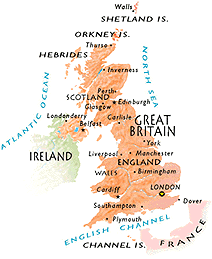
Source: World Travel Guide
Overview
Wales is a historic land of castles and mountains, sweeping beaches and strong national identity dating back to pre-Norman times and reinforced in 1999, when Wales was granted its own assembly.
The capital, Cardiff, has seen extensive regeneration, both in the city centre and the nearby Cardiff Bay area, which is now seen as a major entertainment and administrative centre. In the rural north, farming and tourism continue to be the main sources of income.
Populous south Wales incorporates Cardiff, the cities of Swansea and Newport, Carmarthen Bay and two national parks, Pembrokeshire Coast and Brecon Beacons. The Cambrian Mountains and the attractive coastal resorts of Cardigan Bay are highlights of mid Wales, while the north has popular seaside resorts like Llandudno and Rhyl, the island of Anglesey and the scenic delights of Snowdonia National Park.
Passport/Visa
|
Passport Required? |
|
British |
N/A |
|
Australian |
Yes |
|
Canadian |
Yes |
|
USA |
Yes |
|
Other EU |
1 |
|
Visa Required? |
|
British |
N/A |
|
Australian |
No |
|
Canadian |
No |
|
USA |
No |
|
Other EU |
No |
|
Return Ticket Required? |
|
British |
N/A |
|
Australian |
No |
|
Canadian |
No |
|
USA |
No |
|
Other EU |
No |
Passports
Passport valid for at least three months beyond length of stay required by all nationals referred to in the chart above except:
1. EU nationals holding a valid national ID card.
Note: EU nationals are only required to produce evidence of their EU nationality and identity in order to be admitted to any EU Member State. This evidence can take the form of a valid national passport or national identity card. Either is acceptable. Possession of a return ticket, any length of validity on their document, sufficient funds for the length of their proposed visit should not be imposed.
Passport Note
(a) A passport is not required for travel between Great Britain and Ireland, Northern Ireland, the Channel Islands or the Isle of Man. (b) Passengers transiting the UK destined for the Republic of Ireland are advised to hold return tickets to avoid delay and interrogation.
Visas
Not required by nationals referred to in the chart above for stays of up to six months.
Visa Note
(a) Nationals not requiring visas are advised to be in possession of either a return ticket or, if arriving on a one-way ticket, proof of sufficient funds to accommodate and support themselves for the duration of stay. (b) Nationals not referred to in the chart above are advised to contact the embassy to check visa requirements (see Contact Addresses).
Money
Currency
See the individual Money sections within the Jersey, Guernsey, Isle of Man and Northern Ireland sections for information on currency specific to these regions.
Pound (GBP; symbol £) = 100 pence. Notes are in denominations of £50, 20, 10 and 5. Additional bank notes issued by Scottish banks (including £1 notes) are accepted in all parts of the UK, although some smaller shops outside Scotland may prefer English banknotes. Coins are in denominations of £2 and 1, and 50, 20, 10, 5, 2 and 1 pence.
Currency Exchange
Money can be exchanged in banks, exchange bureaux, some post offices and many hotels. The exchange bureaux are often open outside banking hours but charge higher commission rates. All major currencies can be exchanged.
Credit/Debit Cards and ATMs
American Express, MasterCard and Visa are all widely accepted. Cash can be obtained from a multitude of ATMs available across the country.
Traveller's Cheques
Widely accepted. To avoid additional exchange rate charges, travellers are advised to take traveller's cheques in Pounds Sterling.
Banking Hours
Mon-Fri 0930-1630 (there may be some variations in closing times). Some banks are open Saturday morning; some all day Saturday.
Health
Vaccinations
|
|
Special Precautions |
|
Diphtheria |
Yes |
|
Hepatitis A |
No |
|
Malaria |
No |
|
Rabies |
No |
|
Tetanus |
Yes |
|
Typhoid |
No |
|
Yellow Fever |
No |
|
Inoculation regulations can change at short notice. Please take medical advice in the case of doubt. Where 'Sometimes' appears in the table above, precautions may be required, depending on the season and region visited. |
Health Care
If suddenly taken ill or involved in an accident during a visit to an EEA country or Switzerland, free or reduced-cost necessary treatment is available for European travellers - in most cases on production of a valid European Health Insurance Card (EHIC). Comprehensive insurance is advised for all other nationals.
The National Health Service (NHS) provides free medical treatment (at hospitals and general surgeries) to all who are ordinarily resident in the UK, but requires payment for dental treatment, prescriptions and spectacles. Immediate first aid/emergency treatment is free for all visitors, after which charges are made unless the visitor’s country has a reciprocal health agreement with the UK. Full details of individual agreements are available from the Department of Health (website: www.dh.gov.uk).
Getting There
Main Airports
Cardiff International Airport (CWL) (website: www.cwlfly.com) is 19km (12 miles) from Cardiff. To/from the airport: A rail link connects the airport with Cardiff Central station. A bus runs between Cardiff city centre and the airport. Taxis are available outside the terminal building. Car hire is available. Facilities: Restaurants, shops, bureaux de change, ATMs, children's play area and executive lounge.
Departure Tax
None.
Getting There by Water
Main ports: Fishguard, Holyhead (Anglesey) (website: www.holyheadport.com), Pembroke (website: www.mhpa.co.uk) and Swansea (website: www.abports.co.uk), all of which have ferry connections to the Republic of Ireland, with companies including Irish Ferries (tel: 0870 517 1717; website: www.irishferries.com) and Stena Line (tel: 0870 570 7070; website: www.stenaline.com).
Getting There by Rail
There are two mainline routes into Wales. One runs from London Paddington to Fishguard along the south Wales coast (branching at Whitland to serve Haverford West and Milford Haven), while the other links Holyhead with Chester and northwest England. In addition, the line from Cardiff to Chester (via Newport, Hereford and Shrewsbury) links the south Wales cities with Abergavenny in Gwent and Wrexham in Clwyd. There are also two smaller cross-country lines: these run from Shrewsbury to Welshpool, Barmouth, Harlech, Porthmadog and Pwllheli; from Shrewsbury via Welshpool to Aberystwyth; and from Craven Arms (on the Shrewsbury–Ludlow line) through Llandrindod Wells and Llandovery down to Swansea. For details, contact National Rail Enquiries (tel: 0845 748 4950; website: www.nationalrail.co.uk).
Getting There by Road
The best road approach to Wales from southern England is via the M4 motorway, which runs from west London to Newport, Cardiff and Swansea, almost to Carmarthen. The A5 links London and the Midlands with the ferry port of Holyhead, and the A55 links Holyhead with Chester. The best cross-country road is probably the A44/A470 from Oxford to Aberystwyth.
Climate
Wales tends to be wetter than England, with slightly less sunshine. The coastal areas, however, can be very warm in summer. Conditions in upland areas can be dangerous and changeable at all times of the year.
Required Clothing
Similar to the rest of the UK, according to season. Waterproofing advised throughout the year, and warm clothes are required for upland areas.
Contacts
Visit Wales/Croeso Cymru
Brunel House, 2 Fitzalan Road, Cardiff CF24 0UY, UK
Tel: 0870 830 0306.
Website: www.visitwales.com
Visit Wales/Croeso Cymru in the USA
551 Fifth Avenue, Suite 701, New York, NY 10176, USA
Tel: 1 800 462 2748.
Website: www.visitwales.com