|
|
|
|
|
Kilimanjaro Big Game Trail
Tanzania
Tanzania
Tanzania is a country famous for its wildlife and scenery - and for good reason. Here you find the greatest concentrations of wild animals left anywhere in the world, you see extremes of climate unknown in the western world, and you meet people with cultural backgrounds so distinct from your own that you are forced to question all your previous beliefs and way of life.
This is wild Africa - this is true exploration, and on horseback!
The great "Out of Africa" experience on horseback! Follow in Hemingway’s footsteps over the western game corridor of Mt. Kilimanjaro. Enjoy the diverse scenery and flora and fauna, from the montane forest to the western savannah, where African animals roam freely as they have for thousands of years. This safari is designed for experienced riders and offers breathtaking views, exhilarating canters and close contact with wildlife such as elephant, zebra, eland, wildebeest - to name but a few.
Enjoy the 24 hour bush-experience, lighted by lanterns, listening to animal voices next to the camp fire… and much more!
Our aim is to offer our guests an intimate and personal experience, affording them the best that East Africa has to offer in terms of the African 'Bush'. Our safaris are highly personalized, very much ‘off the beaten track’ and away from human settlement. You will be accompanied on all rides and activities by your hosts ensuring that your riding holiday will be a truly memorable one.
Your hosts are both veterinarians and ensure the condition of the horses. Even in challenging circumstances in the bush the condition of the horses is superb.
A shorter 4 day/ 3 night Safari option is available throughout the year on request with 2+ riders, which can be combined with extra days at the farm with day rides. With the snow-capped peak of Kilimanjaro rising to your East and Mt. Meru to the West, this safari takes place in one of the most dramatically beautiful settings in East Africa.
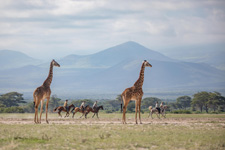
Game viewing is possible even if you are on a tight schedule. If you are an experienced rider, we invite you to join us for an unforgettable adventure. As we ride through the African bush, far away from roads and other tourists, we share the pristine habitat with elephants, wildebeests, giraffes, gazelles, and more.
Exploring your environment, bush and game area on horseback is the perfect way to experience the real African Bush! It is a wonderful experience and we hope you enjoy it as much as we all do!
--Alternative non-riders itinerary on request.
|
Camping Ride with vehicle support Short Getaway Safari Ride
Meeting:
Moshi
Airport:
Kilimanjaro
Transfer:
Kilimanjaro Airport
|
|
|
|
Rates and Dates for 2013
Rates include:
Accommodations - 2 nights at farm, 1 night in a farm guest house with sharing bathroom, 1 night tented camp in Ndarakwai, 3 nights fly-camp , all meals, snacks, tea, coffee and beverages, horses incl. tack, luggage transfers where necessary, English & German speaking guide.
| A | 2013 | 8 day trip, AP | 8d / 7n | €3700 | $4810 |
Transfer and Other Options:
|
2013
|
Transfer round trip from Kilimanjaro International Airport or Moshi, included
|
€
0
|
$0
|
|
2013
|
Single supplement
|
€
480
|
$625
|
|
2013
|
Conservation/entry fees to reserves
|
€
190
|
$245
|
Additional dates are available on request with 2+ riders
Rates do not include:
Tips and gratuities, laundry and phone calls, other items of a personal nature.
Big Game Trail
Day 1: Arrival at the farm on the Foothills of Mt. Kilimanjaro
Arrive at the farm, our starting point for the safari. The 358-acre coffee and horse farm is nestled into the lower slopes of Kilimanjaro. The house and rooms are situated to take in spectacular views of this impressive mountain; Africa’s highest peak!
During the afternoon we will introduce you to the horses, and help you choose one to match your size and skill. Then we embark on a ride so you can become familiar with your horse.
Day 2: Kilimanjaro Forest Reserve
After breakfast, transfer with the horses to the Kilimanjaro Forest Reserve. Today we explore the indigenous montane forests of the Kilimanjaro Reserve - a lush world of exotic scenery. We ride slowly and carefully so as to spot the shy black and white Colobus monkeys.
Mostly there are no roads and we use elephant trails to pass through. The dense forests are populated by a whole range of, mostly secretive animals. A sharp eye will doscover lots of tracks and signs, even an elusive leopard, and a keen ear might pick up the crunching sound of a herd of elephants feeding not far off.
After a picnic lunch in the forest reserve we continue to the Namuai guesthouse on a farm located at the edge of the Kilimanjaro Forest Reserve where we spend the night. We will arrive in time for a sun downer drink, a hot shower and a delicious meal.
Day 3: Out of Africa
We leave the guest house and ride toward the northwest. Our journey leads us through a mixture of open grassland and thorn bush savannah. Along the way we will encounter our first plains animals. Lunch will be prepared under a shady tree and if you are lucky there will be an elephant herd watching us during our break.
Late afternoon we reach Mgunga Camp; you will be welcomed with a cold gin and tonic at the end of the day. Our private fly camp is set in the shade of an ancient African tree, with stunning views of Mt. Meru. Relax with a cool drink and take in the rich colours of the African sunset. Your dinner is prepared on nothing more than a wood fire, served under the stars, weather depending there might be a mess tent. Our camp chef will impress you with her culinary skills, despite the rustic setting. After dinner, retire to the campfire and marvel at the enormous night sky before falling asleep to the sounds of the African night.
The fly camp usually consists of a dome tent with beds, mattresses and duvets/pillows, under a beautiful Acacia tree, toilet tents and classic hot bush showers are available. The stars are visible from your pillow, and the night noises of Africa are the background to your sleep. Nothing brings the experience of Africa closer…
Day 4: Tracking game on horseback
Wake up early with a cup of steaming tea or coffee served in your tent. We start for a long morning ride of game spotting along the western boundary of the ranch. In addition to the ever-present antelopes, zebras and gazelles, we'll keep an eye out for giraffes, ostriches, warthogs and maybe a cheetah. What we really hope for though, is the chance for a peaceful meeting with a herd of magnificent African elephants. Don't forget your binoculars and camera!
Depending on the game situation we might return to camp for lunch or have a picnic on the way. Evening rides are especially good for photography because of the beautiful light, and with photos in mind, it will be a calm ride.
Day 5: More game...
Another day of game viewing: The day will be mostly dictated by the game movements. You are in the heart of the West-Kilimanjaro wilderness and we may find seasonally large herds of elands and sometimes up to 100 to 200 elephants. Expect to spot lesser kudu, waterbuck, many other antelopes and smaller species like warthog, with some luck even predators such as striped and spotted hyena, cheetah and leopard.
We return to camp for late lunch. In the afternoon we start in an open game-drive vehicle for another tour. We drive through bush savannah and plains to track some more game; we will be sure to meet indigenous Masai while herding their cattle. You may take the chance to visit them in their Masai Boma to learn more about their daily life.
Day 6: The West Kilimanjaro Wilderness
Rise to an African sunrise for an early breakfast. We mount our horses and head out into the savannah. Kori bustards and secretary birds are often seen here stalking their prey. Our ride today starts crossing perfect terrain for long canters through bush and grasslands. Slowly and carefully we approach the wildlife we find along the way - lesser kudus, antelopes, gazelles and a lot of other animals. If you feel up to it, you can canter with zebras and wildebeests. This is a safari the way it was meant to be!
Arrive at Ndarakwai Camp for lunch. Afterwards there is time for some rest or for a hike to the nearby water hole for some wildlife viewing. The elevated wooden platform by the waterhole offers great sightings and the perfect place for another sunset drink. Back in camp you will enjoy your spacious and comfortable tent and after the traditional bush shower we meet for dinner. After dinner we start for a night-game drive. Here you can view, with the aid of a spotlight, all the nocturnal species not generally seen during the day.
Day 7: Ride over Narco-Plains and back to the farm
Today we will leave the West Kilimanjaro wilderness. We explore the area of ‘Tembobridge’ and seek out herds of elephant in between the euphorbia forest. Later we continue on our way southeast passing the plains between Mt. Meru and Mt. Kilimanjaro. See herd animals watching the horses with interest, have a canter with zebra and eland, then stop en route for a picnic lunch.
Late afternoon we meet the truck which will transport riders and horses back to Makoa Farm. Enjoy the view of Mt.Kilimanjaro in it’s lush environment, bush babies visiting you while you sit on the veranda with a sunset drink.
Day 8: Farm and Departure
After a relaxed breakfast there may remain some time to have look around our farm and visit our uncountable number of animals. This is a farm environment with many pet and tame wild animals - dogs, cats, geese, chickens and peacocks roam freely with marabou stork, grey and black headed herons, not to forget Gin & Tonic, the bush pigs. A little further on are stables for horses, donkeys, pigs and cattle. All the animals are very friendly and welcome a pat or scratch behind the ear!
Later transfer for Kilimanjaro International Airport and departure.
Shorter 4-day Safari Getaway option:
Day 1: Arrival at the farm on the Foothills of Mt. Kilimanjaro
Arrive late afternoon at the farm, our starting point for the safari. The 358-acre coffee and horse farm is nestled into the lower slopes of Kilimanjaro. The house and rooms are situated to take in spectacular views of this impressive mountain, Africa’s highest peak. In the afternoon we will introduce you to the horses and start on a ride so you can become familiar with horses, tack and riding style. For the non-riders this is time to settle in their rooms or to stretch their legs on a relaxed walk. Both, ride and walk, follow the boundary of the farm through grass and bush land which is used for grazing horses and cattle. Wild animals also inhabit the area, and unlike on other farms, we welcome them. These include Sykes monkeys, yellow baboons, duikers, bushbucks, reedbucks and bush pigs as well as nocturnal animals like aardvarks, porcupines and jackals. In the evening you will receive a briefing on all details about the safari and riding in game area.
Day 2: The West Kilimanjaro Wilderness
After breakfast you will be transferred to a meeting point, the horses will be waiting for you. On the plains between Mt. Kilimanjaro and Mt. Meru we start our ride to the northwest. The non-riders have their own vehicle and this will be the first game drive for them, they also might spot the rider group on the way. The landscape changes completely as we head through a mixture of open grassland and thorn bush savannah. This is a long ride interrupted by a short break and some snacks on the way. We may encounter the first antelopes, zebra maybe some ostriches and jackals.
Late lunch will be prepared next to a water hole, the elevated wooden platform offers great wildlife viewing during your meal. The sightings will keep your camera busy and the warm afternoon light will provide the best background. If you are interested in Masai culture then you will do an excursion to visit them after lunch. Alternatively you may decide for another sunset-ride or take the chance for a little walk to our near camp for a sun downer drink.
For the next two nights you will stay in our private mobile bush-camp. The mobile tents are classic canvas dome tents and equipped with comfortable beds, mattresses, blankets and linen. There are toilet and hot bucket shower tents. Emphasis is on privacy, game viewing and scenery in remote areas. Depending on requirements this might be arranged as a mobile trail where the site for our fly camp will be mostly determined by the game situation. In our mobile bush-camp the food is always prepared fresh and most of the ingredients are produced on our farm. This includes most vegetables, meat, milk and milk products. Expect to find freshly home baked bread on your table every morning, as well as homemade confectionary in the afternoon.
Day 3: Out of Africa
Wake up early with a cup of steaming tea or coffee served in your tent. This will be an exciting day for game viewing; the route will be mostly dictated by the game situation. We mount our horses and head out into the savannah. You are in the heart of the West-Kilimanjaro wilderness and we may find seasonally large herds of Elands, sometimes up to 100, and up to 200 Elephants. Kori bustards and secretary birds are often seen here stalking their prey. Slowly and carefully we approach the wildlife we find along the way - lesser kudus, antelopes, gazelles and a lot of other animals. If you feel up to it, you can canter with zebras and wildebeests. This is a safari the way it was meant to be! Late afternoon we ride on another route back to camp, while we enjoy the sunset from horseback in the savannah.
Day 4: More game ... on the ride towards Mt. Kilimanjaro
Start early for a long morning ride for spotting game along the western boundary of the reserve. In addition to the ever-present antelopes, zebras and gazelles, we'll keep an eye out for giraffes, ostriches, warthogs and maybe a cheetah. What we really hope for though, is the chance for a peaceful meeting with a herd of magnificent African elephants and we will explore the area of "Tembobridge" to seek out herds in between the euphorbia forest. Don't forget your binoculars and camera!
Later we continue our way southeast passing the plains between Mt. Meru and Mt. Kilimanjaro. See herd animals watching the horses with interest, have a canter with zebra and eland, then we stop en route for a picnic lunch.
Later afternoon we meet the vehicle and transport horses and guests back to the farm. Enjoy the view of Mt.Kilimanjaro while sitting on the veranda with a sunset drink.
Later departure for your onwards or homewards journey or opt for another night at Makoa for a more relaxed pace.
--Itineraries are subject to changes.
|
|
|
Meeting:
|
|
Moshi
|
|
Airport:
|
|
Kilimanjaro
|
|
Transfer:
|
|
Kilimanjaro Airport
|
|
Level:
|
|
Moderate
|
|
|
|
Extended trots and canters, about 4-6 hours in the saddle.
Daily kms varies as the idea of the ride is to emphasize game viewing and scenery in remote areas.
|
|
Participants:
|
|
Min
2
participants
|
Max
6
participants
|
|
The minimum riding requirement for safari rides is intermediate with the ability to post to the trot for ten minutes at a time and be able to canter with a secure seat, controlling the horse's speed and direction at all times. Safari rides require prior experience in riding over rough terrain as during the rides we may cross steep valleys, river with seasonally strong current and dry river beds. We spend 4 to 6 hours per day in the saddle.
Important for Kilimanjaro Big Game Trail and Wilderness Rides: You need to be able to react to the movement of wildlife which may startle the horse. You may also be required to gallop out of trouble so the minimum ability for these rides are intermediate.
It will be at the discretion of the company whether you will be permitted to ride, taking into consideration the safety and enjoyment of the group as a whole.
Horses: The horses are much loved, well mannered and in excellent condition. A variety of reliable, for safari-purpose trained horses like Partbred- and Anglo-Arab, Thoroughbred, Trakehner, Bavarian Warmblood, Australian Brumby etc., ranging from 14 to 16.2 hands - there is a horse to suit everyone.
Foals - we believe in raising our own future safari horses bred from mares well experienced in horseback safaris and the bush.
Riding terrain: The terrain can be uneven with areas of rocks, clumps of grass, thorns and holes. These obstacles can sometimes not be seen from far and therefore require a quick reaction of the horses - they will confidently jump or move around rocks, stones, thorns or holes. The horses are sure footed. They will bring the riders safe to where we want to go, however the rider is expected to be balanced enough to follow the movement of the horse.
Tack: Tack is usually bitless (Hackamore and Sidepull).
There are good quality treeless (Barefoot), Endurance and Trail Saddles.
Riders weight limit: Strictly 15 stone, 210 lbs or 95 kg.
Passport and Visa Requirements:
Passport valid for at least six months required by all nationals referred to in the chart.Required by all nationals referred to in the chart above except: 1. nationals of Cyprus and Malta for stays of. more
Tanzania is hot throughout the year and is humid on the coast and dry on the central plateau. The heavy rains last from March to June and can make unsealed road travel difficult. The hot, dry weather in January and February attracts the most tourists. The best time to visit the Serengeti is from January to March when the grazers are calving and there are plenty of lion around, or to witness the wildebeest migration to and from Kenya which occurs at the onset of the dry season and again with the first rains, usually the beginning of June and mid-November. Zanzibar has a warm climate year-round and its coastal resorts are tempered by sea breezes. The island is best avoided in April and May, the rainy season.
We recommend:
A light-weight and breathable riding hat, wearing one is your responsibility.
A shade hat with strap
Bush color riding clothes (not white or bright colors)
Cotton riding trousers
Light-weight riding shoes
Long sleeved shirts
A jersey, fleece or multi pocketed waistcoat
A lightweight, waterproof windbreaker jacket
Important are chaps for protection of trousers and skin, we recommend to use long chaps, available as leather or synthetik version
Sun block, lip salve
Film, camera and binoculars on a strong shoulder strap, preferably in a (waterproof) pouch to be secured to belt.
Please note: don't bring your newest or favourite clothes as they can get very dirty or damaged.
Safety: Every ride will be accompanied by one of the owners as guide and a back-up rider and will be equipped with a GPS, first aid kit, mobile phone and radiocall.
Information for riders taking malaria prophylaxis:
Important is a good insect repellent and long-sleeved shirts/trousers for the evening hours. Most guests seem to tolerate Malarone or Doxycycline well. Please consider that some drugs cause physical problems which might have a negative impact on your riding holiday in case you choose other drugs for malaria prophylaxis.
| This list is only a guideline for you |
|
|
| Travel documents and Voucher |
| Flight tickets |
| Passport |
| Visa (check with your consulate) |
|
|
| RIDING GEAR |
| Riding pants or Jodhpurs - cotton |
| Important: FULL chaps, leather or synthetic to protect you from thorns |
| Light-weight riding shoes which are comfortable for walking. We will dismount every hour for 10 minutes and walk, sometimes the horses will be led over difficult terrain. |
| Riding helmet- light-weight and breathable, wearing one is your responsibility |
| Riding gloves |
| Wide-brim hat with strap & scarf for sun protection |
| Bush color riding clothes (not white or bright colors) |
|
|
| PERSONAL CLOTHING |
| A jersey, fleece or multi pocketed waistcoat |
| Long sleeve cotton shirts |
| Jeans |
| Shorts |
| Underwear and socks |
| Pyjama |
| A lightweight, waterproof windbreaker jacket |
| Trekking boots/ comfortable shoes |
| Swimsuit |
| |
| ADDITIONAL THINGS TO BRING |
| Personal Toiletries |
| Insect repellent which prevents ticks * |
| Personal medications |
| Sore cream (for an emergency) |
| Sewing kit |
| Handkerchiefs |
| Rehydration salts |
| Torch or head lamp |
| Camera, binoculars on a strong shoulder strap, preferably in a waterproof pouch to be secured to belt- extra film and batteries |
| Malaria pills |
| Biodegradable soap and shampoo |
| Sun glasses with strap |
| Sun tan lotion and lip balm |
* Some tick sprays can be used for clothes and shoes only. You can treat your clothes at home and the tick prevention will last for the whole safari period.
Sorry, no video is currently available for this tour.
*Important Notice: The following ratings have been submitted by guests and do not necessarily represent the views of Hidden Trails, its partners or employees.
Every care is taken to ensure accuracy but Hidden Trails is not liable for any errors or omissions.
..view other reports for different trips
Recently upgraded accommodation: Shared accommodation in canvas tents with BEDS, mattress and bedding for 3 nights, and one night in cottages or guest house at Makoa-Farm, one night in Namuai Guesthouse, one night in a luxury type permanent camp, tea, coffee, drinking water and homemade juices during the day, table wine and alcoholic drinks in the evening.
Produce from our own farm and kitchen garden (the bounty of which we happily share with monkeys, duikers and a myriad of other small creatures) is used to prepare the wonderful meals on offer.
This trip includes
some wine with dinner
and can accommodate special dietary requests.
|
Tack:
|
|
Quality trail saddles (‘Trailrider’), treeless saddles (‘Barefoot’ and ‘Torsion’)
Bitless bridles like Sidepull and Hackamore
|
|
Horses:
|
|
Variety of Thoroughbred, Warmbloods and Mix of both, Arabian Mix, Australian Brumby, Achal-Tekke
|
|
Pace:
|
|
Extended trots and canters, about 4-6 hours in the saddle.
Daily kms varies as the idea of the ride is to emphasize game viewing and scenery in remote areas.
|
Walk |
Trot |
Canter |
Gallop |
|
|
Level:
|
|
(3
to
4
out of 5) Intermediate
|
|
Age:
|
|
Min
12
|
|
|
Weight:
|
|
Max
210 lbs
|
|
Riders:
|
|
Min
2
|
Max
6
|
The minimum riding requirement for safari rides is intermediate with the ability to post to the trot for ten minutes at a time and be able to canter with a secure seat, controlling the horse's speed and direction at all times. Safari rides require prior experience in riding over rough terrain as during the rides we may cross steep valleys, river with seasonally strong current and dry river beds. We spend 4 to 6 hours per day in the saddle.
Important for Kilimanjaro Big Game Trail and Wilderness Rides: You need to be able to react to the movement of wildlife which may startle the horse. You may also be required to gallop out of trouble so the minimum ability for these rides are intermediate.
It will be at the discretion of the company whether you will be permitted to ride, taking into consideration the safety and enjoyment of the group as a whole.
Horses: The horses are much loved, well mannered and in excellent condition. A variety of reliable, for safari-purpose trained horses like Partbred- and Anglo-Arab, Thoroughbred, Trakehner, Bavarian Warmblood, Australian Brumby etc., ranging from 14 to 16.2 hands - there is a horse to suit everyone.
Foals - we believe in raising our own future safari horses bred from mares well experienced in horseback safaris and the bush.
Riding terrain: The terrain can be uneven with areas of rocks, clumps of grass, thorns and holes. These obstacles can sometimes not be seen from far and therefore require a quick reaction of the horses - they will confidently jump or move around rocks, stones, thorns or holes. The horses are sure footed. They will bring the riders safe to where we want to go, however the rider is expected to be balanced enough to follow the movement of the horse.
Tack: Tack is usually bitless (Hackamore and Sidepull).
There are good quality treeless (Barefoot), Endurance and Trail Saddles.
Riders weight limit: Strictly 15 stone, 210 lbs or 95 kg.
Passports
Passport valid for at least six months required by all nationals referred to in the chart.
Visas
Required by all nationals referred to in the chart above except:
1. nationals of Cyprus and Malta for stays of up to three months and issued with a visitor's pass on arrival, but may still need entry permit clearance. It is possible for British nationals to obtain a tourist visa for single entry at any one of the main port of entries to Tanzania, subject to the fulfillment of all immigration requirements. All other visitors must obtain visa prior to travelling to Tanzania.
Visa Note
(a) The high commission does not issue multiple entry visas for tourist or business purposes. All multiple entry visas should be applied for at the Immigration Head Office in Dar es Salaam through your host. (b) Nationals not referred to in the chart above are advised to contact the embassy or high commission to check visa requirements (see Contact Addresses).
Types of Visa and Cost
£38 per single-entry (prices are for application at high commission in London). US visas: US$100 (single or double-entry, six months); US$120 (express service).
Validity
Tourist single-entry: three months from date of issue; Business single-entry: two months.
Applications to:
Consulate (or consular section at high commission or embassy); see Contact Addresses.
Working Days Required
Normally three. Up to 10 for postal applications. 24-hour service is available at an extra charge of £5.
| Passport Required? |
| British |
Yes |
| Australian |
Yes |
| Canadian |
Yes |
| USA |
Yes |
| Other EU |
Yes |
| Visa Required? |
| British |
Yes |
| Australian |
Yes |
| Canadian |
Yes |
| USA |
Yes |
| Other EU |
Yes/1 |
| Return Ticket Required? |
| British |
Yes |
| Australian |
Yes |
| Canadian |
Yes |
| USA |
Yes |
| Other EU |
Yes |
|
|
|
|
Kilimanjaro Big Game Trail
Tour Code:
IT-TZRT05
8 days /
7 nights
~$4,810.00
Dates: Available all Year
Trip Rating :
Level :
Difficulty Levels Explained
|
1. |
Easy
|
Easy pace and an average-to-sedentary level of fitness. You should be in good health and fit enough for full day of normal sightseeing and walking.
|
|
2. |
Easy to Moderate
|
An average level of fitness or some experience with the featured
activity is recommended.
|
|
3. |
Moderate
|
Requires you to have performed the featured activity regularly, with
some periods on challenging terrain. Activities are mandatory and
you may be traveling at high elevations. You need to be in good health and physical condition to enjoy these trips, with adequate muscular strength and cardiovascular endurance.
|
|
4. |
Demanding
|
You must be extremely physically fit and are expected to hike or
ride four to six hours over steep or more rugged terrain. |
|
5. |
Strenuous
|
Prolonged hiking/biking on moderate to difficult terrain (five to nine hours a day).
May include high altitude, rugged terrain etc.. |
Introduction
Day to Day Itinerary
Rates | Dates
Accomodation
Airport:
Kilimanjaro
Location on Google Map
Image Gallery
Image Slide Show
Climate
What To Bring
Download tour PDF
↑ Back to Top
|