|
|

|
|
|
|
Horseback riding vacations in
Canada
There are few countries in the world able to offer as many choices to the adventure traveler as Canada. Horse vacations in Canada are numerous. Whether you are drawn to the great outdoors for a quiet, scenic trail ride or wish to experience life on a working ranch, horse riding holidays in Canada have it all.
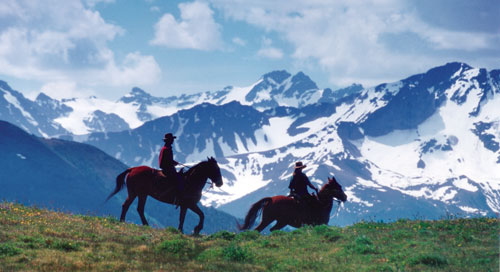
Western Canada (British Columbia, Alberta, Saskatchewan)
is renowned for its stunningly beautiful landscapes – the towering
mountain ranges of BC give way to impossibly beautiful, rugged coastlines and island sanctuaries. Alberta's mountains eventually give way to the wide-open prairies. Alberta is home
to Spruce Meadows, an internationally renowned showjumping venue
attracting Olympic caliber athletes several times a year and the
province is also host to the world-famous Calgary Stampede – where
western horse riding takes center stage every July.
Wildlife viewing is at its best in Northern Canada; and, everywhere, you will be surprised by how much more there is to this country than just maple syrup and Mounties!
Hidden Trails invites you to check out the beauty that is Canada on an exciting horse riding tour: endless rugged backcountry, stunning snow capped mountains, expansive flatlands of the prairies, fast flowing and powerful rivers, gigantic and pristine glacier lakes and a fascinating array of wildlife from one end to another!
Whether your passion is horseback riding, hiking, canoeing, kayaking or indulging in exceptional cuisine, Canada truly has it all.
With various overnights in tents, luxury cabins, lodges and ranches and all with delicious, cooked meals, Canada offers exhilarating destinations from which to explore the great outdoors. From the Rocky Mountains in British Columbia, the great Saskatchewan plains of the Prairies to the wilds of the Yukon, Canada offers an equestrian horseback riding vacation for everyone.
Explore more North American Horse Riding Vacations
|
|
Holidays on horseback in Canada
See Mini Country Guide
|
Below is a list of our trips in this area with video clips.
 Click on the 'watch video' icon

to view a video clip,
Beckley Guest and Cattle Ranch in British Columbia near Cranbrook

|
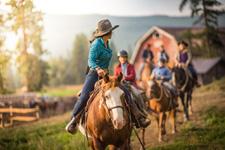
Located in a truly beautiful part of the world with an abundance of nature, clean fast moving water, green fields and breathtaking mountain vistas you find a spectacular 35,000 acres guest ranch which offers the invigorating lifestyle of a working cattle ranch and reining horse training facilities - with exceptional lodgings and cuisine of a world-class resort. The ranch offers a whole world of fun things to see and do, including a complete range of horseback riding programs, hiking, mou.
|
Trip Details
|
|
Chilko Explorer Ride
|
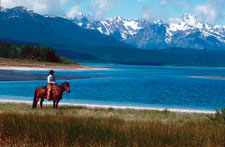
The remote wilderness lodge and base for this trip is located at the north end of Chilko Lake, British Columbia, the gateway to Ts'yl-os Park. This is the dividing point between the stunning Coast Mountain range and the Chilcotin Plateau, where the crystal clear Chilko River winds its way down to the coastal watersheds.
|
Trip Details
|
|
Canada
Travel restrictions
Fully vaccinated travelers, including those engaging in non-essential travel (travel for tourism or recreation), may enter Canada.
For all travelers entering Canada on or after October 1st 2022:
- Proof of COVID-19 vaccination is not required
- COVID-19 pre-entry and arrival tests are not required
- Quarantine after you enter Canada is not required
- Using ArriveCAN is not required but if you’re flying into Toronto Pearson, Vancouver, or Montréal-Trudeau international airports, you can still use ArriveCAN to complete your Advance CBSA Declaration to save time upon arrival
- Pre-boarding tests for cruise passengers are not required
- Health checks to board planes and trains are not required
- Wearing masks on planes and trains is not required
Travelers can consult the following website for up-to date information concerning travel requirements into Canada: https://travel.gc.ca/travel-covid
Canadians can take a look at travel recommendations by country at the following link: https://travel.gc.ca/travelling/advisories
Measures taken by the government
Essential services in the country remain generally available, but some provinces continue to limit discretionary activities, such as visits to restaurants, bars, gyms, and retail shops, to individuals who can provide proof of COVID-19 vaccination.
Testing
COVID-19 testing is available throughout Canada for medical purposes. Testing programs are administered by provincial and territorial health authorities. In some provinces and territories, you can also obtain testing for travel purposes directly from the health authorities, while in others you must pay a private facility.
Costs for private testing for travel purposes vary widely and can exceed $300.
This Government of Canada website contains information about COVID-19 testing in Canada and includes a link to the COVID-19 information websites of each province and territory: https://www.canada.ca/en/public-health/services/diseases/2019-novel-coronavirus-infection/symptoms/testing.html#toc3
Emergency number (related to COVID-19) while visiting the country
COVID-19 Information Service: 1-833-784-4397
Source:
US Embassy in Canada https://ca.usembassy.gov/covid-19-information-canada/
Published on January 4th 2023 (checked on April 5th 2023)
For more information please visit our COVID-19 Updates page at https://www.hiddentrails.com/article/covid19update.aspx
|
|
Canada
At A glance
Capital City: Ottawa
Land size: 9,093,507 sq km
Population: 38,232,593 (2022 est.)
Official languages: English & French
Currency: Canadian Dollar ($ / CAD)
UNESCO properties and sites:
- Head-Smashed-In Buffalo Jump
- Historic District of Old Québec
- L’Anse aux Meadows National Historic Site
- Landscape of Grand Pré
- Old Town Lunenburg
- Red Bay Basque Whaling Station
- Rideau Canal
- SGang Gwaay
- Writing-on-Stone / Áísínai’pi
- Canadian Rocky Mountain Parks
- Dinosaur Provincial Park
- Gros Morne National Park
- Joggins Fossil Cliffs
- Kluane / Wrangell-St. Elias / Glacier Bay / Tatshenshini-Alsek
- Miguasha National Park
- Mistaken Point
- Nahanni National Park
- Waterton Glacier International Peace Park
- Wood Buffalo National Park
- Pimachiowin Aki
Source: https://www.cia.gov/the-world-factbook/countries/canada/
Canada is known for its stunning landscapes, vibrant cities, and warm hospitality. From the majestic Rocky Mountains to the vast coastal regions, Canada offers a captivating blend of natural wonders and cultural treasures. Whether you seek outdoor adventures, cultural experiences, or urban escapades, Canada promises an unforgettable journey filled with awe-inspiring sights and unforgettable memories.
Canada's expansive wilderness offers endless possibilities for riders of all levels, from meandering trails through pristine forests to exhilarating gallops across open plains. Traverse the majestic Rocky Mountains, feeling the rhythm of your horse's hooves as you soak in panoramic views of towering peaks and crystal-clear alpine lakes. From the rugged terrains of the Yukon to the serene tranquility of Sakatchewan’s plains, each region offers a unique and captivating horseback riding adventure.
Brief History
Canada became a self-governing dominion in 1867, while retaining ties to the British crown. Canada gained legislative independence from Britain in 1931 and formalized its constitutional independence from the UK when it passed the Canada Act in 1982.
Economically and technologically, the nation has developed in parallel with the US, its neighbor to the south across the world's longest international border.
Source: https://www.cia.gov/the-world-factbook/countries/canada/
Cultural Insights
The ethnic diversity of Canada means that rules of social propriety are quite complex. There are certain general expectations. Greeting, except in formal settings, does not require touching in the form of embraces or handshakes. Behavior in public should be subdued. Rowdiness and loud speech, for example, are considered inappropriate except under special circumstances or in places such as bars or other venues. As a community, Canadians are in general soft spoken, patient, and almost apologetic in their public behavior. They are also in general tolerant of the complex network of cultural differences in public behavior, more so in cities perhaps, where such diversity is more common place.
Source: https://www.everyculture.com/Bo-Co/Canada.html
Transportation
By Air
All large Canadian cities have an international airport.
Calgary International Airport (YYC) has come a long way since its inception in 1914. Transport Canada launched an ambitious program of land acquisition and airfield construction and in November of 1977 the terminal building that we see today opened, and with it came the modern age of aviation. On October 31, 2016, YYC Calgary International Airport opened the doors to its largest infrastructure project to date, the new International Terminal.
Vancouver International Airport’s (YVR) story began with a single runway and a small, wood-frame administration building that welcomed 1,072 passengers in 1931. Today, YVR is Canada's second busiest airport, connecting passengers to over 118 non-stop destinations.
In the early 2000s, Saskatoon International airport expanded its terminal and increased passengers to over 1 million in 2007. The airport received its international status in 2006 and conducted major expansion of the Air Terminal Building, completed in April 2015.
Source: https://www.yyc.com/en-us/calgaryairportauthority/abouttheauthority/
history.aspx#:~:text=YYC%20Calgary%20International%20Airport%20has,both%20hangar%20and%20terminal%20building.
https://www.yvr.ca/en/about-yvr/who-we-are/past-and-future
https://skyxe.ca/en-us/about-us/mission-history
Money
You can change currencies at commercial banks and exchange bureaus.
Credit and debit cards are widely accepted.
Source: https://www.smartraveller.gov.au/destinations/americas/canada
Health
The level of public health and sanitation in Canada is high. Adequate health facilities are available throughout Canada. Canada’s medical care is of a high standard but is government controlled. Although trauma-care is on par with that in the United States, emergency room waits for non-life threatening problems can be very long.
Some health care professionals in the Quebec may only speak French.
The cost of medical treatment can be very expensive. For emergency health care you can go to a hospital’s emergency room or to a large number of walk-in clinics where an appointment is not required beforehand.
Make sure you have adequate travel health insurance and accessible funds to cover the cost of any medical treatment abroad and repatriation.
If you need emergency medical assistance during your trip, dial 911 and ask for an ambulance. You should contact your insurance/medical assistance company promptly if you are referred to a medical facility for treatment.
Source: https://www.gov.uk/foreign-travel-advice/canada
https://travel.state.gov/content/travel/en/international-travel/International-Travel-Country-Information-Pages/Canada.html
Electricity
Canada operates on a 120V supply voltage and uses type A and B plugs.
The Type A electrical plug (or flat blade attachment plug) is an ungrounded plug with two flat parallel pins. Although the American and Japanese plugs appear identical, the neutral pin on the American plug is wider than the live pin, whereas on the Japanese plug both pins are the same size.
The Type B electrical plug has two flat parallel pins and a round grounding (or earth) pin. The earth pin is longer than the other two so that the device is grounded before the power is connected.
The pins on Type A and Type B plugs have a hole near the tip that fits into ‘bumps’ found on the contact wipers of some sockets, so that the pins are gripped more tightly allowing for better contact and also to prevent the plug from slipping out of the socket. Some sockets have spring-action blades that grip the sides of the pins, making the holes obsolete.
Source: https://www.iec.ch/world-plugs
Communication
Time zones in Canada: Newfoundland Standard Time (GMT-3:30), Atlantic Standard Time (GMT-4), Eastern Standard Time (GMT-5), Central Standard Time (GMT-6), Mountain Standard Time (GMT-7) & Pacific Standard Time (GMT-8)
International country code – 1
The Canadian telecom market continues to show steady development as operators invest in network upgrades; much of the investment among tel companies has been channeled into LTE infrastructure to capitalize on consumer demand for mobile data services, while there has also been further investment in 5G.
Government policy has encouraged the extension of broadband to rural and regional areas, with the result that services are almost universally available and the emphasis now is on improving service speeds to enable the entire population to benefit from the digital economy and society.
Canadians have provided for LTE and LTE-A infrastructure; despite topographical challenges and the remoteness of many areas, the major players effectively offer 99% population coverage with LTE. Operators now provide up to 70% population coverage with 5G. (2022)
Source: https://www.cia.gov/the-world-factbook/countries/canada/
Phrasebook
| English |
French |
| Hello! |
Bonjour |
| Goodbye |
Au Revoir |
| Good morning |
Bon matin |
| Good evening |
Bonsoir |
| Good night |
Bonne nuit |
| Please |
S’il vous plait |
| Thank you |
Merci |
| Yes |
Oui |
| No |
Non |
Source: https://www.linguahouse.com/phrasebooks/english-french
Entry Requirements
If you are visiting Canada, your passport should be valid for the proposed duration of your stay. No additional period of validity beyond this is required.
Most people need a visa or an Electronic Travel Authorization (eTA) to travel to Canada - not both. Some people may only need their valid passport.
Click on the link below to find out what applies to you:
https://www.cic.gc.ca/english/visit/visas.asp
Source: https://www.gov.uk/foreign-travel-advice/canada/entry-requirements
Embassies and Consulates
U.S. Embassy in Ottawa
490 Sussex Drive
Ottawa, Ontario K1N 1G8
Phone: 613-688-5335
U.S. Consulate General in Calgary
615 MacLeod Trail S.E. (Rocky Mountain Plaza Building), 10th Floor
Calgary, Alberta T2G 4T8
Phone: 403-266-8962
U.S. Consulate General in Halifax
1969 Upper Water Street (Tower II), Suite 904, Purdy’s Wharf
Halifax, Nova Scotia B3J 3R7
Phone: 902-429-2480
U.S. Consulate General in Montreal
1134 Saint-Catherine St W
Montreal, QC H3B 5K2
Phone: 416-645-9124
U.S. Consulate General in Quebec
2, rue de la Terrasse-Dufferin
Quebec, Quebec G1R 4T9
Phone: 418-692-2095
U.S. Consulate General in Toronto
360 University Avenue
Toronto, Ontario M5G 1S4
Phone: 416-595-1700
U.S. Consulate General in Vancouver
1075 West Pender Street
Vancouver, British Columbia, V6E 2M6
Phone: 604-685-4311
U.S. Consulate in Winnipeg
201 Portage Avenue, Suite 860
Winnipeg, Manitoba R3B 3K6
Tel: 204-940-1800
Source: https://www.usembassy.gov/
UNESCO Sites
Head-Smashed-In Buffalo Jump
In south-west Alberta, the remains of marked trails and an aboriginal camp, and a tumulus where vast quantities of buffalo (American Bison) skeletons can still be found, are evidence of a custom practised by aboriginal peoples of the North American plains for nearly 6,000 years. Using their excellent knowledge of the topography and of buffalo behaviour, they killed their prey by chasing them over a precipice; the carcasses were later carved up in the camp below.
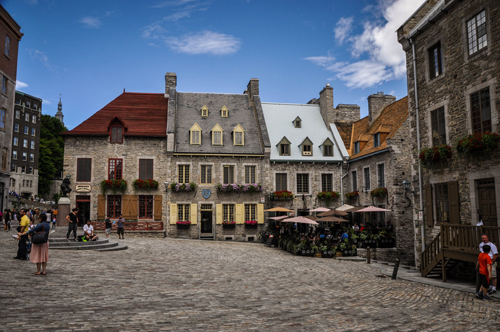
Photo by Camille Loiseau
Historic District of Old Québec
Québec was founded by the French explorer Champlain in the early 17th century. It is the only North American city to have preserved its ramparts, together with the numerous bastions, gates and defensive works which still surround Old Québec. The Upper Town, built on the cliff, has remained the religious and administrative centre, with its churches, convents and other monuments like the Dauphine Redoubt, the Citadel and Château Frontenac. Together with the Lower Town and its ancient districts, it forms an urban ensemble which is one of the best examples of a fortified colonial city.
L’Anse aux Meadows National Historic Site
At the tip of the Great Northern Peninsula of the island of Newfoundland, the remains of an 11th-century Viking settlement are evidence of the first European presence in North America. The excavated remains of wood-framed peat-turf buildings are similar to those found in Norse Greenland and Iceland.
Landscape of Grand Pré
Situated in the southern Minas Basin of Nova Scotia, the Grand Pré marshland and archaeological sites constitute a cultural landscape bearing testimony to the development of agricultural farmland using dykes and the aboiteau wooden sluice system, started by the Acadians in the 17th century and further developed and maintained by the Planters and present-day inhabitants. Over 1,300 ha, the cultural landscape encompasses a large expanse of polder farmland and archaeological elements of the towns of Grand Pré and Hortonville, which were built by the Acadians and their successors. The landscape is an exceptional example of the adaptation of the first European settlers to the conditions of the North American Atlantic coast. The site – marked by one of the most extreme tidal ranges in the world, averaging 11.6 m – is also inscribed as a memorial to Acadian way of life and deportation, which started in 1755, known as the Grand Dérangement.
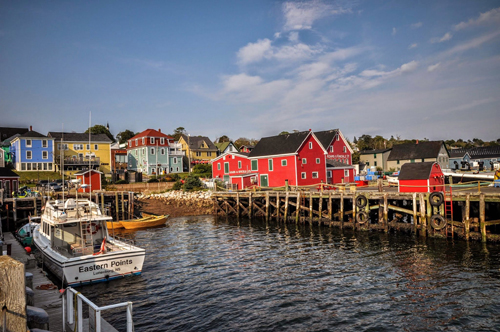
Photo by Camille Loiseau
Old Town Lunenburg
Lunenburg is the best surviving example of a planned British colonial settlement in North America. Established in 1753, it has retained its original layout and overall appearance, based on a rectangular grid pattern drawn up in the home country. The inhabitants have managed to safeguard the city's identity throughout the centuries by preserving the wooden architecture of the houses, some of which date from the 18th century.
Red Bay Basque Whaling Station
Red Bay, established by Basque mariners in the 16th century at the north-eastern tip of Canada on the shore of the Strait of Belle Isle is an archaeological site that provides the earliest, most complete and best preserved testimony of the European whaling tradition. Gran Baya, as it was called by those who founded the station in 1530s, was used as a base for coastal hunting, butchering, rendering of whale fat by heading to produce oil and storage. It became a major source of whale oil which was shipped to Europe where it was used for lighting. The site, which was used in the summer months, includes remains of rendering ovens, cooperages, wharves, temporary living quarters and a cemetery, together with underwater remains of vessels and whale bone deposits. The station was used for some 70 years, before the local whale population was depleted.
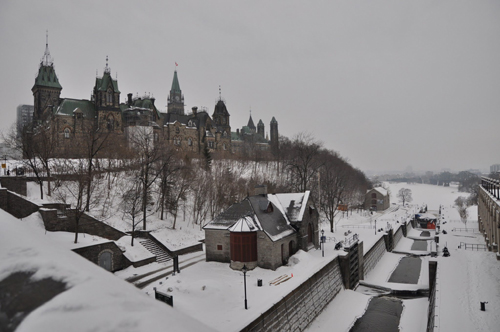
Photo by Camille Loiseau
Rideau Canal
The Rideau Canal, a monumental early 19th-century construction covering 202 km of the Rideau and Cataraqui rivers from Ottawa south to Kingston Harbour on Lake Ontario, was built primarily for strategic military purposes at a time when Great Britain and the United States vied for control of the region. The site, one of the first canals to be designed specifically for steam-powered vessels, also features an ensemble of fortifications. It is the best-preserved example of a slackwater canal in North America, demonstrating the use of this European technology on a large scale. It is the only canal dating from the great North American canal-building era of the early 19th century to remain operational along its original line with most of its structures intact.
SGang Gwaay
The village of Ninstints (Nans Dins) is located on a small island off the west coast of the Queen Charlotte Islands (Haida Gwaii). Remains of houses, together with carved mortuary and memorial poles, illustrate the Haida people's art and way of life. The site commemorates the living culture of the Haida people and their relationship to the land and sea, and offers a visual key to their oral traditions.
Writing-on-Stone / Áísínai’pi
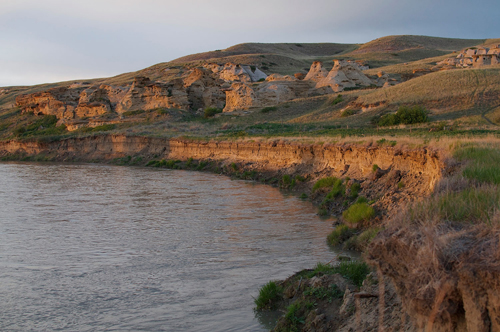
The property is located on the northern edge of the semi-arid Great Plains of North America, on the border between Canada and the United States of America. The Milk River Valley dominates the topography of this cultural landscape, which is characterized by a concentration of pillars or hoodoos – columns of rock sculpted by erosion into spectacular shapes. The Blackfoot Confederacy (Siksikáíítsitapi) left engravings and paintings on the sandstone walls of the Milk River Valley, bearing testimony to messages from Sacred Beings. Dated in situ archaeological remains cover a period between ca. 4,500 BP - 3,500 years BP and the Contact Period. This landscape is considered sacred to the Blackfoot people, and their centuries-old traditions are perpetuated through ceremonies and in enduring respect for the places.
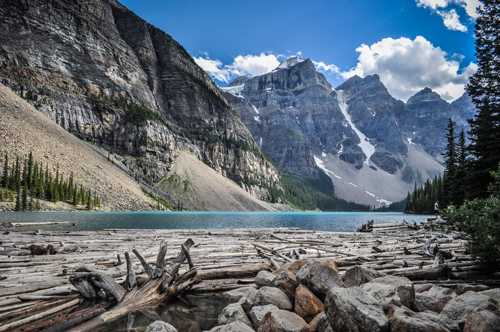
Photo by Camille Loiseau
Canadian Rocky Mountain Parks
The contiguous national parks of Banff, Jasper, Kootenay and Yoho, as well as the Mount Robson, Mount Assiniboine and Hamber provincial parks, studded with mountain peaks, glaciers, lakes, waterfalls, canyons and limestone caves, form a striking mountain landscape. The Burgess Shale fossil site, well known for its fossil remains of soft-bodied marine animals, is also found there.
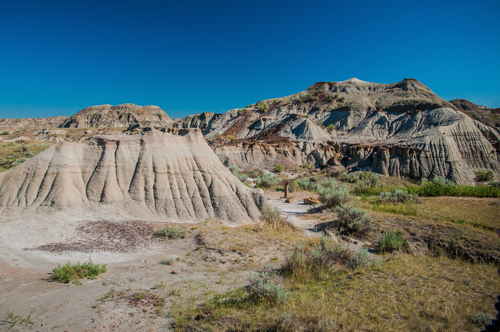
Photo by Camille Loiseau
Dinosaur Provincial Park
In addition to its particularly beautiful scenery, Dinosaur Provincial Park – located at the heart of the province of Alberta's badlands – contains some of the most important fossil discoveries ever made from the 'Age of Reptiles', in particular about 35 species of dinosaur, dating back some 75 million years.
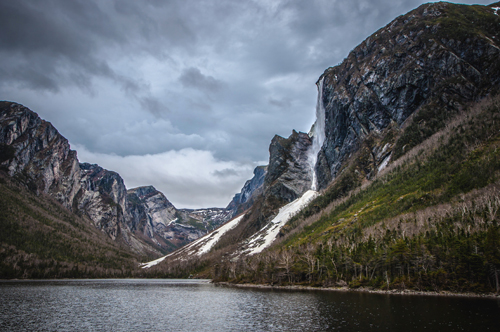
Photo by Camille Loiseau
Gros Morne National Park
Situated on the west coast of the island of Newfoundland, the park provides a rare example of the process of continental drift, where deep ocean crust and the rocks of the earth's mantle lie exposed. More recent glacial action has resulted in some spectacular scenery, with coastal lowland, alpine plateau, fjords, glacial valleys, sheer cliffs, waterfalls and many pristine lakes.
Joggins Fossil Cliffs
The Joggins Fossil Cliffs, a 689 ha palaeontological site along the coast of Nova Scotia (eastern Canada), have been described as the “coal age Galápagos” due to their wealth of fossils from the Carboniferous period (354 to 290 million years ago). The rocks of this site are considered to be iconic for this period of the history of Earth and are the world’s thickest and most comprehensive record of the Pennsylvanian strata (dating back 318 to 303 million years) with the most complete known fossil record of terrestrial life from that time. These include the remains and tracks of very early animals and the rainforest in which they lived, left in situ, intact and undisturbed. With its 14.7 km of sea cliffs, low bluffs, rock platforms and beach, the site groups remains of three ecosystems: estuarine bay, floodplain rainforest and fire prone forested alluvial plain with freshwater pools. It offers the richest assemblage known of the fossil life in these three ecosystems with 96 genera and 148 species of fossils and 20 footprint groups. The site is listed as containing outstanding examples representing major stages in the history of Earth.
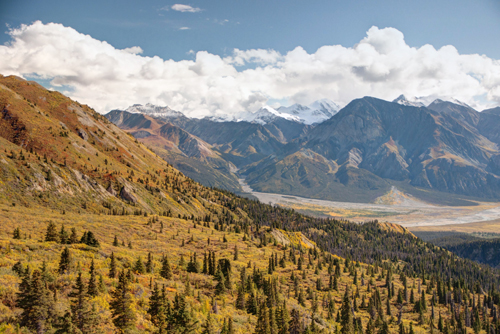
Photo by Camille Loiseau
Kluane / Wrangell-St. Elias / Glacier Bay / Tatshenshini-Alsek
These parks comprise an impressive complex of glaciers and high peaks on both sides of the border between Canada (Yukon Territory and British Columbia) and the United States (Alaska). The spectacular natural landscapes are home to many grizzly bears, caribou and Dall's sheep. The site contains the largest non-polar icefield in the world.
Miguasha National Park
The palaeontological site of Miguasha National Park, in south-eastern Quebec on the southern coast of the Gaspé peninsula, is considered to be the world's most outstanding illustration of the Devonian Period known as the 'Age of Fishes'. Dating from 370 million years ago, the Upper Devonian Escuminac Formation represented here contains five of the six fossil fish groups associated with this period. Its significance stems from the discovery there of the highest number and best-preserved fossil specimens of the lobe-finned fishes that gave rise to the first four-legged, air-breathing terrestrial vertebrates – the tetrapods.
Mistaken Point
This fossil site is located at the south-eastern tip of the island of Newfoundland, in eastern Canada. It consists of a narrow, 17 km-long strip of rugged coastal cliffs. Of deep marine origin, these cliffs date to the Ediacaran Period (580-560 million years ago), representing the oldest known assemblages of large fossils anywhere. These fossils illustrate a watershed in the history of life on earth: the appearance of large, biologically complex organisms, after almost three billion years of micro-dominated evolution.
Nahanni National Park
Located along the South Nahanni River, one of the most spectacular wild rivers in North America, this park contains deep canyons and huge waterfalls, as well as a unique limestone cave system. The park is also home to animals of the boreal forest, such as wolves, grizzly bears and caribou. Dall's sheep and mountain goats are found in the park's alpine environment.
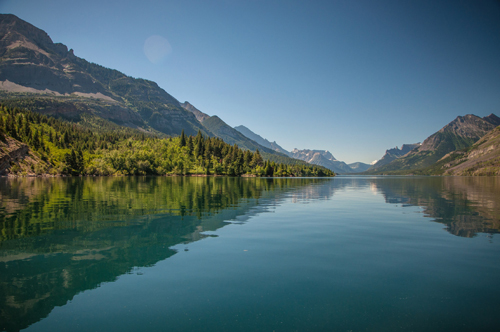
Photo by Camille Loiseau
Waterton Glacier International Peace Park
In 1932 Waterton Lakes National Park (Alberta, Canada) was combined with the Glacier National Park (Montana, United States) to form the world's first International Peace Park. Situated on the border between the two countries and offering outstanding scenery, the park is exceptionally rich in plant and mammal species as well as prairie, forest, and alpine and glacial features.
Wood Buffalo National Park
Situated on the plains in the north-central region of Canada, the park (which covers 44,807 km2) is home to North America's largest population of wild bison. It is also the natural nesting place of the whooping crane. Another of the park's attractions is the world's largest inland delta, located at the mouth of the Peace and Athabasca rivers.
Pimachiowin Aki
Pimachiowin Aki ('The Land That Gives Life') is a landscape of rivers, lakes, wetlands, and boreal forest. It forms part of the ancestral home of the Anishinaabeg, an indigenous people living from fishing, hunting and gathering. The site encompasses the traditional lands of four Anishinaabeg communities (Bloodvein River, Little Grand Rapids, Pauingassi and Poplar River). It is an exceptional example of the cultural tradition of Ji-ganawendamang Gidakiiminaan ('keeping the land'), which consists of honouring the gifts of the Creator, respecting all forms of life, and maintaining harmonious relations with others. A complex network of livelihood sites, habitation sites, travel routes and ceremonial sites, often linked by waterways, provides testimony to this ancient and continuing tradition.
Source: https://whc.unesco.org/en/statesparties/ca/
|
|

|
|
|
|