|
Horseback riding tours
Rides in Canada
Intro to Canada
Alberta British Columbia Quebec Saskatchewan Yukon
Extensions:
Gulf Islands Inn to Inn
Johnstone Straight
|
 |
|
 |
|
|
Banff - Wilderness Tenting Ride
Alberta
Canada
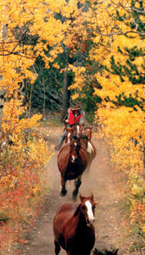
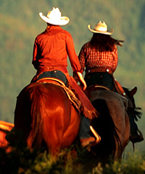
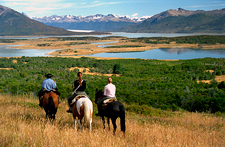
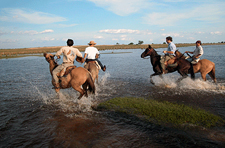
A trip that offers true western heritage experiences in Banff National Park. Exciting horseback riding brings you closer to nature, where you will learn all about life in the west! The cowboys will guide you through the best photographers haven that the Canadian Rockies have to offer. These packtrip takes you and fellow adventurers deep into the heart of the wilderness.
Explore some of Banff National Park's most spectacular back country and join us on a 6-day Wilderness Tenting Ride in the Cascade Valley (4 and 5 day options are available).
The clanging of the dinner bell calls all to delicious ranch-style meals. Coffee is always on and kept hot on the wood stove. The horses, chosen especially to meet your needs and experience, will win you over with their charming personalities and amaze you with their abilities. A strong "partnership" is usually formed by ride's end. During your ride, trails may lead to the tranquil beauty of Rainbow, Sawback or Cuthead Lakes; to the overwhelming views of 40 Mile Summit, Cuthead View Point, or the Rainbow Ridge; the open valleys on the Passes of Elk Lake or 40 Mile Summit, the beauty of the Dormer and Block Valleys or the eerie atmosphere of Mystic Valley. The historic elk corral or wild goat trap should provide you with plenty of opportunities to see and capture on film the abundant wildlife common to the area: elk, deer, bighorn sheep, goats, eagles and the occasional bear or timber wolf. The rides are casual, with breaks and leisurely lunches.
Lunch is served on the trail and there is usually time for some exploring, fishing and even a well deserved snooze in the tall grass.
------
Special Departures 2009
Year of the Grizzly Trip
- 6 days Aug 26 to 31 '09
Paws in the Wilderness
- 5 days Sept 5 to 9 '09
Mountain Photography Trip
- 6 days Aug 19 to 24 '09
|
Meeting:
Banff
Airport:
Calgary, AB
Transfer:
Pick up: Banff at 8:30 AM - drop off at 4:30 PM
|
|
|
|
Rates and Dates for 2009
Rates include:
Overnight camps, all meals from lunch on Day 1 to lunch on last day, 1 wrangler for every 9 riders, 6 riding days on the 6 day trip.
| A | 2009 | 6 day wilderness tenting trip, AP 6 riding days | 6d / 5n | $1446 | $1305 |
| C | 2009 | 6 day wilderness tenting trip, AP 6 riding days | 6d / 5n | $1243 | $1120 |
| D | 2009 | 6 day Year of the Grizzly trip, AP 6 riding days | 6d / 5n | $1546 | $1395 |
| E | 2009 | 6 day Photography trip, AP 6 riding days | 6d / 5n | $1546 | $1395 |
GST (VAT) 2.5% (5% for Canadian Resident)
There are 3 airport shuttle companies offering transfers from Calgary to Banff. We recommend you overnight in Banff the night before the ride in order to be at the meeting point in town on Day 1 at 8:30 AM
Tour Dates
Check here for details and availability
| C |
2009
|
06/24
- 06/29
|
6d / 5n
|
3
/20
|
Expired
|
Reserve
|
| A |
2009
|
07/01
- 07/06
|
6d / 5n
|
3
/20
|
Expired
|
Reserve
|
| A |
2009
|
07/08
- 07/13
|
6d / 5n
|
3
/20
|
Available
|
Reserve
|
| A |
2009
|
07/15
- 07/20
|
6d / 5n
|
3
/20
|
Available
|
Reserve
|
| A |
2009
|
07/22
- 07/27
|
6d / 5n
|
3
/20
|
Available
|
Reserve
|
| A |
2009
|
07/29
- 08/03
|
6d / 5n
|
3
/20
|
Available
|
Reserve
|
| A |
2009
|
08/05
- 08/10
|
6d / 5n
|
3
/20
|
Available
|
Reserve
|
| A |
2009
|
08/12
- 08/17
|
6d / 5n
|
3
/20
|
Available
|
Reserve
|
| E |
2009
|
08/19
- 08/24
|
6d / 5n
|
3
/20
|
Available
|
Reserve
|
| D |
2009
|
08/26
- 08/31
|
6d / 5n
|
3
/20
|
Available
|
Reserve
|
| C |
2009
|
09/02
- 09/07
|
6d / 5n
|
3
/20
|
Sold Out
|
Reserve
|
| C |
2009
|
09/09
- 09/14
|
6d / 5n
|
3
/20
|
Available
|
Reserve
|
| C |
2009
|
09/16
- 09/21
|
6d / 5n
|
3
/20
|
Available
|
Reserve
|
|
Rates do not include:
Park User Fee, sleeping bag and mat, saddle bag
Day 1 - The riders meet in Banff at 8:30 a.m. and are transported by van to the trailhead corral at Mount Norquay. There they are met by their guides and horses, and mount up for the eleven mile ride over Elk Lake Summit between Brewster Mountain and Cascade Mountain, and down into Stoney Creek Camp. Day 2 - A ride is taken toward the headwaters of Stoney Creek, returning to camp for the night. This area is a favorite haunt of Rocky Mountain Bighorn Sheep, who are often grazing in the high meadows, providing ample opportunity for pictures. Day 3 - The riders roll up their duffel, mount up, and ride the ten miles to Flint's Park Camp. This camp, located in the center of open, grassy ridges topped with high peaks, has become a favorite of many of our riders. Wildlife is commonly seen and photographed in this area. Day 4 - A day ride is conducted from camp to Block Mountain, or perhaps to Cuthead Viewpoint - just two of the many points of interest accessible from Flint's Park. This area has much to offer the rider, photographer, hiker and fisherman alike. Day 5 - Once again the riders roll up their duffel in preparation for the ride to the Mystic Valley Camp. At this time the guests have the opportunity to observe the historic art of horse packing, using the famous diamond hitch. When everything is securely in place, the riders mount up and ride into Mystic Valley for the final night. It is traditional with our guides to have a real western dinner for the last night. By this time everyone has become friends, and all are ready for a wind-up get-together. Day 6 - Unfortunately, every trip has a last day, but what better way to end the trip than with the scenic nine mile ride from Mystic Valley to the Mount Norquay Corral. The "Full Circle" has been completed and the riders return to Banff at approximately 5:00 p.m.
The 4 day trip departs Mondays and stays one night in Stoney Creek, Flints Park and Mystic camps.
The 5 day trip departs Saturdays and stays one night in Stoney Creek camp, two nights in Flints Park camp and one night in Mystic camp.
Special Departures 2009 Year of the Grizzly Trip - 6 days Aug 26 to 31 '09 Paws in the Wilderness - 5 days Sept 5 to 9 '09 Photography Trip - 6 days Aug 19 to 24 '09
Year of the Grizzly Trip Aug 26 to 31 2009 = 6 days Year 2001 was emphasized as the "Year of the Grizzly", however due to popular demand we will continue with our interpretive trip to study the Grizzly and it's habitat. This summer, and hopefully for years to come, we will be organizing a six-day horseback trip that will focus on the history, habitat and the future of the grizzly bear. Over the past 100 years of horse travel in the Rockies, we can attest to the compatibility between bears and horseback travel. Whatever the reasons may be, bears take little notice of horse parties. Knowledge about the needs of a healthy grizzly population is growing as more and more administrators from a variety of jurisdictions work together to improve habitat for all species, humans included. In co-operation with Parks Canada, Dr. Mike Gibeau, one of Canada's leading authorities on grizzlies and their environment, will accompany you for the entire six days. Mike has worked with bears in National Parks for the past 27 years, first as a Park Warden, and now as a biologist. You will enjoy a horseback adventure and share in a rare opportunity to spend time in some of Canada's prime grizzly habitat with professional interpretation.
Paws in the Wilderness Sept 5 to 9 2009 = 5 days Wolves have always been a fascinating part of mountain life as their presence contributes greatly to the ecology of the area while remaining mysterious and elusive towards humans. Melanie Percy, accredited wolf researcher in the Bow Valley will take guests into the world of these amazing animals offering insight into pup production, denning habits, high wolf use areas and general wolf presence in the park. Melanies time spent studying these animals and their interaction with other wildlife has also given her a wide spectrum of knowledge regarding Grizzly & Black bears, Cougars, Elk and other animals in the area Melanie's experience as a wildlife biologist began in 1994 after completing an undergraduate degree at the University of Guelph, Ontario. At that time she moved to Banff to assist Carolyn Callaghan (co-director of the Central Rockies Wolf Project) with collecting field data on wolves in the central Rockies ecosystem. Melanie recently completed her Master of Science thesis on the movement patterns of wolves and bears in the Bow Valley of Banff National Park.
Mountain Photography Trip August 19 - 24 2009= 6 days We are proud to announce the addition of a new interpretive photography trip this summer! Join world-renowned photographer Raymond Gehman for a 6-day Wilderness Tenting ride August 19 – 24 and share in his knowledge and experiences gained as a National Geographic photographer. Raymond’s desire is to show you how to envision a compelling and timeless image true to the National Geographic level of photography as well as some secrets and hints for utilizing you and your camera’s creative potential. The abundance of spectacular scenery, wildlife, and cowboy lifestyle should provide any enthusiastic artist with prospective portraits. Raymond Gehman is a long-time contributor to National Geographic Magazine, Books, and Traveler Magazine as well as an expert on photographing in the Canadian Rockies. A resident of Waynesboro, PA where he lives with his wife and two sons, Raymond continues to photograph and teach workshops in western Canada. The addition of a high level photographer to our trip lineup has been in the works for a few years, we are excited to be able to offer the opportunity to ride with Raymond in 2009.
Meeting:
Banff
Airport:
Calgary, AB
Transfer:
Pick up: Banff at 8:30 AM - drop off at 4:30 PM
There are 3 airport shuttle companies offering transfers from Calgary to Banff. We recommend you overnight in Banff the night before the ride in order to be at the meeting point in town on Day 1 at 8:30 AM
|
Tack:
|
|
Western
|
|
Horses:
|
|
Quarter Mix
|
|
Pace:
|
|
Slow, 4 to 6 hrs per day
|
Walk |
Trot |
|
|
Level:
|
|
(2
to
2
out of 5) Novice+
|
|
Age:
|
|
Min
9+
|
|
|
Riders:
|
|
Min
3
|
Max
20
|
Passport and Visa Requirements:
Passport valid for at least one day beyond the intended departure date from Canada required by all nationals referred to in the chart except the following: (a) 1. Canadian citizens holding a Canadian . more
It is no coincidence that visitor activities in Banff National Park are as varied as the Park's climate. A year in Banff National Park would give a visitor a taste of everything in terms of weather and recreation. The summer sees sunny, warm days for such things as horseback riding, hiking, biking, camping, and climbing. The winter brings crisp, snowy days for tracking, skating, and alpine and nordic skiing. July is the warmest, with average highs of 22°C in the Town of Banff. January is the coldest month with average lows of -15°C, though the mercury can drop into the minus thirties. The relative dryness of the air in Banff, however, makes even extreme temperatures more bearable. Likely the most reliable characteristic of the weather in Banff National Park is its variability. The weather at one point in the park may be quite different from that of other points relatively near by. At one specific location the weather can vary considerably from year to year, and from day to day, so be prepared! Even if it is warm and sunny at the trailhead, take rain gear and a sweater. You might need them by the time you reach your destination. The weather can also change dramatically throughout the day. The dryness of the air causes temperatures to vary considerably from night to day. The temperature on a summer night can drop to a few degrees above freezing even if daytime temperatures climbed into the upper twenties. Vacationing in such a variable climate means thinking ahead.
AVERAGE TEMPERATURE Town of Banff (Elevation 1397m / 4540 ft)
|
Averages |
Daily High (°C) |
Daily Low (°C) |
Rainfall (mm) |
Snowfall (cm) |
Hours of Sun/Day |
|
Jan |
-5.3 |
-14.9 |
2.4 |
38.2 |
8.1 |
|
Feb |
0.1 |
-11.3 |
1.7 |
30.0 |
10.0 |
|
Mar |
3.8 |
-7.9 |
1.6 |
27.0 |
12.0 |
|
Apr |
9.0 |
-2.8 |
10.6 |
26.3 |
14.0 |
|
May |
14.2 |
1.5 |
42.4 |
17.1 |
15.5 |
|
Jun |
18.7 |
5.4 |
58.4 |
1.7 |
16.5 |
|
Jul |
22.1 |
7.4 |
51.1 |
0.0 |
16.0 |
|
Aug |
21.6 |
6.8 |
51.2 |
0.0 |
14.5 |
|
Sep |
16.1 |
2.7 |
37.7 |
7.0 |
12.7 |
|
Oct |
10.1 |
-1.1 |
15.4 |
18.9 |
10.7 |
|
Nov |
0.5 |
-8.2 |
6.0 |
33.6 |
9.0 |
|
Dec |
-5.3 |
-13.8 |
2.8 |
43.9 |
7.8 |
What does the climate in Banff National Park affect?
Climate, more than any other factor, determines what will exist in an ecosystem. The climate is the primary determinant of what types and amounts of vegetation will exist in an area. The types and amounts of vegetation determine the types and numbers of herbivorous and omnivorous animals. At the top of the ladder are the carnivores, dependent on all below them. So the answer to the above question is, "Climate influences everything in Banff National Park!"
Wildlife habitat is sculpted by the weather. During the winter some animals, like bears, can hibernate. Others animals, like voles, adapt by traveling through tunnels in the snow. Still others, like bighorn sheep, are dependent on the grass that hides beneath the snow. In the winter, they must make their way down toward the montane valleys or to the few windswept slopes to find food. Their long term populations are determined by the numbers that their winter habitat will support.
Humans in Banff National Park have habits similar to those of the wildlife, and we respond to the changes in weather in a similar way. In winter, we may choose to hibernate in our own way. Those that do not, stay pretty much to the montane valleys, perhaps traveling to the few high mountain slopes where the conditions are right for skiing. In the summer we again range high up into the mountains to hike, ride horses, bike, climb.
Visitors to Banff National Park must remain aware of the effect that climate has on all the animals (humans included) in the Park. Make sure that you are informed, and prepared to enjoy and endure all of the kinds of weather that you will encounter. Please be sensitive to Banff's wildlife and to their efforts to respond to the park's climatic cycles. Remember that humans share Banff's valleys and mountains with the park's wildlife and vegetation.
**You need to bring your sleeping bag and water bottle.
When packing your gear, keep in mind it is being packed out on a mule and our animal’s comfort is very important to us. Cellular phones do not work in the areas you'll be riding in so leave them somewhere safe.
By following these guidelines you can help us ensure that.
You must pack your gear in soft-sided, cloth or nylon bag. It can not have any hard edges, frames or wheels. Your gear is restricted to a Total maximum weight of 30 lbs. (sleeping bag, thermorest pad, and your duffel). It’s a good idea to line the inside of your bag with garbage bags for waterproofing. You may pack your sleeping bag and mattress separately from your other gear. Your coat, rain gear, hat and gloves are packed separately from your duffel and are either worn or tied with saddle strings to the back of your saddle. Saddlebags, rain gear and other essentials that you are taking on your horse with you are not included in the 30lb weight restriction.
If you would like to bring saddlebags please fill them with only those essential items that you would need during the day, such as lip balm, your camera, sunscreen, etc. We reserve the right to limit the amount of gear in the saddlebags for weight. Fanny packs (a small pack that ties around the waist) also work well. Daypacks, backpacks or other bags are NOT allowed -- they are hard on your back and hard on the horse’s back, and do not tie properly to the saddle.
We have a limited supply of saddlebags for rent for $2/day, however we suggest you book them early, as last year this was a popular service. These are available for pick up upon check in (sorry, no earlier), and are rented out on a cash only basis.
| … this list is only a guideline for you |
|
|
| Travel documents and Voucher |
| Flight tickets |
| Passport |
| Visa (check with your consulate) |
|
|
| RIDING GEAR |
| Chaps -- If you have them, bring them |
| Riding boots -- A boot with a heel that can easily slip in and out of stirrups. Alternatives would be a narrow style of hiking boot or solid sneaker. For safety reasons, clunky hiking boots are not recommended. Plastic bags inside your boots will keep your feet dry on rainy days |
| Riding helmet (recommended for all trips) |
| Gloves -- Lined leather or suede gloves provide protection from the elements and a sure grip on the reins (bring two pair just in case one gets wet) |
| Hat -- A cowboy hat offers the most protection from the elements. Baseball caps or canvas-type hats are also fine. Please ensure that your hat fits snug or ties on and will not blow off in the wind |
| Scarf -- A silk or cotton scarf is recommended for extra warmth |
|
|
| PERSONAL CLOTHING |
| A warm coat -- Essential to ward off chilly nights or a windy day. Also bring a heavy sweater (wool is a great insulator) or fleece jacket |
| Shirts -- 2 Sweatshirts, 1 long-sleeved shirt (turtleneck if you prefer) and 2 t-shirts |
| Jeans -- We suggest one pair for riding in over the six days and one other pair for wearing around various camps at night. Also important is a pair of long underwear for chilly nights |
| Underwear and socks |
| Sneakers -- or an extra pair of shoes for wearing around camp, an extra pair of DRY socks is also recommended |
| Rain gear -- A rain coat and rain pants, and if possible, coverings for your boots and hat. Please DO NOT bring rain ponchos, they flap in the wind and spook the horses. If you have one, we recommend an oilskin slicker. We have a limited supply of full-length oilskin slickers for rent for $7/day. |
| |
| For Camping trips: |
| A warm sleeping bag -- We recommend a bag rated to -15 degrees Celsius or 5 degrees Fahrenheit. You may not need it, but it sure comes in handy if you do. To further keep you snug and warm, we also recommend that you bring a flannel sheet or non-bulky blanket that fits inside your sleeping bag |
| A treated canvas tarp -- used to wrap under and around your sleeping bag to help keep you warm and dry during the night. This can also be used during the day to waterproof your sleeping bag (see instructions below on how to make a bedroll. |
| A mattress -- A self-inflatable mattress (e.g. Thermorest) works the best to ensure a comfortable night’s sleep |
| |
| ADDITIONAL THINGS TO BRING |
| Toiletries -- towel, facecloth, biodegradable shampoo, toothbrush, toothpaste, disposable razors, etc. Please note that we do not have any electricity at the camps. WE SUPPLY TOILET PAPER AND HAND SOAP AT ALL CAMPS |
| Liquor -- Please make sure that all bottled liquor is well-wrapped in plastic and placed in the middle of your duffel to prevent it from breaking. Plastic bottles are preferred. Please remember that alcohol is included in your 30lb weight limit on your duffel. All camps are supplied by mule or pack horse |
| Personal medications |
| Sore cream (for the emergency) and Incent repellant |
| Sewing kit |
| Handkerchiefs |
| Camera and enough extra films and batteries |
| Belt pack |
| Address book and pen (for pictures postcards!) |
| Sun glasses with strap |
| Sun tan lotion and lip balm |
EQUIPMENT RENTAL
It's a good idea to reserve ahead if you are interested in renting saddlebags or rain slickers. Saddle bags rent for $2 a day. Rain slickers rent for $7 a day.
Sleeping bags and ground mats are about $12 a day
Sorry, no video is currently available for this tour.
*Important Notice: The following ratings have been submitted by guests and do not necessarily represent the views of Hidden Trails, its partners or employees.
Every care is taken to ensure accuracy but Hidden Trails is not liable for any errors or omissions.
** No trip reports found
with the tour ID you provided.
|
..view other reports for different trips
Each of the three camps on the circuit offer their own particular charms. Stoney Creek Camp sits at the junction of Stoney Creek and the Cascade River, and offers the rugged, sculptured peaks of the Palliser Range as a backdrop. is nestled into the base of massive Flints Peak. Open vistas and starry nights highlight this beautiful Flints Park Camp camp. The last camp is aptly called Mystic, with its stands of big, old pine and spruce trees covered with hanging moss, and open, grassy slides; this camp is set in a truly mystical location. All the camps are of a similar set up. Simple luxuries abound: wash stands and hot water, a fire pit for evening socializing, tales and song, a large kitchen tent where meals are cooked and served, plenty of "A" frame canvas tents which make for cozy accommodations, and rustic rail corrals for the horses. Rivers flow nearby for the fishermen or brave swimmers. The clanging of the dinner bell calls all to delicious ranch-style meals. Coffee is always on and kept hot on the wood stove.
Although we can cater to some specialty diets, we do not cater specifically to vegetarian diets. There are always plenty of meat-free options available. However we do not offer a “vegetarian” main course.

|
Tack:
|
|
Western
|
|
Horses:
|
|
Quarter Mix
|
|
Pace:
|
|
Slow, 4 to 6 hrs per day
|
Walk |
Trot |
|
|
Level:
|
|
(2
to
2
out of 5) Novice+
|
|
Age:
|
|
Min
9+
|
|
|
Riders:
|
|
Min
3
|
Max
20
|
Passports
Passport valid for at least one day beyond the intended departure date from Canada required by all nationals referred to in the chart except the following:
(a) 1. Canadian citizens holding a Canadian Certificate of Identity, Canadian birth certificate or a certificate of Canadian citizenship;
(b) permanent residents of Canada with proof of status, ie Permanent Resident Card, Record of Landing, Returning Resident Permit or a Refugee Travel Document issued by the government of Canada to refugees who have been resettled in Canada;
(c) 2. citizens of the USA holding proof of citizenship (eg US birth certificate or US naturalisation papers).
Note: As of 23 January 2007 all persons, including US citizens, travelling by air between the USA and Canada, Central and South America, the Caribbean and Bermuda are required to present a valid passport or other approved document when entering or re-entering the USA. Similar requirements for those travelling by land or sea will be introduced as early as 1 January 2008. For further details about the Western Hemisphere Travel Initiative, visit the website of the US Department of State: http://travel.state.gov/travel/cbpmc/cbpmc_2223.html.
(d) persons entering from St Pierre & Miquelon or the USA who are legal permanent residents of the USA and hold a US alien registration card (Green Card);
(e) 3. citizens of France who are residents of and entering from St Pierre & Miquelon.
Note: (a) Children under 18 years must have information with them on the people responsible for their welfare, if travelling alone; this includes a letter of permission to travel from guardian(s), and also a letter from the custodian in Canada. (b) Depending on circumstance and nationality, certain applicants may need to undergo a medical examination in order to receive their visas; this must be carried out by a physician on Canada's list of Designated Medical Practitioners.
Passport Note
Visitors to Canada must satisfy an examining officer at the Port of Entry that they are genuine visitors, in good health, with no criminal convictions, and have sufficient funds to maintain themselves during their stay in Canada and to return to their country of origin, as well as evidence of confirmed onward reservations out of Canada. Persons under 18 years of age who are unaccompanied by an adult should bring with them a letter from a parent or guardian giving them permission to travel to Canada.
Identity/travel documents issued to non-national residents of the country of issue, refugees or stateless persons are recognised for travel to Canada.
Visas
Not required by all nationals referred to in chart above (visitor or transit) for stays of up to six months except the following:
(a) 4. holders of passports endorsed ‘British Subjects’ and ‘British Protected Persons’;
(b) 5. nationals of Bulgaria and Romania;
(c) those visiting Canada who, during that visit, also visit the USA or St Pierre & Miquelon (a French Overseas Territory) and return directly to Canada as visitors within the period authorised on their initial entry (or any extension thereto).
Note: Nationals not referred to in the chart above are advised to contact the high commission to check visa requirements (see Contact Addresses).
Visa Note
The Government of Canada refuses admission to: (a) holders of passports issued by the UK Government entitled 'British Temporary Resident's Passport'.
(a) A single-entry visa is still valid if used to visit the USA. (b) Persons wishing to attend a course of six months duration or less, at any level, do not require a study permit. However, if there is the possibility that you will extend your period of study in Canada, or if you are a full time student and wish to work on campus, you may apply for a study permit.
Types of Visa and Cost
Visitor: C$75 (single-entry); C$150 (multiple-entry). Family: C$400 (for families of six or more persons). Transit: free. Transit visas are necessary for all nationals who require a visitor visa. Although transit visas are not required by British citizens, they may be required by foreign nationals with British passports; check with the embassy or high commission for details. For further information on payment methods, contact the high commission. Prices are subject to frequent change.
Validity
Up to six months depending on circumstances of individual applicant. The determination regarding length of stay in Canada can only be decided by the examining officer at the port of entry, but visas cannot exceed the validity of the passport and cannot be longer than five years. If no actual departure date is indicated within the visitor’s passport, then the visitor will be required to depart within three months from the date of entry. Visitors must effect their departure from Canada on or before the date authorised by the examining officer on arrival. If an extension of stay is desired, an application must be made in writing to the nearest Canada Immigration Centre at least three weeks before the expiry of the visitor visa. Multiple-entry visas cannot be valid longer than passport. Transit visas are only allocated if a national's flight/onward journey is continuing within 24 hours. Single-entry visas can be used multiple times by nationals of St Pierre & Miquelon and the USA.
Applications to:
Consulate (or consular section at embassy or high commission)
Working Days Required
10 days are required from receiving applications, but applications should be made at least one month prior to the intended date of departure. Certain nationals are subject to longer processing times. For urgent applications it is advised to apply in person. Same-day processing is available for applications made in person and 24-hour processing for those using the drop-in service.
| Passport Required? |
| British |
Yes |
| Australian |
Yes |
| Canadian |
1 |
| USA |
2 |
| Other EU |
3 |
| Visa Required? |
| British |
No/4 |
| Australian |
No |
| Canadian |
N/A |
| USA |
No |
| Other EU |
5 |
| Return Ticket Required? |
| British |
Yes |
| Australian |
Yes |
| Canadian |
N/A |
| USA |
No |
| Other EU |
Yes |
This information is not being updated on a regular basis. Hidden Trails does not
take any responsibility for the accuracy of the above information. Please, consult
the embassy or consulate for updated info.
|
 |
|
|
Banff - Wilderness Tenting Ride
|