|
Horseback riding tours
Rides in
India
Intro to India
Georgia
Mongolia
Siberia
|

|
|

|
|
|
Mewar Riding Safari in Rajasthan
Rajasthan
India
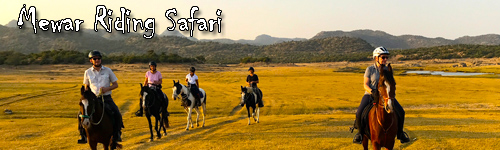
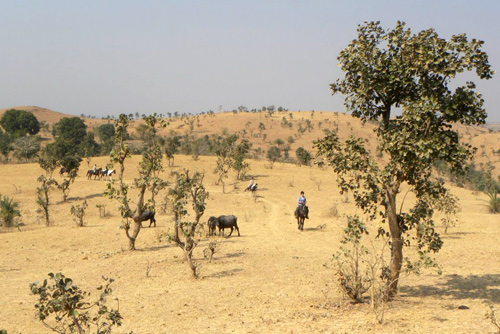
Our Mewar Riding Safari takes you over the plains of South-East Rajasthan, in an area known as Malwa. It is a paradise for riders with its soft level ground and wild savannah allowing for long trots, canters and gallops. It is a region of great fertility and rich soils thus the plain is dotted with villages, fields and farmsteads.
Starting from a little hamlet in the hills, where Nilgai antelopes, Cheetal deer and countless birds can be observed, the trail continues through rocky terrain down into the Malwa Plain, a region geographically belonging to Central India which is so fertile that even Opium is grown here. This is a part of Rajasthan undisturbed by tourism, thus unspoiled and still rather traditional in outlook and appearance. There are no big touristic sights but rather many undiscovered jewels to be visited by our riders.
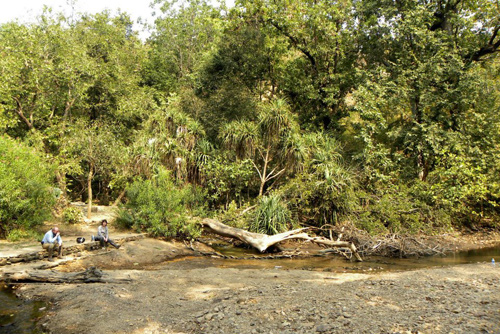
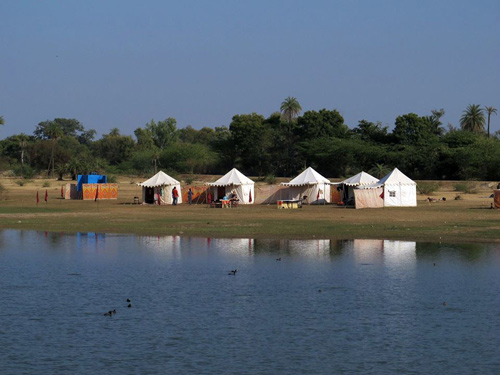
Due to the relative agricultural richness of this area, they will pass small palaces, old hill forts and beautiful adorned farmhouses. The riders will camp at the shore of two serene flat-water lakes (for 2 nights), a heaven for birds and animals. On this safari the riders will also discover the Sita-Mata Wildlife Sanctuary one of the last virgin forests of Rajasthan and home to many different animals from flying squirrels to leopards. Inside the forest we will visit the mythical warm springs of Sita Mata.
|
Camping Ride with vehicle support
Safari Ride
|
|
Meeting:
|
Udaipur
|
|
Airport:
|
Maharana Pratap Airport in Udaipur (UDR)
|
|
Transfer:
|
Udaipur airport or railway station
|
|
Riders:
|
Min
2 riders
Max
12 riders
(per riding group)
Max Capacity
16
|
|
Trip Brochure (PDF)  Trip Rating
 Video
Video
|
|
|
|
Rates include*:
Accommodations, All meals with non-alcoholic drinks, Transfers & Riding days according to program
Helmets, half-chaps, boots, breeches, gloves and seat savers available to lend.
| A | 2026 | 8 day trip | 8d / 7n | $2480 |
* prices are per person based on double/twin occupancy
Transfer and Other Charges:
|
2026
|
Round trip transfer from Udaipur is included
|
$0
|
|
2026
|
Single supplement
|
$175
|
|
2026
|
Extra night in Udaipur at Hotel Boheda or Boheda Villa -- please inquire
|
$0
|
Pick-up/ drop-off is available from Maharana Pratap Airport in Udaipur (UDR) or Udaipur railway station. We can sometime arrange transfers from bus stops or accommodations within the Old City of Udaipur at no extra cost.
This trip is available any time during the year (except for June) with a minimum of 2 riders.
|
Rates do not include:
Alcoholic beverages, Entrance fees, Gratuities & Optional extra excursions (Agra, New Delhi...)
Sample itinerary: 8-day tour - subject to changes
Day 1: Arrival in Udaipur
Arrival in Udaipur, we collect you from the airport/train station and bring you to a comfortable Haveli-style middle class hotel in Udaipur. If time permits you can go for a boat ride on Lake Pichola or visit the City Palace.
In the evening, safari briefing, dinner and overnight stay at Hotel Boheda Palace.
Meals included: Dinner
Overnight stay at Hotel Boheda Palace in Udaipur
Day 2: Udaipur Sightseeing & First Ride
After breakfast, visit the City Palace with a guide and go for a boat ride on Lake Pichola to visit the magical Jag Mandir Island Palace. In the afternoon go for a test ride to get to know the horses and guide.
Meals included: Breakfast, Lunch & Dinner
Overnight stay at Safari camp in Boheda
Day 3: Badwei to Boheda
Today, pick-up from your hotel in the morning and drive to Badwei Lake (around 1,5 hours driving time)
At the lakeside the horses will be already waiting for you. You start your ride through a countryside dotted with palm trees, fields and small villages. With some luck Nilgai antelopes can be spotted. You will cross the small railway line connecting Barisadri to Mauvi once a week with a steam engine. Around here, the villages are much richer than anywhere else in Rajasthan due to the rich soil. Most farmhouses sport richly ornamented entry gates and even the bullock carts are made of carved wood.
Long sandy country lanes are inviting for trots and canters. The horses enjoy the soft ground under their feet and keep going for miles and miles.
Mighty Mango trees grow along village paths flowering yellow and white in springtime and spending welcomed shade for horse and rider. Village wells are powered by a pair of oxen, slowly brining up buckets full of water for irrigating the fields.
Arrival in Boheda around 4 pm. Our safari camp is situated a little outside the village in the middle of fields dotted with palm trees and bushes.
Meals included: Breakfast, Lunch & Dinner
Overnight stay at Safari camp in Boheda
Day 4: Parsoligarh Ride
Another day ride through a fantastic countryside. The ride takes you along shaded country lanes through a few villages and alongside fields of chick peas, wheat or mustard. The countryside is flat and the ground allows for a speedy pace. Around late morning the riders will reach a more lonely and hilly area where the old ruined fort of Parsoligarh is located. Have lunch in the fort with enough time to enjoy the great views over the countryside and discover the remains of the fort.
Return to the plains in the afternoon and circle back to our camp in Boheda. We ride through a mix of farmland and wilder, open areas dotted with the typical Dhak trees and palms. With some luck we might spot Nilgai antelopes, mongoose or the ever-present peacocks. Arrival in Boheda in the afternoon and go for a village walk if you like or just rest and enjoy the beautiful sunset over the Malwa Plain.
Meals included: Breakfast, Lunch & Dinner
Overnight stay at Safari camp in Boheda
Day 5: Boheda to Mangalwad
Today's ride leads us over a large plain, sometimes dotted with fields and villages, sometimes arid and empty. The soft level ground invites for long canters and gallops over the plain. Again and again Nilgai antelopes can be spotted, resting in the shade or grazing on the dry grass.
Around late afternoon the riders reach the beautiful lake of Mangalwad where our safari camp is situated.
Meals included: Breakfast, Lunch & Dinner
Overnight stay in safari camp near Mangalwad Lake
Day 6: Shani Maharaj Temple Ride
We set out on another day ride through the open countryside of Malwa. We ride over the Palod dam and follow small country sand lanes across fields and villages and through the open steppes dotted with palm trees. Visit the interesting temple of Shani Maharaj and enjoy its colorful paintings. Lunch is held at a scenic spot in the shade of some trees where the horses can find some grass and the riders some rest. In the afternoon we circle back to Mangalwad and reach our camp in the afternoon.
Meals included: Breakfast, Lunch & Dinner
Overnight stay in safari camp near Mangalwad Lake
Day 7: Last Ride
We enjoy a last morning ride around Mangalwad, then transfer back to Udaipur. There is a chance to do some last-minute shopping or sightseeing.
Meals included: Breakfast, Lunch & Dinner
Overnight stay at Hotel Boheda Palace in Udaipur
Day 8: Departure day
After breakfast, transfer back to the airport.
Meals included: Breakfast
Meeting:
Udaipur
Airport:
Maharana Pratap Airport in Udaipur (UDR)
Train station:
Udaipur railway station
Transfer:
Udaipur airport or railway station
Distance:
25km
Pick-up/ drop-off is available from Maharana Pratap Airport in Udaipur (UDR) or Udaipur railway station. We can sometime arrange transfers from bus stops or accommodations within the Old City of Udaipur at no extra cost.
|
Tack:
|
|
English
|
|
Horses:
|
|
Marwari
|
|
Pace:
|
|
Long trots and canters, open stretches invite for gallops. 5-6 hours in the saddle per riding day
|
Walk |
Trot |
Canter |
Gallop |
|
|
Level:
|
|
 (3
to
3
out of 5) Intermediate
(3
to
3
out of 5) Intermediate
|
|
Riders:
|
|
Min
2 riders
|
Max
12 riders
(per riding group)
|
Max Capacity
16
|
 Daily Schedule
A normal safari day includes between 5 and 6 hours in the saddle plus a lunch break (lunch is either taken as a lunch packet or brought to the riders by our jeep) and several smaller breaks for sightseeing on the way or a tea stop in the little hamlet by the way.
Our Horses
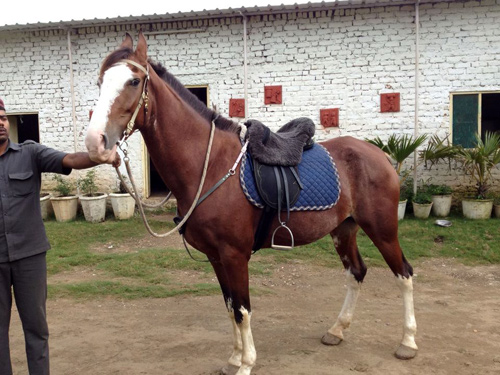
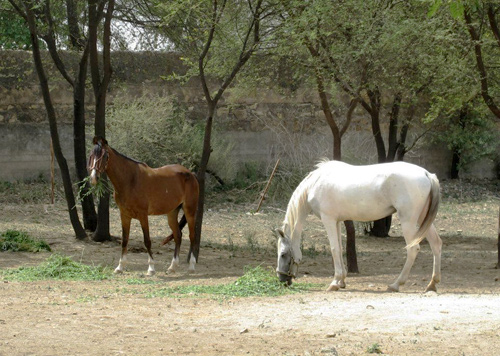
Nearly all the horses we use for safaris and trail riding are Marwari horses. This breed is native in Rajasthan and best suited for long rides in this region.
Our horses live in comfortable stables and paddocks and are left to roam free during the day on our farm. All our horses have been handpicked by us as we wanted to have only the best suited horses for our safari. As we have some foals every year, some of our riding horses were born in our stable and raised and trained by us. In fact, we are very proud that today we have a stable of finest Marwari horses fit for riding and breeding.
We believe in the principle of Natural Horsemanship which means that we keep our horses as natural as possible and train them according to NHS. Some of them are ridden with a hackamore, just a halter or even a simple neck rope. All are very well trained, obedient and a pleasure to ride. Our horses are cared for with love and affection. They are properly fed, vaccinated, de-wormed and shoed.
On the safaris we take only horses which are 100% fit and prepared. Already before the safari, we try to find a suitable horse for each rider according to riding skill and preference. Spare horses go along each trail in case another horse goes lame or one rider wants to change.
Tack & Riding Style
We have imported saddle tack for all our horses in order to maximize comfort for horse and rider.
The riding style is different to both English and Western. We offer lessons on the horses prior to the ride. A couple of extra days for pre-safari lessons may make your riding experience more enjoyable. Please let Hidden Trails know if you would like to book lessons before your ride.
Guides
The safari is run by a member of the oldest and most honored noble families of Udaipur, whose history is interwoven with horses for many centuries, and his German wife.
 Passport and Visa Requirements:
Passports Passport valid for at least 190 days required by all nationals referred to in the chart. Visas Required by all nationals referred to in the chart above. Note: Nationals not referred to in th. more
Udaipur area
|
Month
|
Jan
|
Feb
|
Mar
|
Apr
|
May
|
Jun
|
Jul
|
Aug
|
Sep
|
Oct
|
Nov
|
Dec
|
|
Average High Temperature (°F)
|
76
|
83
|
92
|
100
|
104
|
99
|
90
|
87
|
90
|
92
|
86
|
79
|
|
Average Low Temperature (°F)
|
49
|
54
|
63
|
73
|
81
|
81
|
78
|
76
|
74
|
67
|
59
|
51
|
|
Average High Temperature (°C)
|
24
|
28
|
34
|
38
|
40
|
37
|
32
|
31
|
32
|
33
|
30
|
26
|
|
Average Low Temperature (°C)
|
9
|
12
|
17
|
23
|
27
|
27
|
26
|
24
|
23
|
19
|
15
|
11
|
Source: NOAA
Seasons
The largest state in India, Rajasthan's climate can be divided into 4 seasons: summer, monsoon, post-monsoon and winter. Temperatures vary depending on the season and the region.
Summer (April to June)
Summers in Rajasthan are particularly hot with temperatures rising up to 48°C during the day. However, in places like Mount Abu, Kumbhalgarh or Ranakpur, the weather is pleasant and the views offered are breath-taking.
Monsoon season (July to September)
Monsoon is a far more pleasant experience, the temperatures tend to drop across the state and the rain showers transform the arid landscape of Rajasthan. It is a particularly good time to visit if you wish to avoid the crowds you'd usually find during peak tourist season.
Post Monsoon and Winter (October to March)
The temperatures continue to drop once the monsoon has passed, and come October winter sets in that lasts till March. During December and January, there can be a severe variation in temperatures during the day and the night. In fact, temperatures are known to drop as low as 0°C. This is the best time to visit Rajasthan as the desert sun is not as intense and the days are pleasant.
Your luggage will be transported by car, so you do not have to take everything with you on horseback. We do, however, recommend that you use lockable bags or suitcases. Princess Trails is not responsible for the loss of any valuables unless they are handed to us before the safari. For each item we will give you a receipt.
Each horse has two saddle bags, but your lunch packet and water bottles have to fit in before anything else can.
|
This list is only a guideline for you
|
|
|
|
Travel documents and Voucher
|
|
Flight tickets
|
|
Passport
|
|
Visa (check with your consulate)
|
|
|
|
RIDING GEAR
|
|
Riding breeches or comfortable jeans for the ride
|
|
Riding boots (short) + Minichaps
|
|
Riding helmet (recommended for all trips)
|
|
Riding gloves
|
|
Hat (with chin strip) for sun protection
|
|
Lightweight Rain coat
|
|
|
|
PERSONAL CLOTHING
|
|
Jacket or sweater for cool evenings
|
|
Comfortable T-Shirts/Shirts
|
|
Jeans
|
|
Shorts
|
|
Underwear and socks
|
|
Pyjama
|
|
Bag for dirty clothes
|
|
Swimsuit
|
|
|
|
ADDITIONAL THINGS TO BRING
|
|
Personal Toiletries
|
|
Small backpack or bag to carry with you on when you ride
|
|
Insect protection
|
|
Personal medications
|
|
Small flashlight
|
|
Handkerchiefs
|
|
Adapter for electric appliances
|
|
Camera and enough extra films and batteries
|
|
Sun hat and sun block
|
*Important Notice: The following ratings have been submitted by guests and do not necessarily represent the views of Hidden Trails, its partners or employees.
Every care is taken to ensure accuracy but Hidden Trails is not liable for any errors or omissions.
** No trip reports found
with the tour ID you provided.
|
..view other reports for different trips
Accommodations
This is a wilderness ride, so nights will be spent in a combination of hotels and camps. You will spend 3 nights in hotels and 4 nights in tents.
Description
Accommodation during the riding portion of the tour (in most cases) will be in a safari camp. The reason for this is that many of our routes lead through scarcely populated areas away from the usual tourist paths. Very often the night has to be spent in the nature away from human dwellings.
Accommodation Itinerary for 8-day tour - subject to changes based on availability
Night 1 & 2: Hotel Boheda Palace in Udaipur
Night 3 & 4: Camp near Boheda
Night 5 & 6: Camping near Mangalwad Lake
Night 7: Hotel Boheda Palace in Udaipur
Hotel Boheda Palace in Udaipur
This small hotel has been classified as an heritage building thanks to its traditional architecture. Each of the 16 rooms all come equipped with a TV, air conditioning, private facilities and free Wi-Fi access. The hotel’s most appreciated feature is without doubt its rooftop terrace offering panoramic views over the city. There are laundry facilities onsite (extra charge).
Camps
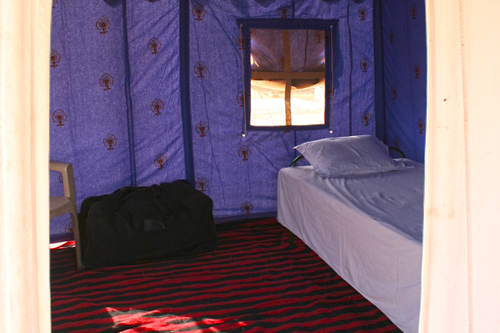
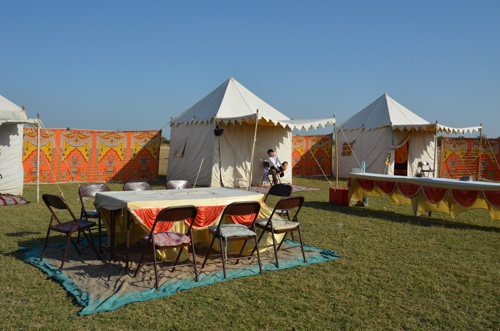
Our campsites are chosen with great care and offer a maximum safety and superb views. Away from the busy Indian towns or villages, they are a paradise for nature lovers and birdwatchers. The camp offers all necessary facilities to the riders. The tents are comfortable and inviting Indian hunting tents with high ceilings, double or single occupancy. The tents are made in the traditional Indian style with a roofed entrance where the riders can leave their shoes. Each tent is equipped with mattresses, sheets, pillow, cushion, quilts, and woolen blankets. The camp has bathroom trolleys with two showers (bucket shower with hot water) and toilets. Hot water is provided in buckets. Towels, soaps, etc. are supplied. Grouped around the dining area, they are encircled by a partition enclosure of cloth with a colorful Rajasthan pattern.
As of 2023, the camp in Mangalwad has a proper bathroom with a toilet and shower.
As of 2023, the camp in Boheda has a hut with kitchen (with electric plugs) that can serve has shelter in case of heavy rain.
 Meals
Meals
All meals are included from dinner on Day 1 to breakfast on the last.
Breakfast is Continental style with fruits of the season, eggs, and toast.
Lunch will be either taken as package on the trail or brought to you by Jeep.
Dinner is a traditional 3-course menu of Indian food (non-spicy).
Alcoholic beverages are not included but alcohol can be purchased (not expensive) or brought. Beer, wine (Indian), whiskey, rum, gin and vodka are available.
Dietary Restrictions
We can cater to most dietary restrictions with prior notice.
This trip
can accommodate special dietary requests.
|
Tack:
|
|
English
|
|
Horses:
|
|
Marwari
|
|
Pace:
|
|
Long trots and canters, open stretches invite for gallops. 5-6 hours in the saddle per riding day
|
Walk |
Trot |
Canter |
Gallop |
|
|
Level:
|
|
(3
to
3
out of 5) Intermediate
|
|
Riders:
|
|
Min
2 riders
|
Max
12 riders
(per riding group)
|
Max Capacity
16
|
Daily Schedule
A normal safari day includes between 5 and 6 hours in the saddle plus a lunch break (lunch is either taken as a lunch packet or brought to the riders by our jeep) and several smaller breaks for sightseeing on the way or a tea stop in the little hamlet by the way.
Our Horses
Nearly all the horses we use for safaris and trail riding are Marwari horses. This breed is native in Rajasthan and best suited for long rides in this region.
Our horses live in comfortable stables and paddocks and are left to roam free during the day on our farm. All our horses have been handpicked by us as we wanted to have only the best suited horses for our safari. As we have some foals every year, some of our riding horses were born in our stable and raised and trained by us. In fact, we are very proud that today we have a stable of finest Marwari horses fit for riding and breeding.
We believe in the principle of Natural Horsemanship which means that we keep our horses as natural as possible and train them according to NHS. Some of them are ridden with a hackamore, just a halter or even a simple neck rope. All are very well trained, obedient and a pleasure to ride. Our horses are cared for with love and affection. They are properly fed, vaccinated, de-wormed and shoed.
On the safaris we take only horses which are 100% fit and prepared. Already before the safari, we try to find a suitable horse for each rider according to riding skill and preference. Spare horses go along each trail in case another horse goes lame or one rider wants to change.
Tack & Riding Style
We have imported saddle tack for all our horses in order to maximize comfort for horse and rider.
The riding style is different to both English and Western. We offer lessons on the horses prior to the ride. A couple of extra days for pre-safari lessons may make your riding experience more enjoyable. Please let Hidden Trails know if you would like to book lessons before your ride.
Guides
The safari is run by a member of the oldest and most honored noble families of Udaipur, whose history is interwoven with horses for many centuries, and his German wife.
Passports
Passport valid for at least 190 days required by all nationals referred to in the chart.
Visas
Required by all nationals referred to in the chart above.
Note: Nationals not referred to in the chart above are advised to contact the embassy to check visa requirements.
Visa Note
Certain parts of the country have been designated protected or restricted areas that require special permits and in some cases prior government authorisation. Intent to visit a specific restricted region should be indicated when applying for a visa and a permit will be granted to visit that region only. An additional form must be completed. Passengers are advised to check with the tourist board for up-to-date information before departure.
Types of Visa and Cost
Tourist visa: £30 (multiple-entry; six months); £50 (multiple-entry; one year). Business visa: £105 (one year); £160 (more than one year). Transit: £8 (single/double-entry). Prices for certain other nationals vary, nationals are advised to contact the embassy to check cost.
Validity
Tourist: six months or one year for multiple entry. Transit: maximum stays of 15 days within three months. Business: three or six months, or up to two years for multiple entry.
Applications to:
Embassy or high commission (or consular section at embassy or high commission); see Contact Addresses. There are also Indian Visa Application Centres in London, Birmingham and Edinburgh.
Working Days Required
Personal applications can normally be processed the same day. Applications made at the visa centres will take at least 2-3 working days. Postal applications take a minimum of 10 working days. Where referrals are required, applications may require 20-25 working days.
| Passport Required? |
| British |
Yes |
| Australian |
Yes |
| Canadian |
Yes |
| USA |
Yes |
| Other EU |
Yes |
| Visa Required? |
| British |
Yes |
| Australian |
Yes |
| Canadian |
Yes |
| USA |
Yes |
| Other EU |
Yes |
| Return Ticket Required? |
| British |
No |
| Australian |
No |
| Canadian |
No |
| USA |
No |
| Other EU |
No |
This information is not being updated on a regular basis. Hidden Trails does not
take any responsibility for the accuracy of the above information. Please, consult
the embassy or consulate for updated info.
|

|
|
|
Mewar Riding Safari in Rajasthan
Tour Code:
IT-INRT02
8 days /
7 nights
Dates :
Available all Year except June
Difficulty :

Riding Level Explained | A | Beginner
 | Beginner A rider who has limited experience, is unable to post the trot and does not canter. | | B | Novice
 | Novice A rider who is capable of mounting and dismounting unassisted, capable of
applying basic aids, comfortable and in control at the walk, moderate length posting
trots, and short canters. | | C | Intermediate
 | Intermediate A rider who has a firm seat, is confident and in control at all paces
(including posting trots, two point canters and gallops), but does not ride regularly. |
| D | Strong Intermediate
 | Strong Intermediate An intermediate rider who is currently riding regularly and is comfortable in the saddle for at least 6 hours per day. | | E | Advanced
 | All of the above, plus an independent seat, soft hands, and capable of handlinga spirited horse in open country. |

|