|
|
|
|
|
Kilimanjaro Classic Ride
Tanzania
Tanzania
Special Offer Available!!
Tanzania is a country famous for its wildlife and scenery - and for good reason.
Our route takes us
close to the base of Mt. Kilimanjaro with spectacular views of the mountain and
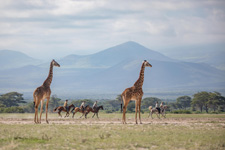
the surrounding landscape. The riding area is unfenced and game moves through
the area freely. You can expect to see a variety of animals including zebra,
wildebeest, giraffe, Thompson's and Grant's gazelle, gerenuk, jackal and others.
We often encounter sizeable herds of elephant and may be lucky to find some of
the bigger cats and other predators. Other species often seen include eland,
oryx, lesser kudu and hyena. The local tribe, the Maasai, contribute to the ride
by adding a splash of colour and provide an insight into the cultural diversity
of Tanzania. This ride takes place away from other tourist attractions in little
visited wilderness. It is unlikely you will meet other travellers during any of
our rides. Passing through Maasailand at the very base of Mt. Kilimanjaro, the
area has some of East Africa's most spectacular scenery, surrounded by 5895m
high Kilimanjaro to the east, 4660m high Meru to the South, the rugged but
beautiful Longido to the North and the Rift Valley volcanoes, Kitumbeine and
Gelai to the west.
A relatively fast pace
makes this an exciting safari for riders interested in a mixture of game
viewing, beautiful semi-arid African bush, a wide variety of birds and good
quality horses. The ride passes through unfenced communal pastoral lands and
some abandoned cattle ranches dating back to colonial days. Areas include, Lake
Natron Game Controlled Area, Longido Game Controlled Area and Ngasurai Open Area
as well as Ndarakwai Ranch on West Kilimanjaro and the newly established
Enduimet Wildlife Management Area.
Game encounters are
varied, with good numbers of Zebra, Grant's and Thompson's gazelle and Giraffe
throughout the ride. Seen in lesser numbers is a large variety of game including
the elusive Lesser Kudu and Oryx antelopes, only found in this semi-arid area as
well as the elegant Gerenuk or Giraffe-neck gazelle which lives off browsing the
leaves of bushes and trees.
In the portion of the
ride that passes closest to Kilimanjaro, encounters with elephant are common as
are sizeable herds of Eland, wildebeest and other game including baboon, vervet
monkey, water-buck, warthog and impala - often all visible at the same moment.
|
Meeting:
|
Farm
|
|
Airport:
|
Kilimanjaro
|
|
Transfer:
|
Kilimanjaro Airport or Arusha town
|
|
Riders:
|
Min
5 riders
Max
12 riders
|
|
Trip Rating
Travel Stories
|
|
|
|
Rates and Dates for 2010
Special Offer: $500 discount for 2010 trips Limited Time Offer
Rates include:
Accommodations - 2 nights at farm - 6 nights camping, all meals with drinks, 7 riding days
| A | 2010 | 9 day trip, AP | 9d / 8n | $3520 |
| Non Rider Rate | $2360 |
| Government Fee | $350 |
Minimum Deposit:
~$1,250.00
per person
Transfer Option:
|
2010
|
Transfer from Kilimanjaro Airport per car, Return
This is a "Group Rate" - to be paid locally
|
$120
|
|
2010
|
Transfer from Arusha town per car, Return
This is a "Group Rate" - to be paid locally
|
$75
|
Tour Dates
Check here for details and availability
|
| A |
2010
|
01/24
- 02/01
|
9d / 8n
|
9 day trip, AP
|
5
/12
|
Expired
|
| A |
2010
|
02/21
- 03/01
|
9d / 8n
|
9 day trip, AP
|
5
/12
|
Expired
|
| A |
2010
|
04/04
- 04/12
|
9d / 8n
|
9 day trip, AP
|
5
/12
|
Reserve
|
| A |
2010
|
05/02
- 05/10
|
9d / 8n
|
9 day trip, AP
|
5
/12
|
Reserve
|
| A |
2010
|
06/06
- 06/14
|
9d / 8n
|
9 day trip, AP
|
5
/12
|
Reserve
|
| A |
2010
|
07/04
- 07/12
|
9d / 8n
|
9 day trip, AP
|
5
/12
|
Reserve
|
| A |
2010
|
08/01
- 08/09
|
9d / 8n
|
9 day trip, AP
|
5
/12
|
Reserve
|
| A |
2010
|
08/29
- 09/06
|
9d / 8n
|
9 day trip, AP
|
5
/12
|
Reserve
|
| A |
2010
|
09/26
- 10/04
|
9d / 8n
|
9 day trip, AP
|
5
/12
|
Reserve
|
| A |
2010
|
10/24
- 11/01
|
9d / 8n
|
9 day trip, AP
|
5
/12
|
Reserve
|
| A |
2010
|
11/21
- 11/29
|
9d / 8n
|
9 day trip, AP
|
5
/12
|
Reserve
|
| A |
2010
|
12/27
- 01/04
|
9d / 8n
|
9 day trip, AP
|
5
/12
|
Reserve
|
|
|
Rates do not include:
Travel insurance and emergency evacuation coverage - mandatory. Gratuities, Government Fees. Laundry service is not available.
Airport Departue Taxes
Day 1 - Transfer/trying out horses
Arrival at the farm, 20 miles north of Arusha in Tanzania. Meet your guides and
support crew. Try and select your horse and tack. Afternoon tea and sundowners
on the veranda, followed by dinner in the Cape Dutch style farmhouse. Overnight
at the farm
Day 2 - Bush ride to Twin Hills camp
Set off in the morning, passing local settlements of the mwa-arush tribe with
their well-built mud and thatch huts. Mid morning, we emerge onto the open
plains. The pace is varied to allow for changing terrain and to allow riders to
find their rhythm. Lunch in the shade of acacia trees. After lunch, continue
north towards our twin hills camp. The country changes and becomes covered with
bush. Good prospects for encountering gerenuk, giraffe, oryx and of course the
more common game such as Zebra, Grants and Thompson's gazelle. Arrival in camp
late afternoon. Today’s pace is relatively slow due to uneven terrain. Safari
Camp
Day 3 - Head east to Ngasurai Plains
Set off from Twin Hills camp towards Oryx hill where lunch will be waiting. We
pass numerous rocky outcrops where we might find Lesser Kudu and Hyrax. We
follow a flood plain to the east heading directly towards Mt. Kilimanjaro. On a
clear day, the mountain will be in front of us. After lunch, head northeast with
good canters across open ground to arrive at our camp at the edge of Ngasurai
Plains with spectacular views of Kilimanjaro on a clear day. Safari Camp
Day 3 – Explore Longido Game Controlled Area and the
Ngasurai Plains
We ride in the Ngasurai and Longido Controlled Area over good ground with ample
opportunities for canters and generally good game viewing. Our route for the day
will follow a circular path, with lunch away from camp, either closer to Longido
Mountain or if conditions allow – up into the Sinya area near the Kenya border.
Depending on the local conditions, we either return to our Ngasurai Camp or move
to a new location for the evening. Safari Camp
Day 5 - Elephant country
Cross the Ngasurai plains heading late in the morning into the edge of dense
woodland frequented by elephant. Lunch at the edge of the dense woodland under
shady acacia trees. After our siesta we ride through nearly impenetrable bush.
The strong smell of elephant confirms their presence in the thickets although
the thicket provides good cover in which to hide. During the afternoon, we ride
up the lower slopes of Mt. Kilimanjaro to Ndarakwai Ranch - a colonial cattle
ranch that now exists purely as a wildlife protection area. Here we are most
likely to encounter our first elephant and numerous other species of game. Camp
at the edge of a hill with views across the area where we have ridden so far.
Safari Camp
Day 6 - Rest day
On this day, camp remains on location at Ndarakwai Ranch. Riding is optional. We
schedule a 1/2 day of riding for the afternoon for those interested. The area
lends itself to walks for those who do not wish to remain in camp. Nearby hills
provide a great view of the area and an opportunity for spotting game with a
good pair of binoculars. For those choosing not to ride, game viewing by Land
Rover is an option. Equestrian Safaris Camp
Day 7 - Head back
Start heading back to Uto Farm. Camp will be mid way between Ndarakwai on West
Kilimanjaro and Uto Farm on the west side of Mt. Meru. The ride takes us through
village lands and across the often dry, Ngare Nanyuki River, but most of the
ride passes through open country. Camp at the edge of open plains. Equestrian
Safaris Camp
Day 8 - Back to the farm
Ride back to the farm arriving late afternoon. The ride takes us back to our
starting point as we head up through the Oldonyo Sambu village. Untack your
horse and watch them delight in their return to green pastures again. Overnight
at the farm.
Day 9
After breakfast transfer to the airport in Arusha or Nairobi.
The itinerary subject to change
without notice if necessary
Meeting:
Farm
Airport:
Kilimanjaro
Transfer:
Kilimanjaro Airport or Arusha town
Distance:
40 miles
|
Tack:
|
|
English
|
|
Horses:
|
|
Thoroughbred and Anglo Arab
|
|
Pace:
|
|
About 6 hours in the saddle per day. Do not overestimate your own riding ability - this is a 250km ride which requires experience in riding English with extended trots and a good number of canters.
|
Walk |
Trot |
Canter |
|
|
Level:
|
|
(3.5
to
4
out of 5) Strong Intermediate
|
|
Age:
|
|
Min
14
|
Max
70
|
|
Weight:
|
|
Max
200 lbs
|
|
Riders:
|
|
Min
5 riders
|
Max
12 riders
|
|
This is an exciting and
scenic 7-day bush ride covering some 225 km aimed at intermediate to experienced
riders accustomed to English tack. You will ride between Mt. Meru to the south,
Lake Natron game controlled area to the west, Mt. Kilimanjaro to the East and
the Kenya border and Amboseli National Park to the North. The ride follows a
circuit starting and ending at Uto Farm. We ride about 3 hours during the
morning, break for lunch and siesta during the heat of the day, and then ride
another 2 to 3 hours in the afternoon. Distance covered averages 30 to 40 km per
day depending on the speed of the group. Each evening when you arrive at camp
there is a campfire ready and your tents are set up with your gear inside; all
you have to do is tie your horse to the picket line and make sure it gets a
bucket of water. One rest day is included in the itinerary.
The horses are mostly
thoroughbreds. Riders should expect to spend on average 6 hours per day in the
saddle and be capable of controlling their horse at a trot and a canter.
During the months of
July through November, riders should expect to get dusty as this is the dry
period, with most of the trees without leaves - but also spectacularly
beautiful. Riders during December to June can expect some rain, but also a
landscape transformed to brilliant green, teeming with life - a very different
ride from that during the dry season.
Please note
Riders who do not meet the required riding standard or who pose a risk to themselves and/or other riders may be asked to sit out the ride and continue in the support vehicle.
Passport and Visa Requirements:
Passport valid for at least six months required by all nationals referred to in the chart.Required by all nationals referred to in the chart above except: 1. nationals of Cyprus and Malta for stays of. more
The climate is reversed from that of the Northern hemisphere. The summer months of December through February (equivalent to July and August in the North) are generally pleasantly hot, although rain can be expected at anytime. Temperatures vary greatly according to the weather, with daytime highs ranging from 15°C into the 30°'s centigrade, and overnight lows in the 10°'s C or 20°'s centigrade. Winter months correspond to June through August when the weather is very dry and dusty, and temperatures are cool to cold (10°C to 20°C). After the rains (April-May and November) the land is green and full of flowers, the dry season can be very dusty but it is often the best time to see game. The altitude in the riding areas is from 1100 to 2000 meters above sea level.
|
… this list is only a guideline for you |
|
|
X = Necessary |
Check List |
|
Travel documents and Voucher |
X |
|
|
Flight tickets |
X |
|
|
Passport |
X |
|
|
Visa (check with your consulate) |
|
|
|
|
|
RIDING GEAR |
|
Riding pants or Jodhpurs (used if possible!) |
X |
|
|
Riding boots or short boots and + Minichaps |
X |
|
|
Riding helmet (recommended for all trips) |
X |
|
|
Riding gloves |
X |
|
|
Wide-brim hat & scarf for sun protection |
X |
|
|
Lightweight Rain coat |
X |
|
|
|
|
PERSONAL CLOTHING |
|
Jacket or sweater for cool evenings |
X |
|
|
Long sleeve cotton shirts |
X |
|
|
Jeans |
X |
|
|
Shorts |
X |
|
|
Underwear and socks |
X |
|
|
Pyjama |
X |
|
|
Bag for dirty clothes |
X |
|
|
Trekking boots/ comfortable shoes |
X |
|
|
Swimsuit |
X |
|
|
|
|
For Camping trips: |
|
Sleeping Bag (we provide or bring your own) |
|
|
|
Ground Mat (supplied) |
|
|
|
Towel (supplied) |
|
|
|
Small pillow (supplied) |
|
|
|
|
|
|
|
ADDITIONAL THINGS TO BRING |
|
Personal Toiletries |
X |
|
|
Insect protection |
X |
|
|
Personal medications |
X |
|
|
Sore cream (for the emergency) |
X |
|
|
Sewing kit |
X |
|
|
Handkerchiefs |
X |
|
|
Rehydration salts |
X |
|
|
Camera and enough extra films and batteries |
X |
|
|
Malaria pills |
X |
|
|
Biodegradable soap and shampoo |
X |
|
|
Sun glasses with strap |
X |
|
|
Sun tan lotion and lip balm |
X |
|
It is easiest to travel on safari packing two bags; one containing clothing and equipment to change/use in the evenings at camp, and another smaller bag for items needed during the lunch stops - camera, sunscreen, scarf, raincoat and such.
You will want something comfortable to change into at the end of a long day's riding. Jeans and a cotton T-shirt will be fine for hot afternoons, but evenings are chilly and you are advised to bring a sweater and a wind & waterproof jacket. Be aware that you may not have the chance to wash anything out. But don't burden yourself with too many changes of clothing. Grin and bear it, and you'll have more fun. For footwear a pair of light hiking boots are an excellent choice in addition to your riding shoes/boots. Proper head gear is another important item. A wide-brimmed hat is a good choice. Just be sure it has a chin strap, as lunging for a flying hat is almost guaranteed to land you in the dust. Bring along a good pair of sunglasses, which should also have a strap. A pair of riding gloves is a good investment, both to avoid blisters while riding and as protection against the sun.
We do carry a comprehensive medical kit that will suffice for normal first aid. In case of accidents we evacuate to Arusha. If you use any special medication be sure to bring along enough to last the holiday.
NOTE: there is no possibility of shopping during the rides which take place in remote locations. Also we sometimes get people asking if they can recharge their digital cameras etc., generally this is not possible unless you can bring some kind of adapter that will connect to the 12v batteries in our vehicles. So you need to bring enough batteries, film etc. for the duration. Naturally you can charge your appliances before and after the rides at the base house.
Sorry, no video is currently available for this tour.
*Important Notice: The following ratings have been submitted by guests and do not necessarily represent the views of Hidden Trails, its partners or employees.
Every care is taken to ensure accuracy but Hidden Trails is not liable for any errors or omissions.
| |
| Name |  |  |  |  |  |  | Date |
|
johanne bournival
|
|
|
|
|
|
|
11/16/2007
|
|
..view other reports for different trips
Meals
Our cook conjures up a variety of mouth-watering dishes over the open fire. Most of these are based on a meat diet, but we cater to vegetarians when given due notification. We fully believe that neither lunch nor dinner - is complete without a good glass of wine or beer. For those who don't agree, Equestrian provides juice, coffee, tea, and filtered water. Other beverages include soft drinks and a selection of spirits. Lunch is transported by Landrover and laid out in the shade of a tree ahead of the guests' arrival. Camp chairs and siesta mats are provided at each lunch stop. The lunch vehicle has space to accommodate any light baggage riders may wish to use during the stop, such as toiletries and cameras.
Farm
Located on the slopes of Mt. Meru at an altitude of 2000 meters (6000 ft), the farm is a 500 acre working dairy farm. The only fixed accommodation on these trips are the guest bungalows at Uto Farm which have been converted from various farm outbuildings. They are simple, but clean and comfortable, based on double and triple occupancy.
The farm caters only to clients participating in our riding excursions.
With clear cool days and nights, the farm has excellent views over the rift valley and surrounding mountains. Guests should expect farm work to go on around them. Meals are prepared and served in the main farm house.
The Camps
We operate a light-weight mobile camp which is moved on a daily basis. The tented fly camps, exclusive to our own group of guests, are comfortable with as many amenities as can be provided considering that the location is changed every day, and that we try to limit ecological disturbance by taking only the number of support vehicles strictly necessary. All equipment is transported in a 4x4 Bedford truck and support landrovers which also carry food and water for the horses. As we bring all water along on safari for the horses, for cooking, and for bathing; this means that water is limited, but usually is enough for a splash in the morning and a warm shower at night. Since space is at a premium, unnecessary luxuries are dispensed with and the focus is on comfort, good food and plenty of drinks.
The canvas tents are comfortable 2 man A-frame tents with foam mattresses, sleeping bags, pillows and towels.You may provide your own sleeping bag if you wish.
• Water is limited to the 4,500 l carried for all purposes for the entire trip by our camp lorry
Meals
Our cook conjures up a variety of mouth-watering dishes over the open fire. Most of these are based on a meat diet, but we cater to vegetarians when given due notification. We fully believe that neither lunch nor dinner - is complete without a good glass of wine or beer. For those who don't agree, Equestrian provides juice, coffee, tea, and filtered water. Other beverages include soft drinks and a selection of spirits. Lunch is transported by Landrover and laid out in the shade of a tree ahead of the guests' arrival. Camp chairs and siesta mats are provided at each lunch stop. The lunch vehicle has space to accommodate any light baggage riders may wish to use during the stop, such as toiletries and cameras.
Highlights
Simple and comfortable
Camps set up in advance ahead of clients
Open-air showers with a view
Relaxed atmosphere
Excellent food
This trip includes
some wine with dinner
and can accommodate special dietary requests.
This is an exciting and
scenic 7-day bush ride covering some 225 km aimed at intermediate to experienced
riders accustomed to English tack. You will ride between Mt. Meru to the south,
Lake Natron game controlled area to the west, Mt. Kilimanjaro to the East and
the Kenya border and Amboseli National Park to the North. The ride follows a
circuit starting and ending at Uto Farm. We ride about 3 hours during the
morning, break for lunch and siesta during the heat of the day, and then ride
another 2 to 3 hours in the afternoon. Distance covered averages 30 to 40 km per
day depending on the speed of the group. Each evening when you arrive at camp
there is a campfire ready and your tents are set up with your gear inside; all
you have to do is tie your horse to the picket line and make sure it gets a
bucket of water. One rest day is included in the itinerary.
The horses are mostly
thoroughbreds. Riders should expect to spend on average 6 hours per day in the
saddle and be capable of controlling their horse at a trot and a canter.
During the months of
July through November, riders should expect to get dusty as this is the dry
period, with most of the trees without leaves - but also spectacularly
beautiful. Riders during December to June can expect some rain, but also a
landscape transformed to brilliant green, teeming with life - a very different
ride from that during the dry season.
Please note
Riders who do not meet the required riding standard or who pose a risk to themselves and/or other riders may be asked to sit out the ride and continue in the support vehicle.
|
Tack:
|
|
English
|
|
Horses:
|
|
Thoroughbred and Anglo Arab
|
|
Pace:
|
|
About 6 hours in the saddle per day. Do not overestimate your own riding ability - this is a 250km ride which requires experience in riding English with extended trots and a good number of canters.
|
Walk |
Trot |
Canter |
|
|
Level:
|
|
(3.5
to
4
out of 5) Strong Intermediate
|
|
Age:
|
|
Min
14
|
Max
70
|
|
Weight:
|
|
Max
200 lbs
|
|
Riders:
|
|
Min
5 riders
|
Max
12 riders
|
|
This is an exciting and
scenic 7-day bush ride covering some 225 km aimed at intermediate to experienced
riders accustomed to English tack. You will ride between Mt. Meru to the south,
Lake Natron game controlled area to the west, Mt. Kilimanjaro to the East and
the Kenya border and Amboseli National Park to the North. The ride follows a
circuit starting and ending at Uto Farm. We ride about 3 hours during the
morning, break for lunch and siesta during the heat of the day, and then ride
another 2 to 3 hours in the afternoon. Distance covered averages 30 to 40 km per
day depending on the speed of the group. Each evening when you arrive at camp
there is a campfire ready and your tents are set up with your gear inside; all
you have to do is tie your horse to the picket line and make sure it gets a
bucket of water. One rest day is included in the itinerary.
The horses are mostly
thoroughbreds. Riders should expect to spend on average 6 hours per day in the
saddle and be capable of controlling their horse at a trot and a canter.
During the months of
July through November, riders should expect to get dusty as this is the dry
period, with most of the trees without leaves - but also spectacularly
beautiful. Riders during December to June can expect some rain, but also a
landscape transformed to brilliant green, teeming with life - a very different
ride from that during the dry season.
Please note
Riders who do not meet the required riding standard or who pose a risk to themselves and/or other riders may be asked to sit out the ride and continue in the support vehicle.
Passports
Passport valid for at least six months required by all nationals referred to in the chart.
Visas
Required by all nationals referred to in the chart above except:
1. nationals of Cyprus and Malta for stays of up to three months and issued with a visitor's pass on arrival, but may still need entry permit clearance. It is possible for British nationals to obtain a tourist visa for single entry at any one of the main port of entries to Tanzania, subject to the fulfillment of all immigration requirements. All other visitors must obtain visa prior to travelling to Tanzania.
Visa Note
(a) The high commission does not issue multiple entry visas for tourist or business purposes. All multiple entry visas should be applied for at the Immigration Head Office in Dar es Salaam through your host. (b) Nationals not referred to in the chart above are advised to contact the embassy or high commission to check visa requirements (see Contact Addresses).
Types of Visa and Cost
£38 per single-entry (prices are for application at high commission in London). US visas: US$100 (single or double-entry, six months); US$120 (express service).
Validity
Tourist single-entry: three months from date of issue; Business single-entry: two months.
Applications to:
Consulate (or consular section at high commission or embassy); see Contact Addresses.
Working Days Required
Normally three. Up to 10 for postal applications. 24-hour service is available at an extra charge of £5.
| Passport Required? |
| British |
Yes |
| Australian |
Yes |
| Canadian |
Yes |
| USA |
Yes |
| Other EU |
Yes |
| Visa Required? |
| British |
Yes |
| Australian |
Yes |
| Canadian |
Yes |
| USA |
Yes |
| Other EU |
Yes/1 |
| Return Ticket Required? |
| British |
Yes |
| Australian |
Yes |
| Canadian |
Yes |
| USA |
Yes |
| Other EU |
Yes |
This information is not being updated on a regular basis. Hidden Trails does not
take any responsibility for the accuracy of the above information. Please, consult
the embassy or consulate for updated info.
|
|
|
|
Kilimanjaro Classic Ride
Tour Code:
IT-TZRT01
9 days /
8 nights
~$3,520.00
Dates :
Available all Year
Trip Rating :
Difficulty :
Lodging:
Introduction
Day to Day Itinerary
Rates | Dates
Accomodation
Tack:
English
Horses:
Thoroughbred and Anglo Arab
Pace:
About 6 hours in the saddle per day. D...
Walk,
Trot,
Canter,
Airport:
Kilimanjaro
Location on Google Map
Image Gallery
Image Slide Show
Customer Trip Rating
Climate
What To Bring
Travel Stories
|