|
|

|
|
|
|
Horseback riding vacations in
Ecuador
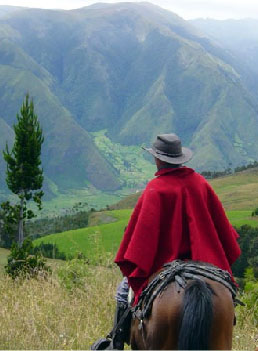
Ecuador is a country of boundless diversity, friendly people, and spectacular natural wonders. Ecuador is bursting with tropical color, whether it is the vibrant wild orchids, rainbow-hued toucans, indigenous costumes, or the multi-colored butterflies. Horse riding in Ecuador is a time to immerse yourself in the sights, sounds, colors, rainforests, volcanoes, and ancient Inca trails. Ecuador is also a time to lounge in the quiet ambience of a colonial hacienda. Our Ecuadorian horse riding holidays offer a taste of Ecuador quite unlike anything else.
Horse Riding in Ecuador
Horseback riding from one geographic area to another exposes Ecuador’s exciting ethnic diversity. The country has the second-highest percentage of indigenous people in South America, with over a dozen distinct ethnic and language groups. On our horseback vacations, you will visit Indian markets and festivities, walk in the colonial streets of Quito (declared UNESCO cultural heritage sights), relax at a hacienda, or admire the wildlife in the Galapagos Islands or the Amazon.
Hidden Trails has numerous horseback riding vacations in Ecuador. The Colonial Hacienda Trail and the Otavalo Ride, base themselves at beautiful colonial era haciendas (farm estates), and follow in the footsteps of the earliest Spanish settlers. On the Volcano Avenue Ride and the Cotopaxi Adventure Ride you will witness some of Ecuador’s finest volcanoes (including Cotopaxi Volcano). The Hacienda Primavera Ride is a wilderness horseback ride, based at an eco-lodge in the stunning El Choco rainforest.
Ecuador Weather and Climate
The coast is hot all year, with a humid rainy season between December and May. In the mountains climate depends on altitude, becoming cooler the higher you go. The Amazon region is hot, humid and wet while the Galapagos Islands are dry with a steady year-round average temperature of 77ºF (25ºC).
Explore more South America Horse Riding Holidays
|
|
Holidays on horseback in Ecuador
See Mini Country Guide
|
Below is a list of our trips in this area with video clips.
 Click on the 'watch video' icon

to view a video clip,
Horseback in Ecuador at Hacienda Alegria

|
Join us for a few days or a whole week on this Ecuadorian hacienda - on a very special riding holiday. It is a family-run organic farm in the heart of Ecuador's "Avenue of the Volcanoes", just one hour south of the historic colonial city of Quito, the capital of Ecuador.
|

Trip Details
|
|
Ecuador
Travel restrictions
Ecuador approved resumption of commercial flight operations beginning June 1st, 2020, with limited flight capacity.
Ecuador eliminated its COVID-19 entry requirements effective October 20th 2022. International travelers are no longer required to present COVID-19 vaccination cards or proof of a negative COVID-19 test prior to entering Ecuador.
Travelers to the Galapagos are still required to present a “transit control card” issued by the Government of Galapagos. Guidance on registering for a “transit control card” is available here: https://www.gobiernogalapagos.gob.ec/step-by-step-tct-online/.
Ecuador’s Ministry of Public Health has discontinued its practice of performing random COVID-19 testing to international travelers upon arrival. However, if airlines or airport staff observe a traveler with symptoms, that traveler may be referred to the Ministry of Public Health for testing.
Ecuador’s Ministry of Public Health no longer requires international travelers that test positive for COVID-19 to quarantine in hotels or private accommodations. If you test positive for COVID-19 while in Ecuador, the Ministry of Public Health recommends you isolate for five days and then wear a mask in public spaces while you continue to exhibit symptoms.
Measures taken by the government
Ecuador’s Emergency Operations Committee eliminated the nationwide mask requirement for indoor spaces on February 7th 2023. Masks are now voluntary in indoor and outdoor spaces.
The Government of Ecuador provides coronavirus-related information at this website (Spanish only): https://www.coronavirusecuador.com.
Please see https://www.gestionderiesgos.gob.ec/coe-nacional/ (Spanish only) for general information regarding restrictions and https://www.gestionderiesgos.gob.ec/resoluciones-coe/ (Spanish only) for specific resolutions for the most up to date information regarding curfew times and other restrictions.
Testing
A list of laboratories licensed to perform RT-PCR and rapid antigen tests is available on the website maintained by Ecuador’s Medical Services and Prepaid Medicine Quality Assurance Agency (ACESS). The Ministry of Public Health signed a ministerial agreement on April 20, 2021, which fixed the price of RT-PCR tests at $45. More information is available at this link: https://www.salud.gob.ec/comunicado-oficial-el-costo-de-las-pruebas-rt-pcr-sera-de-usd-45-08/ Rapid antigen tests can also be purchased at local pharmacies.
Laboratories generally promise results within 24 hours. Many laboratories will email results the same day.
Emergency number (related to COVID-19) while visiting the country
Individuals with symptoms may call 171 or 911.
Source:
US Embassy in Ecuador https://ec.usembassy.gov/covid-19-information-ecu-2/
Published on February 17th 2023 (checked on April 5th 2023)
For more information please visit our COVID-19 Updates page at https://www.hiddentrails.com/article/covid19update.aspx
|
|
Ecuador
At A glance
Capital City: Quito
Land size: 276,841 sq km
Population: 17,289,554 (2022 est.)
Official language: Spanish
Currency: US dollar ($ / USD)
UNESCO properties and sites:
- City of Quito
- Historic Centre of Santa Ana de los Ríos de Cuenca
- Qhapaq Ñan (Andean Road System)
- Galápagos Islands
- Sangay National Park
Source: https://www.cia.gov/the-world-factbook/countries/ecuador/
Ecuador might be small but it is filled with diverse landscapes and plenty of opportunities for adventure, nature exploration, and cultural immersion.
Explore the historic streets of Quito, the capital city, with its colonial architecture. Discover the enchanting beauty of the Galapagos Islands, where unique wildlife and pristine ecosystems thrive. Marvel at the towering peaks of the Andes Mountains, venturing through picturesque valleys, and colorful indigenous markets.
Riding through Ecuador allows you to forge a profound connection with the land, its culture, and its people. From picturesque rides in Cotopaxi National Park, to delightful stays in historic haciendas, there are plenty of opportunities to explore the beauty of Ecuador on horseback.
Brief History
What is now Ecuador formed part of the northern Inca Empire until the Spanish conquest in 1533. Quito became a seat of Spanish colonial government in 1563 and part of the Viceroyalty of New Granada in 1717. The territories of the Viceroyalty - New Granada (Colombia), Venezuela, and Quito - gained their independence between 1819 and 1822 and formed a federation known as Gran Colombia.
When Quito withdrew in 1830, the traditional name was changed in favor of the "Republic of the Equator." Between 1904 and 1942, Ecuador lost territories in a series of conflicts with its neighbors.
Although Ecuador marked 30 years of civilian governance in 2004, the period was marred by political instability. In late 2008, voters approved a new constitution, Ecuador's 20th since gaining independence. Guillermo LASSO was elected president in April 2021 becoming the country's first center-right president in nearly two decades when he took office the following month.
Source: https://www.cia.gov/the-world-factbook/countries/ecuador/
Cultural Insights
The most basic, ubiquitous prepared food is soup, with many variations according to region and ingredients.
The middle and upper classes follow a European model of diet and dining: the primary meal, dinner, features several courses, is served at 2:00 P.M. , and may last for two hours. First comes the soup, and then the segundo ("second") or seco ("dry") courses. It is a time to gather with family at home, or to meet friends or business acquaintances at a restaurant.
National favorites from the street to restaurants include empanadas, small pies (meat, vegetable, or corn), shrimp, bivalves, fish, pork, or beef specialties; and "typical" dishes such as locro , a potato and cheese soup, and llapingachos , potato– cheese fritters.
Respeto (respect) is the key to etiquette across all of the class and ethnic divisions and between the genders. The granting and receiving—or withholding and denying—of respect governs much of interpersonal relationships.
All Ecuadorians demand respect in their interactions, and conflict on interpersonal, aggregate, or group bases occurs when disrespect is repeatedly observed or inferred.
Source: https://www.everyculture.com/Cr-Ga/Ecuador.html
Transportation
By Air
Mariscal Sucre International Airport serves Ecuador’s capital, Quito. The airport is located 18km east of the city on the Tababela plateau, where its lower elevation and longer runway allow for a greater range of international and intercontinental services than the previous facility. The airport is well-served by a number of Latin American carriers.
Source: https://centreforaviation.com/data/profiles/airports/quito-mariscal-sucre-international-airport-uio
Money
Apart from Ecuadorean-minted 5c, 10c, 25c and 50c coins, which are used in parallel with the US equivalents, the US Dollar is the only legal currency in Ecuador.
Credit cards are generally accepted in cities.
The maximum tax free cash limit that can be taken out of the country is US$1,200 (equivalent to 3 minimum salaries). You may be asked to declare the amount of cash you’re carrying when leaving the country. If you wish to take more than this amount of cash out of the country you will be required to pay 5% tax (ISD).
Source: https://www.gov.uk/foreign-travel-advice/ecuador
Health
The Ecuadorean authorities are recommending travelers to have a yellow fever vaccination if travelling to some areas in the Amazon region. A yellow fever vaccination is obligatory when entering Ecuador from endemic countries such as Brazil, Dominican Republic, Congo, Uganda, etc.
Parts of Ecuador (including Quito at 2,800m) are at high altitude. Do not underestimate the effects of high altitude on your body. Be aware of higher exposure to UV radiation. Since January 2020, the levels of UV radiation have significantly increased throughout Ecuador. You should use a high factor sunblock, wear long sleeved clothing and keep very well hydrated.
If you plan to travel to altitudes over 2,500 meters, discuss the health risks associated with travelling to high altitude with your GP before you travel.
If you are taking a long bus/plane journey, make sure you keep yourself well hydrated during the trip and move around regularly.
In many areas, tap water is not potable. Bottled water and beverages are generally safe, although you should be aware that many restaurants and hotels serve tap water unless bottled water is specifically requested. Be aware that ice for drinks may be made using tap water.
If you need emergency medical assistance during your trip, dial 911 and ask for an ambulance. Consider using the ECU 911 free smartphone application to register any medical issues and to report various types of emergencies involving yourself or others for emergency assistance.
You should contact your insurance/medical assistance company promptly if you are referred to a medical facility for treatment.
Make sure you have adequate travel and medical insurance and accessible funds to cover the cost of any medical treatment abroad and repatriation. For life threatening emergencies, in principle every private or public health institution is obliged by law to assist patients.
The Ecuadorean public healthcare system provides the same level of assistance to locals and foreigners, at no cost. However, good/specialized medical treatment may not always be available outside the main cities. Private treatment can be very expensive and private hospitals will require a credit card guarantee for admission. Hospitals and doctors often require payment “up front” prior to service or admission.
Ambulance services are not present throughout the country and unreliable in most areas except Quito.
Medical staff may speak little or no English.
Source: https://www.gov.uk/foreign-travel-advice/ecuador
https://travel.state.gov/content/travel/en/international-travel/International-Travel-Country-Information-Pages/Ecuador.html
Electricity
Ecuador operates on a 120V supply voltage and uses type A and B plugs.
The Type A electrical plug (or flat blade attachment plug) is an ungrounded plug with two flat parallel pins. Although the American and Japanese plugs appear identical, the neutral pin on the American plug is wider than the live pin, whereas on the Japanese plug both pins are the same size. As a result, Japanese plugs can be used in the US but often not the other way around.
The Type B electrical plug has two flat parallel pins and a round grounding (or earth) pin. The earth pin is longer than the other two so that the device is grounded before the power is connected. As with the type A plugs, the American and Japanese versions vary slightly.
The pins on Type A and Type B plugs have a hole near the tip that fits into ‘bumps’ found on the contact wipers of some sockets, so that the pins are gripped more tightly allowing for better contact and also to prevent the plug from slipping out of the socket. Some sockets have spring-action blades that grip the sides of the pins, making the holes obsolete.
Source: https://www.iec.ch/world-plugs
Communication
Time zone in Ecuador: Ecuador Time (GMT-5)
International country code – 593
Ecuador has a small telecom market dominated by the mobile sector. The evolution of the market has been influenced by the poor fixed-line infrastructure, which has stymied the development of fixed-line broadband services; to some extent poor infrastructure has been the result of topographical challenges which have rendered the cost of deploying networks to remote and mountainous areas prohibitive.
Although Ecuador has several fixed-line operators and a large number of ISPs, the state-owned incumbent leads the fixed-line market, and thus also the fixed broadband market.
Ecuador lacks a national 5G roadmap - the mobile operators have conducted several 5G pilots, but no progress has been made on allocation spectrum for 5G, or on developing strategies to encourage investment in the sector.
Source: https://www.cia.gov/the-world-factbook/countries/ecuador/
Phrasebook
| English |
Spanish |
| Hello! |
Hola |
| Goodbye |
Adiós |
| Good morning |
Buenos días |
| Good evening |
Buenos tardes |
| Good night |
Buenas noches |
| Please |
Por favor |
| Thank you |
Gracias |
| Yes |
Sí |
| No |
No |
Source: https://www.linguahouse.com/phrasebook/english-spanish/basic-words-and-phrases/basic-words-and-phrases
Entry Requirements
Both visitors and residents must have a minimum of 6 months’ validity on their passport from the date of entry.
This is a strict legal requirement from the Ecuadorean government. If your passport does not meet this requirement, you will be denied entry to Ecuador.
Ecuador welcomes visitors from most countries for 90 days, issuing a T3 visa stamp on arrival.
However, citizens of certain countries need to apply for a visa in advance. You can consult the list of these countries by clicking the link below:
https://www.cancilleria.gob.ec/2020/06/30/lista-de-paises-que-deben-presentar-visa-al-ingresar-al-ecuador/
Source: https://www.gov.uk/foreign-travel-advice/ecuador/entry-requirements
Embassies and Consulates
U.S. Embassy in Quito
E12-170 Avigiras Ave. and Eloy Alfaro Ave.
Quito
Phone: 593-2-398-5000
U.S. Consulate General in Guayaquil
Santa Ana St. and Jose Eduardo Rodriguez Bonin Ave. San Eduardo Sector
Guayaquil
Phone: 593-4-371-7000
Embassy of Canada in Quito
Av. Amazonas N37-29 and Union Nacional de Periodistas, Eurocenter Building, 3rd Floor (one block north of the Supreme Court Building, near Amazonas and United Nations)
Quito
Phone: 593-2-245-5499
Consulate of Canada in Guayaquil
Avenida Francisco de Orellana, Number 234, Blue Towers Building, 6th Floor, Office 604
Guayaquil
Phone: 593-4-263-1109
Source: for USA https://www.usembassy.gov/
For Canada: https://travel.gc.ca/assistance/embassies-consulates
UNESCO Sites
City of Quito
Quito, the capital of Ecuador, was founded in the 16th century on the ruins of an Inca city and stands at an altitude of 2,850 m. Despite the 1917 earthquake, the city has the best-preserved, least altered historic centre in Latin America. The monasteries of San Francisco and Santo Domingo, and the Church and Jesuit College of La Compañía, with their rich interiors, are pure examples of the 'Baroque school of Quito', which is a fusion of Spanish, Italian, Moorish, Flemish and indigenous art.
Historic Centre of Santa Ana de los Ríos de Cuenca
Santa Ana de los Ríos de Cuenca is set in a valley surrounded by the Andean mountains in the south of Ecuador. This inland colonial town (entroterra ), now the country's third city, was founded in 1557 on the rigorous planning guidelines issued 30 years earlier by the Spanish king Charles V. Cuenca still observes the formal orthogonal town plan that it has respected for 400 years. One of the region's agricultural and administrative centres, it has been a melting pot for local and immigrant populations. Cuenca's architecture, much of which dates from the 18th century, was 'modernized' in the economic prosperity of the 19th century as the city became a major exporter of quinine, straw hats and other products.
Qhapaq Ñan (Andean Road System)
This site is an extensive Inca communication, trade and defence network of roads covering 30,000 km. Constructed by the Incas over several centuries and partly based on pre-Inca infrastructure, this extraordinary network through one of the world’s most extreme geographical terrains linked the snow-capped peaks of the Andes – at an altitude of more than 6,000 m – to the coast, running through hot rainforests, fertile valleys and absolute deserts. It reached its maximum expansion in the 15th century, when it spread across the length and breadth of the Andes. The Qhapac Ñan, Andean Road System includes 273 component sites spread over more than 6,000 km that were selected to highlight the social, political, architectural and engineering achievements of the network, along with its associated infrastructure for trade, accommodation and storage, as well as sites of religious significance.
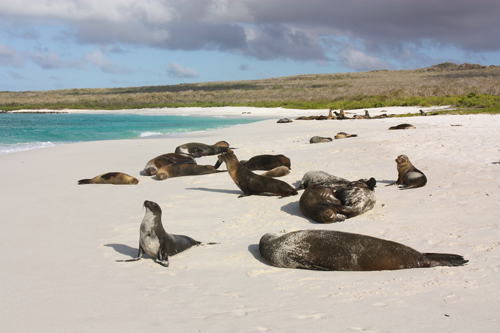
Galápagos Islands
Situated in the Pacific Ocean some 1,000 km from the South American continent, these 19 islands and the surrounding marine reserve have been called a unique ‘living museum and showcase of evolution’. Located at the confluence of three ocean currents, the Galápagos are a ‘melting pot’ of marine species. Ongoing seismic and volcanic activity reflects the processes that formed the islands. These processes, together with the extreme isolation of the islands, led to the development of unusual animal life – such as the land iguana, the giant tortoise and the many types of finch – that inspired Charles Darwin’s theory of evolution by natural selection following his visit in 1835.
Sangay National Park
With its outstanding natural beauty and two active volcanoes, the park illustrates the entire spectrum of ecosystems, ranging from tropical rainforests to glaciers, with striking contrasts between the snowcapped peaks and the forests of the plains. Its isolation has encouraged the survival of indigenous species such as the mountain tapir and the Andean condor.
Source: https://whc.unesco.org/en/statesparties/ec
|
|

|
|
|
|