|
Overview Northern Africa
Horseback riding tours
Morocco
Middle East
Israel
Oman
|

|
|

|
|
|
|
Horseback riding vacations in
Morocco
|
"The Earth is a peacock, and its glorious tail Morocco" is an old saying that alludes to Morocco’s exotic architecture, colorful lifestyles, and general love for life. Morocco brims over with exquisite contrasts, color and mystery and all you can do is simply catch your breath in wonder. It has a timeless quality that no longer exists in the modern world, a sense that the past with all its glory and savagery still lives on, threading in and out of the present, informing with its every word and gesture. On a horse riding holiday in Morocco you are plunged into a culture, a religion and a lifestyle utterly unlike anything that you have ever experienced before; a mystery tour of a land of endless surprises, enchantment and enduring fascination, a land perfect for a very special horseback vacation.
Horse Riding in Morocco
Explore Berber villages at the foot of the Atlas Mountains, fanciful adobe castles on the edge of the Sahara, and lush vegetation along the Mediterranean contrast with stern cliffs and rock formations. Hidden Trails has selected some of the best Moroccan horseback tours for our clients to choose from!
|
|
Our Moroccan horse vacations offer a chance to escape the modern world and experience the exotic old tradition world, full of the bright colors and intrigue of the desert. Explore valleys that once belonged to mighty ancient kings, on our Cities of Kings horseback tour. Horse ride through the Atlas Mountains.
Visit a famed desert oasis on the Oasis of Tafilalelt horse riding holiday. Finally, our Sable d’Or horseback tour is a taste of Southern Morocco, in the foothills of the Anti Atlas mountains.
Morocco People and Culture
Moroccans are friendly, polite, competitive and intensely curious about the outside world. Islam is a thriving faith but Morocco's version is also extremely moderate, open minded and tolerant. You can go a long way into the heart of their culture just by feeling independent enough to accept their hospitality which pours forth from rich and poor alike whether in the city or the countryside. Such gestures of friendship are what transforms a good holiday into a great experience, for then you are no longer just visiting but really living.
|
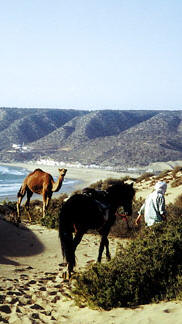
On each of our riding tours will be in very different landscapes. 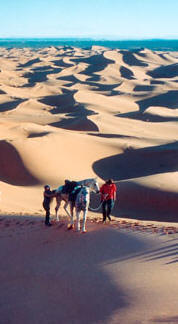 |
|
Morocco is an exciting country and there is no need to make idle promises and exaggerations. It is all there for you to experience, but we will help you create an itinerary that involves as little inconvenience as possible and steer you away from the places that may be of little or no interest to you.
There is no better way than to explore this beautiful country on horseback. We will take you deep into the most remote areas and show you the culture and history on our horse riding holidays. An adventure you will not forget.
Explore more North Africa Horse Riding Vacations
|
|
|
Holidays on horseback in Morocco
See Mini Country Guide
|
Below is a list of our trips in this area with video clips.
 Click on the 'watch video' icon

to view a video clip,
On Horseback In Morocco

|
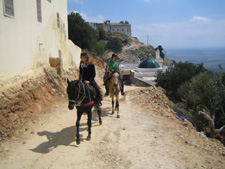
A unique horse riding experience that leads you through a rich and beautiful country to the historic heart of Morocco, a heart that is still very much alive and beating. You will see the Roman ruins of Volubilis and Meknes, the town of the great king Moulay Ismail and Fez, the Islamic centre of culture, handicrafts and religion.
|
Trip Details
|
|
Morocco
Travel restrictions
International air travel to and from Morocco resumed on February 7th 2022.
Ferry services between Morocco and Spain have also resumed.
The borders with Ceuta and Melilla are now open for travelers who do not require a visa.
Moroccan authorities lifted COVID-related travel restrictions on September 30th 2022. Passengers must only complete the Public Health Passenger Form (https://www.onda.ma/form.php ) and present it upon arrival.
The Ministry of Foreign Affairs for the Kingdom of Morocco announced on December 31st 2022, that starting January 3rd 2023 all travelers coming from the People’s Republic of China (PRC), regardless of their nationality, are barred from entering Moroccan territory due to the worsening COVID-19 pandemic in PRC.
Measures taken by the government
Effective October 1st 2021, shops, restaurants, cafes, gyms, and hammams may operate at 50% capacity.
Effective October 21st 2021, the Moroccan government requires proof of vaccination to enter most private and public establishments, including hotels, restaurants, cafes, gyms, hammams, grocery stores, and public modes of transportation.
It should be noted that all vaccine passes issued by other countries are accepted as long as they are valid in their country of emission.
Testing
Travelers can obtain a COVID-19 test at the labs listed below, which have been approved by the Moroccan Ministry of Health. The cost for the test is typically around 700 Dirhams.
Results can be provided electronically and are usually available within 24 hours.
Approved COVID-19 testing labs:
AGADIR: Laboratoire d’Analyses Médicales Mahfoud
CASABLANCA: Laboratoire d’Analyses Médicales Derb Sultan / Centre de Biologie Médicale GLab / Biolam / Laboratoire International d’Analyses Biomédicales / Laboratoire d’Analyses Médicales Annoual / Laboratoire d’Analyses LABOMAC / Hopital Cheikh Khalifa Ben Zayed
EL JADIDA: Laboratoire Semlali d’Analyses Médicales et de Biologie de la Reproduction
ESSAOUIRA: Laboratoire El Baroudi
FES: Laboratoire Saiss d’Analyses Médicales / Centre Biologie Maroc / Laboratoire Guessous d’Analyses Médicales
KENITRA: Laboratoire Maamora
MARRAKECH: Laboratoire D’Analyses Médicales et Biologiques Al Massira / Laboratoire Dar Assalam d’Analyses Médicales / Laboratoire de Biologie Médicale Gueliz / Laboratoire AlManar / Laboratoire Dar El Baroud
MEKNES: Laboratoire Chbicheb d’Analyses Médicales
MOHAMMEDIA: Laboratoire Central Analyses Médicales Mohammedia
NADOR: Laboratoire D’Analyses Médicales de Nador
OUJDA: Laboratoire Oujda d’Analyses Médicales
RABAT: Laboratoire d’Analyses Médicales et de Cytogénétique / Laboratoire International d’Analyses Médicales (Témara) / Laboratoire Ibnou Nafiss / Laboratoire PolyBio / Laboratoire Bioclinic / Laboratoire Claridge
TANGIER: Laboratoire d’Analyses Médicales et de Biologie de Reproduction Riad Tétouan
TÉTOUAN: Laboratoire Ibn Nafis d’Analyses Médicales Générales & Spécialisées Reproduction Humaine / Laboratoire Fassi-Fehri d’Analyses Médicales
Emergency number (related to COVID-19) while visiting the country
Epidemiological watch: 080 100 47 47
SAMU: 141
If you are exhibiting signs or symptoms of COVID-19, or to find a testing site, please contact the Moroccan Ministry of Health’s hotline at +212 (0)8-01-00-47-47. Assistance is available in English, French or Arabic.
Source:
US Embassy in Morocco https://ma.usembassy.gov/25161/
Published on January 2023 (checked on April 5th 2023)
For more information please visit our COVID-19 Updates page at https://www.hiddentrails.com/article/covid19update.aspx
|
|
Morocco
At A glance
Capital City: Rabat
Land size: 716,300 sq km
Population: 36,738,229 (2022 est.)
Official languages: Arabic and Berber
Currency: Moroccan Dirham (د.م / MAD)
UNESCO properties and sites:
- Archaeological Site of Volubilis
- Historic City of Meknes
- Ksar of Ait-Ben-Haddou
- Medina of Essaouira (formerly Mogador)
- Medina of Fez
- Medina of Marrakesh
- Medina of Tétouan (formerly known as Titawin)
- Portuguese City of Mazagan (El Jadida)
- Rabat, Modern Capital and Historic City: a Shared Heritage
Source: https://www.cia.gov/the-world-factbook/countries/morocco/
Morocco seamlessly blends rich history, vibrant culture, and stunning landscapes. Discover the cultural melting pot of Fes, where narrow winding streets lead to hidden courtyards and intricate tiled mosques. Journey through the breathtaking landscapes of the Sahara Desert, where golden dunes stretch as far as the eye can see and camel caravans traverse the sand.
Immerse yourself in the warm hospitality of the Moroccan people, experiencing their vibrant traditions, savoring flavorful cuisine like tagines and couscous.
Morocco's diverse landscapes, cultural treasures, and vibrant equestrian culture offer endless opportunities for unforgettable horseback riding experiences. Discover the beauty of the Atlas Mountains, cantering along picturesque trails that wind through valleys, Berber villages, and lush oases. Explore the serene beaches of Agadir, riding along the shorelines, feeling the gentle sea breeze on your face.
Brief History
In 788, about a century after the Arab conquest of North Africa, a series of Moroccan Muslim dynasties began to rule in Morocco. In the 16th century, the Sa'adi monarchy, particularly under Ahmad al-MANSUR (1578-1603), repelled foreign invaders and inaugurated a golden age. The Alaouite Dynasty, to which the current Moroccan royal family belongs, dates from the 17th century. In 1860, Spain occupied northern Morocco and ushered in a half-century of trade rivalry among European powers that saw Morocco's sovereignty steadily erode.
In 1912, the French imposed a protectorate over the country. A protracted independence struggle with France ended successfully in 1956. The internationalized city of Tangier and most Spanish possessions were turned over to the new country that same year. Sultan MOHAMMED V, the current monarch's grandfather, organized the new state as a constitutional monarchy and in 1957 assumed the title of king. Since Spain's 1976 withdrawal from Western Sahara, Morocco has extended its de facto administrative control to roughly 75% of this territory; however, the UN does not recognize Morocco as the administering power for Western Sahara. The UN since 1991 has monitored a cease-fire between Morocco and the Polisario Front - an organization advocating the territory’s independence - and restarted negotiations over the status of the territory in December 2018. On 10 December 2020, the US recognized Morocco's sovereignty over all of Western Sahara.
King MOHAMMED VI in early 2011 responded to the spread of pro-democracy protests in the North Africa region by implementing a reform program that included a new constitution, passed by popular referendum in July 2011, under which some new powers were extended to parliament and the prime minister, but ultimate authority remains in the hands of the monarch.
Source: https://www.cia.gov/the-world-factbook/countries/morocco/
Cultural Insights
Two of the most basic foods in Moroccan daily life are couscous and harira soup. Couscous, a dish made with granulated seminola grains, is usually topped with mutton, veal, or beef and a variety of vegetables such as tomatoes, turnips, and pimentos. It is eaten by all sectors of society, and may be referred to as the national dish. The national soup, harira, is a thick paste that comes in many varieties, although it is classically made from water, bouillon, beef or mutton, onions, saffron, walnuts, and salt.
Moroccans are famous for their hospitality and proudly serve their guests as much food as they can afford. It is considered disgraceful to allow guests to leave a meal unsatisfied.
When greeting one another, Moroccans usually shake hands and touch their heart to show personal warmth.
Segregation of the sexes is very important in almost every social situation outside the home. Only very modern, Westernized women are active in public life. In the Berber countryside, the appearance of women in public may be slightly more common than in major cities. Traditionally, elders are respected and honored by the entire community.
Moroccans have a very lax concept of punctuality. Dates, appointments, business meetings, and people tend to run behind schedule without concern.
Saving face, especially in public, is of the utmost importance and may lead to white lies being told to cover any potentially embarrassing or shameful situation.
When tensions do occur, yelling, expressing frustration, and generally creating a public scene is acceptable and quite ordinary.
Source: https://www.everyculture.com/Ma-Ni/The-United-Kingdom-of-Morocco.html
Transportation
By Air
With 25 airports scattered all across Morocco, there are several airports in Morocco that are able to serve your needs.
The country’s busiest airport is Casablanca Mohammed V, which is also the main port of entry into the country.
If you are flying in from Europe, there are several options including Agadir Airport (main gateway into Southern Morocco) and Marrakech Menara Aiport.
Source: https://www.visitmorocco.com/en/travel-info/getting-to-morocco
https://www.frommers.com/destinations/morocco/planning-a-trip/getting-there
https://www.iexplore.com/articles/travel-guides/africa/morocco/airports
Money
Most major credit cards are accepted in the larger towns.
ATMs are widely available in cities and most of the main towns.
There is no limit on the amount of foreign cash you can bring in to the country.
The best places to change your currency are the exchange offices that are located in the tourist squares of each city in Morocco. You can change your currency at the airport or in hotels as well.
Source: https://www.gov.uk/foreign-travel-advice/morocco
https://www.visitmorocco.com/en/useful-information?id=modaldollar481
Health
Adequate medical care is available in Morocco’s largest cities, particularly in Rabat and Casablanca, although not all facilities meet Western standards.
Most medical staff will have limited or no English-speaking ability.
If you need emergency medical assistance during your trip, dial 150 and ask for an ambulance. You should contact your insurance/medical assistance company promptly if you are referred to a medical facility for treatment.
Emergency and specialized care outside the major cities is far below U.S. standards and may not be available at all.
In the event of vehicle accidents involving injuries, immediate ambulance service is usually not available. The police emergency services telephone number is “190”.
Most ordinary prescription and over-the-counter medicines are widely available. Specialized prescriptions may be difficult to fill and availability of all medicines in rural areas is unreliable.
If traveling with prescription medication, check with the Government of Morocco Ministry of Foreign Affairs to ensure the medication is legal in Morocco. Always carry your prescription medication in original packaging, along with your doctor’s prescription.
Source: https://www.gov.uk/foreign-travel-advice/morocco
https://travel.state.gov/content/travel/en/international-travel/International-Travel-Country-Information-Pages/Morocco.html
Electricity
Morocco operates on a 127 / 220V supply voltage and uses type C and E plugs.
The Type C electrical plug (or Europlug) is a two-wire plug that has two round pins. It fits into any socket that accepts 4.0 – 4.8 mm round contacts on 19 mm centres. They are being replaced by E, F, J, K or N sockets which work perfectly with Type C plugs.
The Type E electrical plug has two 4.8 mm round pins spaced 19 mm apart and a hole for the socket's male earthing pin. The Type E plug has a rounded shape and the Type E socket has a round recess. Type E plugs are rated 16 amps.
Note: The CEE 7/7 plug was developed to work with Type E and Type F sockets with a female contact (to accept the earthing pin of the Type E socket) and has earthing clips on both sides (to work with Type F sockets).
Source: https://www.iec.ch/world-plugs
Communication
Time zone in Morocco: Western European Time (GMT+1)
International country code – 212
Despite Morocco's economic progress, the country suffers from high unemployment and illiteracy affecting telecom market, particularly in rural areas.
Service providers have all successfully completed 5G proofs of concept and are currently lining up 5G equipment providers for both radio and core technology. Regulatory agency expects to conduct the 5G spectrum auction in 2023.
Source: https://www.cia.gov/the-world-factbook/countries/morocco/
Phrasebook
| English |
Arabic |
| Hello! |
Salam |
| Goodbye |
Beslama |
| Good morning |
Sbah lkḥīr |
| Good evening |
Msa Lkheir |
| Good night |
lla yemsek 'la khir |
| Please |
Afak |
| Thank you |
Chokran |
| Yes |
Ah |
| No |
La |
Source: https://www.visitmorocco.com/en/useful-information?id=modalvocabulaire483
Entry Requirements
The need for a visa depends on your nationality. For all nationalities, the maximum duration of the tourist trip is 90 days.
For foreign nationals arriving in Morocco as part of an organized trip, a valid passport must cover at least the duration of the stay in Morocco.
You can find more information at the following link: https://www.consulat.ma/en/ordinary-visas
Source: https://www.visitmorocco.com/en/useful-information?id=modalformalites1096
Embassies and Consulates
U.S. Embassy in Rabat
Km 5.7, Avenue Mohamed VI
Rabat-Souissi
Phone: (212) 0537 637 200
U.S. Consulate General in Casablanca
8, Bd Moulay Youssef
Casablanca
Phone: (212) 522-64-20-00
Embassy of Canada in Rabat
66 Mehdi Ben Barka Avenue
Rabat-Souissi
Phone: (212) 537 54 49 49
Source: for USA https://www.usembassy.gov/
For Canada: https://travel.gc.ca/assistance/embassies-consulates
UNESCO Sites
Archaeological Site of Volubilis
The Mauritanian capital, founded in the 3rd century B.C., became an important outpost of the Roman Empire and was graced with many fine buildings. Extensive remains of these survive in the archaeological site, located in a fertile agricultural area. Volubilis was later briefly to become the capital of Idris I, founder of the Idrisid dynasty, who is buried at nearby Moulay Idris.
Historic City of Meknes
Founded in the 11th century by the Almoravids as a military settlement, Meknes became a capital under Sultan Moulay Ismaïl (1672–1727), the founder of the Alawite dynasty. The sultan turned it into a impressive city in Spanish-Moorish style, surrounded by high walls with great doors, where the harmonious blending of the Islamic and European styles of the 17th century Maghreb are still evident today.
Ksar of Ait-Ben-Haddou
The ksar, a group of earthen buildings surrounded by high walls, is a traditional pre-Saharan habitat. The houses crowd together within the defensive walls, which are reinforced by corner towers. Ait-Ben-Haddou, in Ouarzazate province, is a striking example of the architecture of southern Morocco.
Medina of Essaouira (formerly Mogador)
Essaouira is an exceptional example of a late-18th-century fortified town, built according to the principles of contemporary European military architecture in a North African context. Since its foundation, it has been a major international trading seaport, linking Morocco and its Saharan hinterland with Europe and the rest of the world.
Medina of Fez
Founded in the 9th century, Fez reached its height in the 13th–14th centuries under the Marinids, when it replaced Marrakesh as the capital of the kingdom. The urban fabric and the principal monuments in the medina – madrasas, fondouks, palaces, residences, mosques and fountains - date from this period. Although the political capital of Morocco was transferred to Rabat in 1912, Fez has retained its status as the country's cultural and spiritual centre.
Medina of Marrakesh
Founded in 1070–72 by the Almoravids, Marrakesh remained a political, economic and cultural centre for a long period. Its influence was felt throughout the western Muslim world, from North Africa to Andalusia. It has several impressive monuments dating from that period: the Koutoubiya Mosque, the Kasbah, the battlements, monumental doors, gardens, etc. Later architectural jewels include the Bandiâ Palace, the Ben Youssef Madrasa, the Saadian Tombs, several great residences and Place Jamaâ El Fna, a veritable open-air theatre.
Medina of Tétouan (formerly known as Titawin)
Tétouan was of particular importance in the Islamic period, from the 8th century onwards, since it served as the main point of contact between Morocco and Andalusia. After the Reconquest, the town was rebuilt by Andalusian refugees who had been expelled by the Spanish. This is well illustrated by its art and architecture, which reveal clear Andalusian influence. Although one of the smallest of the Moroccan medinas, Tétouan is unquestionably the most complete and it has been largely untouched by subsequent outside influences.
Portuguese City of Mazagan (El Jadida)
The Portuguese fortification of Mazagan, now part of the city of El Jadida, 90-km southwest of Casablanca, was built as a fortified colony on the Atlantic coast in the early 16th century. It was taken over by the Moroccans in 1769. The fortification with its bastions and ramparts is an early example of Renaissance military design. The surviving Portuguese buildings include the cistern and the Church of the Assumption, built in the Manueline style of late Gothic architecture. The Portuguese City of Mazagan - one of the early settlements of the Portuguese explorers in West Africa on the route to India - is an outstanding example of the interchange of influences between European and Moroccan cultures, well reflected in architecture, technology, and town planning.
Rabat, Modern Capital and Historic City: a Shared Heritage
Located on the Atlantic coast in the north-west of Morocco, the site is the product of a fertile exchange between the Arabo-Muslim past and Western modernism. The inscribed city encompasses the new town conceived and built under the French Protectorate from 1912 to the 1930s, including royal and administrative areas, residential and commercial developments and the Jardins d’Essais botanical and pleasure gardens. It also encompasses older parts of the city dating back to the 12thcentury. The new town is one of the largest and most ambitious modern urban projects built in Africa in the 20th century and probably the most complete. The older parts include Hassan Mosque (begun in 1184) and the Almohad ramparts and gates, the only surviving parts of the project for a great capital city of the Almohad caliphate as well as remains from the Moorish, or Andalusian, principality of the 17thcentury.
Source: https://whc.unesco.org/en/statesparties/ma
|
|

|
|
|
|