|
|

|
|
|
|
Horseback riding vacations in
Slovenia
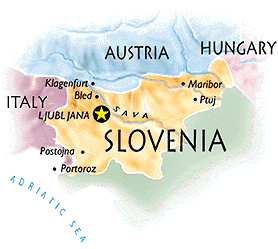
Slovenia is situated at the crossroads of Central Europe, the Mediterranean and the Balkans, and is home to one of the world’s great Lipizzaner horse studs. These elegant animals have long been revered for their classical dressage abilities, and today Lipizzaners tour the world, enrapturing audiences wherever they go. Hidden Trails gives you the unprecedented opportunity to experience the beauty of the Lipizzaner on a classical dressage clinic – a once in a lifetime horseback vacation opportunity for lovers of this breed and the sport of dressage!
Horse Riding in Slovenia
Hidden Trails focuses its attention on the Lipizzaner breeding stud in Slovenia. This stud farm lies in the picturesque Karst region of Slovenia, in the heart of a green oasis under the azure Mediterranean sky, in the shade of century-old lime trees and oaks, and just a stone’s throw from the Slovenian–Italian border. The Lipizzan stud farm was founded in 1580 by an Austrian archduke, and today it is a jewel among the cultural and historical monuments of the Republic of Slovenia. For over four centuries, the Stud Farm has nurtured the tradition of breeding and selecting its horses. In the period after World War II it established its own classical riding school and has successfully performed with its horses at various equestrian events all over the world. Hidden Trails gives you the unique chance to be emerged in the Lipizzan and dressage lifestyle on a very special horse riding holiday at a world famous recreational centre offering its visitors unforgettable moments of relaxation and enjoyment. Enjoy the instruction and attention of experienced teachers while riding beautifully spirited Lipizzan horses. When class is over, explore the green oasis of Slovenia or even travel the two hours to Venice, Italy.
Slovenia Geography
Slovenia is situated at the crossroads of central Europe, the Mediterranean, and the Balkans. Here, at the meeting point of the cultures of the east and the west, the old interlaces in harmony with the new. Slovenia surprises visitors at every step with its natural sites. In this tiny piece of Europe, the picturesque features of the Alpine, Mediterranean, Karst, and Pannonian worlds are combined. At the contact point of such naturally diverse regions, nature shows a hundred attractive faces. One of the smallest countries in Europe, Slovenia more than justifies the ‘Europe in Miniature’ hype. Tucked in an enviable geographical position between the Alps and the Mediterranean, it is blessed with spectacular mountains, thick forests and an Adriatic coastline.
Slovenia Weather and Climate
Slovenian weather is most reliable from May through September. The shoulder seasons mean less European tourists, and less intense heat than the height of summer (July and August).
Explore more European Horse Riding Vacations
|
|
Holidays on horseback in Slovenia
See Mini Country Guide
|
Below is a list of our trips in this area with video clips.
 Click on the 'watch video' icon

to view a video clip,
Slovenia
Travel restrictions
As of February 19th 2022, restrictions due to Covid-19 no longer apply when entering Slovenia.
This means that:
- The RVT (recovered/vaccinated/tested) condition no longer has to be met at the border
- Travelers will no longer be ordered to quarantine at home.
Measures taken by the government
All tourist accommodation/services, food & drink establishments, cultural and sports events, shops and all other amenities can be enjoyed without meeting the RVT rule.
The use of protective masks indoors is optional in Slovenia.
Testing
Testing is available for both foreign nationals and Slovenians. No appointment is required for the rapid antigen tests (RAT), and they are available throughout the country, including Ljubljana airport.
For the PCR test, available at the Ljubljana Clinical Center, an appointment is required, but is usually available within a day.
For foreign nationals, cost for RAT is 5-30 euro; cost for PCR is 93 euro. Results for both tests will be provided to you electronically within 24 hours.
Emergency number (related to COVID-19) while visiting the country
The National Institute of Public Health has set up a special phone number that you can contact to obtain more information. The phone number (+386 31 646 617) is available every day between 9.00 am and 5.00 pm.
Source:
US Embassy in Slovenia https://si.usembassy.gov/covid-19-information/
Published on October 14th 2022 (checked on April 5th 2023)
Republic of Slovenia: Ministry of Interior https://www.policija.si/enterslovenia/en
Published on February 19th 2022 (checked on April 5th 2023)
For more information please visit our COVID-19 Updates page at https://www.hiddentrails.com/article/covid19update.aspx
|
|
Slovenia
At A glance
Capital City: Ljubljana
Land size: 20,151 sq km
Population: 2,099,790 (2023 est.)
Official languages: Slovene, Hungarian (official, only in municipalities where Hungarian national communities reside) and Italian (official, only in municipalities where Italian national communities reside)
Currency: Euro (€ / EUR)
UNESCO properties and sites:
- Heritage of Mercury (Almadén and Idrija)
- Prehistoric Pile Dwellings around the Alps
- The works of Jože Plecnik in Ljubljana – Human Centred Urban Design
- Ancient and Primeval Beech Forests of the Carpathians and Other Regions of Europe
- Škocjan Caves
Source: https://www.cia.gov/the-world-factbook/countries/slovenia/
Discover the beauty and charm of Slovenia. Explore the enchanting capital city of Ljubljana, with its picturesque bridges, cobblestone streets, and vibrant cultural scene. Discover the breathtaking beauty of Lake Bled, with its emerald-green waters, romantic island, and medieval castle perched atop a hill.
Slovenia's natural wonders, historical treasures, and vibrant culture offer a truly unique travel experience.
Slovenia offers a haven for equestrian enthusiasts, with its diverse terrains and a deep connection to nature. Ride into the Karst region, where majestic mountains, lush alpine meadows, and crystal-clear lakes provide a perfect setting for exhilarating horseback riding adventures. Explore picturesque trails that wind through dense forests, traverse scenic valleys, and lead to hidden waterfalls.
Brief History
The Slovene lands were part of the Austro-Hungarian Empire until the latter's dissolution at the end of World War I. In 1918, the Slovenes joined the Serbs and Croats in forming a new multinational state, which was named Yugoslavia in 1929.
After World War II, Slovenia was one of the republics in the restored Yugoslavia, which, though communist, soon distanced itself from the Soviet Union and spearheaded the Non-Aligned Movement. Dissatisfied with the exercise of power by the majority Serbs, the Slovenes succeeded in establishing their independence in 1991 after a short 10-day war.
Historical ties to Western Europe, a growing economy, and a stable democracy have assisted in Slovenia's post-communist transition. Slovenia acceded to both NATO and the EU in the spring of 2004; it joined the euro zone and the Schengen Area in 2007.
Source: https://www.cia.gov/the-world-factbook/countries/slovenia/
Cultural Insights
Slovenia has a rich culinary tradition that is a product of both its climate and its location at the crossroads of central Europe. Slovene culinary heritage is reflective of Mediterranean, Alpine, and Eastern European cultures. Meals are an important part of Slovene family life, and enjoying a snack or a glass of wine at a café with friends is a typical social activity. Although every region in Slovenia has its own specialties, most of Slovenia's oldest traditional dishes are made using flour, buckwheat, or barley, as well as potatoes and cabbage.
Source: https://www.everyculture.com/Sa-Th/Slovenia.html
Transportation
By Air
Slovenia only has one major international airport: Ljubljana Jože Pucnik Airport.
The Ljubljana airport offers direct connections to 22 different destinations including Istanbul, Paris and London.
Many people visiting Slovenia also choose to land at an international airport in a neighboring country (often Italy or Austria) and make their way to Slovenia from there.
By Rail
It is easy to get to Slovenia by train from many European cities. You can take a direct train to Slovenia from the following countries: Croatia, Italy, Austria, Hungary, Serbia, Czech Republic, Germany, and Switzerland.
You can also come to Slovenia by night trains with sleeping cars.
Regular and local train lines also connect different parts of the country. Only the trains from the Slovenian Railways company run around Slovenia. You can find timetables and price lists published on the following web page: https://potniski.sz.si/en/
For local train journeys, you can purchase your ticket online, at every railway station or from the guard on the train.
Source: https://www.slovenia.info/en/plan-your-trip/getting-to-and-around-slovenia/to-slovenia-by-air
https://www.slovenia.info/en/plan-your-trip/getting-to-and-around-slovenia/to-slovenia-by-train
Money
ATMs are easily accessible and major credit cards are widely accepted.
Banks and bureaux de change will change main currencies.
Source: https://www.gov.uk/foreign-travel-advice/slovenia
Health
There are no special vaccinations required for entry into Slovenia. However, vaccination against tetanus is recommended.
If you need emergency medical assistance during your trip, dial 112 and ask for an ambulance. If you are referred to a medical facility for treatment you should contact your insurance/medical assistance company immediately.
Ambulance services are widely available and reliable. When contacting an ambulance, if you do not speak Slovenian, you may need to find a Slovenian speaker who can explain your location.
While many medical providers in Slovenia speak excellent English, that may not be the case for all medical staff.
Medical care throughout Slovenia is comparable to that found in the United States.
Medical care is available all across Slovenia. All Slovenian cities have health centers and there are clinics in small towns.
Emergency responders may determine that patients requiring specialized and more complex medical care need to be transported to Ljubljana Clinical Center (public hospital) by air.
Although most government-run institutions in Slovenia provide care at little or no cost to Slovenian nationals, foreign nationals, including U.S. citizens, are expected to pay the full cost directly. That said, prices in government-run clinics are very reasonable. Private clinics are also an option. For both, you will pay up front and can later seek reimbursement from your health insurance provider.
For minor problems, such as colds, headaches, fever or insect bites, it is possible to obtain medications in pharmacies without prescription.
Almost all prescriptions available in the United States are widely available in Slovenia (although may be under different names). You may need a prescription for medications (such as Ibuprofen when over 200 mg) that could be purchased over-the-counter in the United States.
The citizens of European Union Member States can travel to Slovenia with the European Health Insurance Card. This card can also be obtained by the citizens of Iceland, Liechtenstein, Norway and Switzerland. For the citizens of all other countries, it is best that you take out international travel insurance even before travelling to Slovenia.
The European Health Insurance Card gives you access to health services in the public health sector, , under the same conditions as Slovenian citizens. However, the card does not cover health services from private providers.
When you are in the forest or by the water, you should watch out for ticks. We recommend that you provide yourself with appropriate repellents and, when you get back from the forest, check yourself thoroughly and remove any possible ticks.
Slovenia has a high incidence of Lyme disease and encephalitis, both transmitted by ticks. For stays longer than three months, consider getting a vaccine to prevent tick-borne encephalitis. This vaccine is not available in the United States, but is available in Slovenia.
In Slovenia, you can safely drink tap water.
Source: https://www.gov.uk/foreign-travel-advice/slovenia
https://travel.state.gov/content/travel/en/international-travel/International-Travel-Country-Information-Pages/Slovenia.html
https://www.slovenia.info/en/plan-your-trip/practical-info/healthcare
Electricity
Slovenia operates on a 230V supply voltage and uses type C and F plugs.
The Type C electrical plug (or Europlug) is a two-wire plug that has two round pins. It fits into any socket that accepts 4.0 – 4.8 mm round contacts on 19 mm centres. They are being replaced by E, F, J, K or N sockets which work perfectly with Type C plugs.
The Type F electrical plug (also known as a Schuko plug) has two 4.8 mm round pins spaced 19 mm apart. It is similar to the Type E plug but has two earth clips on the side rather than a female earth contact. The CEE 7/7 plug was developed to work with sockets E and F and has grounding clips on both sides (to work with Type F sockets) and a female contact (to accept the grounding pin of the type E socket).
Source: https://www.iec.ch/world-plugs
Communication
Time zone in Slovenia: Central European Standard Time (GMT+1)
International country code – 386
The two most developed networks are those of Mobitel and Simobil, Slovenia's largest mobile operators. As in other European countries, the GSM mobile phones operate at the frequencies of 900 MHz and 1800 MHz.
Source: https://www.cia.gov/the-world-factbook/countries/slovenia/
https://www.slovenia.info/en/plan-your-trip/practical-info/mobile-phones-mains-voltage-radio-channels
Phrasebook
| English |
Slovenian |
| Hello! |
Dober dan |
| Goodbye |
Nasvidenje |
| Good morning |
Dobro jutro |
| Good evening |
Dober vecer |
| Good night |
Lahko noc |
| Please |
Prosim |
| Thank you |
Hvala |
| Yes |
Ja |
| No |
št |
Source: https://www.ljubljana.info/facts/language/
Entry Requirements
If you need a visa to enter Slovenia, you can obtain one from the Slovenian consular mission in your country. If there is no Slovenian consular mission in your country, please contact a consular mission of any Member State of the Schengen Area.
All Schengen Area countries issue Schengen visas under the same conditions, taking into account the interests of the other Member States as well. A visa issued by one Schengen Member State is also valid for the other Member States. In other words, this means that you can visit several countries which are in the Schengen Area.
Source: https://www.slovenia.info/en/plan-your-trip/practical-info/border-formalities
Embassies and Consulates
U.S. Embassy in Ljubljana
Prešernova 31
1000 Ljubljana
Phone: +386 (1) 200 55 00
Honorary Consul of Canada in Ljubljana
Linhartova cesta 49a.
1000 Ljubljana
Phone: +386 (1) 252 44 44
Source: for USA https://www.usembassy.gov/
For Canada: https://travel.gc.ca/assistance/embassies-consulates
UNESCO Sites
Heritage of Mercury (Almadén and Idrija)
The property includes the mining sites of Almadén (Spain), where mercury (quicksilver) has been extracted since antiquity, and Idrija (Slovenia), where mercury was first found in AD1490. The Spanish property includes buildings relating to its mining history, including Retamar Castle, religious buildings and traditional dwellings. The site in Idrija notably features mercury stores and infrastructure, as well as miners’ living quarters, and a miners’ theatre. The sites bear testimony to the intercontinental trade in mercury which generated important exchanges between Europe and America over the centuries. Together they represent the two largest mercury mines in the world, operational until recent times.
Prehistoric Pile Dwellings around the Alps
This serial property of 111 small individual sites encompasses the remains of prehistoric pile-dwelling (or stilt house) settlements in and around the Alps built from around 5000 to 500 B.C. on the edges of lakes, rivers or wetlands. Excavations, only conducted in some of the sites, have yielded evidence that provides insight into life in prehistoric times during the Neolithic and Bronze Age in Alpine Europe and the way communities interacted with their environment. Fifty-six of the sites are located in Switzerland. The settlements are a unique group of exceptionally well-preserved and culturally rich archaeological sites, which constitute one of the most important sources for the study of early agrarian societies in the region.
The works of Jože Plecnik in Ljubljana – Human Centred Urban Design
The works Jože Plecnik carried in Ljubljana between World War I and World War II present an example of a human centred urban design that successively changed the identity of the city following the dissolution of the Austro-Hungarian Empire, when it changed from a provincial city into the symbolic capital of the Slovenian people. The architect Jože Plecnik contributed to this transformation with his personal, profoundly human vision for the city, based on an architectural dialogue with the older city while serving the needs of emerging modern 20th century society. The property consists of a series of public spaces (squares, parks, streets, promenades, bridges) and public institutions (national library, churches, markets, funerary complex) that were sensitively integrated into the pre-existing urban, natural and cultural context and contributed to the city’s new identity. This highly contextual and human-scale urbanistic approach, as well as Plecnik’s distinctive architectural idiom, stand apart from the other predominant modernist principles of his time. It is an exceptional case of creating public spaces, buildings and green areas according to the vision of a single architect within a limited time, the limited space of an existing city, and with relatively limited resources.
Ancient and Primeval Beech Forests of the Carpathians and Other Regions of Europe
This transnational property includes 94 component parts in 18 countries. Since the end of the last Ice Age, European Beech spread from a few isolated refuge areas in the Alps, Carpathians, Dinarides, Mediterranean and Pyrenees over a short period of a few thousand years in a process that is still ongoing. The successful expansion across a whole continent is related to the tree’s adaptability and tolerance of different climatic, geographical and physical conditions.
Škocjan Caves
This exceptional system of limestone caves comprises collapsed dolines, some 6 km of underground passages with a total depth of more than 200 m, many waterfalls and one of the largest known underground chambers. The site, located in the Kras region (literally meaning Karst), is one of the most famous in the world for the study of karstic phenomena.
Source: https://whc.unesco.org/en/statesparties/si
|
|

|
|
|
|