|
|

|
|
|
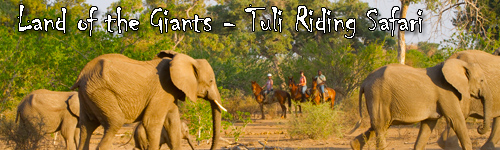
Land of the Giants - Tuli Riding Safari
Mashatu
Botswana
Allow the noble spirit of the horse to carry you on an amazing wildlife safari journey in Botswana; listen as your hoofbeats fall in the rhythm of the Africa!
This journey embraces the true definition of a safari: an expedition to observe animals in their natural habitat. From horseback, the beauty of the African topography, fauna and flora will unfurl, and be complimented by a touch of classic safari luxury: hot showers, mouth-watering food, and memorable camps.
This spectacular horse safari is in the remote Tuli Block of the south-eastern corner of Botswana; home to the impressive Mashatu Game Reserve, the “Land of the Giants” is an area of great diversity, magnificent vistas, unique land formations, wondrous history and legends as ancient as time itself. It is the home to seven of Africa's heralded "Giants": the African elephant, the lion, giraffe, the baobab tree, the eland, the ostrich, and the kori bustard. Each safari is an experience of a lifetime! Here you are surrounded by exotic flora and fauna and bordered by the majestic Limpopo River, guided and befriended by expert horseback guides and jeep rangers. Imagine being enveloped in the wild African bush, falling sleep in tents under the mighty baobab (Mashatu) trees while the lions and hyena serenade you under the starry night sky, waking again to retake your position in the saddle for the ultimate safari vantage point.
As the wildlife in this area is not seasonal, wonderful game viewing experiences are possible throughout the year.
Running throughout the year, this safari is a seven-night adventure that covers a distance of over 120 miles. Traversing the Mopane savannah and stunning river valleys, with accommodation in three unique and beautiful camps, each with distinct design and character.
|
Camping Ride with vehicle support
Trip with multi activities
Safari Ride
|
|
Meeting:
|
Mashatu Game Reserve
|
|
Airport:
|
O.R. Tambo International Airport (JHB)
|
|
Transfer:
|
Johannesburg International
|
|
Riders:
|
Min
2 riders
Max
8 riders
|
|
Trip Brochure (PDF)  Trip Rating
 Video
Travel Stories
Video
Travel Stories
|
|
|
|
Rates and Dates for 2026
Rates include*:
Accommodations, All meals with drinks, 6 riding days & activities as described in the itinerary
| A | 2026 | 8 day trip (High) | 8d / 7n | £4295 | $5715 |
| Single supplement (if not willing to share) | £1505 | $2000 |
| B | 2026 | 8 day trip (Mid) | 8d / 7n | £3625 | $4820 |
| Single supplement (if not willing to share) | £1270 | $1690 |
| C | 2026 | 8 day trip (Low) | 8d / 7n | £3060 | $4070 |
| Single supplement (if not willing to share) | £765 | $1020 |
| D | 2026 | 8 day trip Special (High) | 8d / 7n | £4295 | $5715 |
| Single supplement (if not willing to share) | £1505 | $2000 |
| E | 2026 | 8 day trip Special (Mid) | 8d / 7n | £3625 | $4820 |
| Single supplement (if not willing to share) | £1270 | $1690 |
| F | 2026 | 8 day trip Special (Low) | 8d / 7n | £3060 | $4070 |
| Single supplement (if not willing to share) | £765 | $1020 |
* prices are per person based on double/twin occupancy
Rates Note:
Please, provide your passport information at time of booking
Transfer and Other Charges:
|
2026
|
Air transfer from/to Johannesburg Airport at set times, return, pp on a Sunday (max 6 pax)
|
$1,250
|
|
2026
|
Tourism Levy of US$20 pp, per night to be paid on arrival
- to be paid locally
|
$20
|
|
2026
|
Optional Mashatu Reserve Game Drive, pp
- to be paid locally
|
$88
|
Transfers available from OR Tambo airport in Johannesburg.
We ask that clients land before 9:00 am at the latest on the first day of the safari in order to meet the pickup transfer.
On your departure for home, do not plan to fly out before 8:00pm or else a special transfer is required at further surcharge.
Tour Dates for 2026
Check here for details and availability
|
| A |
2026
|
06/13
- 06/20
|
8d / 7n
|
8 day trip (High)
|
2
/8
|
Expired
|
| D |
2026
|
06/15
- 06/22
|
8d / 7n
|
8 day trip Special (High)
|
2
/8
|
Expired
|
| A |
2026
|
06/20
- 06/27
|
8d / 7n
|
8 day trip (High)
|
2
/8
|
Expired
|
| A |
2026
|
06/27
- 07/04
|
8d / 7n
|
8 day trip (High)
|
2
/8
|
Expired
|
| D |
2026
|
06/29
- 07/06
|
8d / 7n
|
8 day trip Special (High)
|
2
/8
|
Expired
|
| A |
2026
|
07/04
- 07/11
|
8d / 7n
|
8 day trip (High)
|
2
/8
|
Expired
|
| A |
2026
|
07/11
- 07/18
|
8d / 7n
|
8 day trip (High)
|
2
/8
|
Expired
|
| D |
2026
|
07/13
- 07/20
|
8d / 7n
|
8 day trip Special (High)
|
2
/8
|
Expired
|
| A |
2026
|
07/18
- 07/25
|
8d / 7n
|
8 day trip (High)
|
2
/8
|
Expired
|
| A |
2026
|
07/25
- 08/01
|
8d / 7n
|
8 day trip (High)
|
2
/8
|
Expired
|
| D |
2026
|
07/27
- 08/03
|
8d / 7n
|
8 day trip Special (High)
|
2
/8
|
Expired
|
| A |
2026
|
08/01
- 08/08
|
8d / 7n
|
8 day trip (High)
|
2
/8
|
Expired
|
| A |
2026
|
08/08
- 08/15
|
8d / 7n
|
8 day trip (High)
|
2
/8
|
Expired
|
| D |
2026
|
08/10
- 08/17
|
8d / 7n
|
8 day trip Special (High)
|
2
/8
|
Expired
|
| A |
2026
|
08/15
- 08/22
|
8d / 7n
|
8 day trip (High)
|
2
/8
|
Reserve
|
| A |
2026
|
08/22
- 08/29
|
8d / 7n
|
8 day trip (High)
|
2
/8
|
Reserve
|
| D |
2026
|
08/24
- 08/31
|
8d / 7n
|
8 day trip Special (High)
|
2
/8
|
Reserve
|
| A |
2026
|
08/29
- 09/05
|
8d / 7n
|
8 day trip (High)
|
2
/8
|
Reserve
|
| A |
2026
|
09/05
- 09/12
|
8d / 7n
|
8 day trip (High)
|
2
/8
|
Sold Out
|
| D |
2026
|
09/07
- 09/14
|
8d / 7n
|
8 day trip Special (High)
|
2
/8
|
Reserve
|
| A |
2026
|
09/12
- 09/19
|
8d / 7n
|
8 day trip (High)
|
2
/8
|
Reserve
|
| A |
2026
|
09/19
- 09/26
|
8d / 7n
|
8 day trip (High)
|
2
/8
|
Reserve
|
| D |
2026
|
09/21
- 09/28
|
8d / 7n
|
8 day trip Special (High)
|
2
/8
|
Reserve
|
| A |
2026
|
09/26
- 10/03
|
8d / 7n
|
8 day trip (High)
|
2
/8
|
Reserve
|
| A |
2026
|
10/03
- 10/10
|
8d / 7n
|
8 day trip (High)
|
2
/8
|
Reserve
|
| D |
2026
|
10/05
- 10/12
|
8d / 7n
|
8 day trip Special (High)
|
2
/8
|
Reserve
|
| A |
2026
|
10/10
- 10/17
|
8d / 7n
|
8 day trip (High)
|
2
/8
|
Reserve
|
| D |
2026
|
10/12
- 10/19
|
8d / 7n
|
8 day trip Special (High)
|
2
/8
|
Reserve
|
| A |
2026
|
10/17
- 10/24
|
8d / 7n
|
8 day trip (High)
|
2
/8
|
Reserve
|
| A |
2026
|
10/24
- 10/31
|
8d / 7n
|
8 day trip (High)
|
2
/8
|
Reserve
|
| A |
2026
|
10/31
- 11/07
|
8d / 7n
|
8 day trip (High)
|
2
/8
|
Reserve
|
| D |
2026
|
11/02
- 11/09
|
8d / 7n
|
8 day trip Special (High)
|
2
/8
|
Reserve
|
| A |
2026
|
11/07
- 11/14
|
8d / 7n
|
8 day trip (High)
|
2
/8
|
Reserve
|
| A |
2026
|
11/14
- 11/21
|
8d / 7n
|
8 day trip (High)
|
2
/8
|
Reserve
|
| D |
2026
|
11/16
- 11/23
|
8d / 7n
|
8 day trip Special (High)
|
2
/8
|
Reserve
|
| A |
2026
|
11/21
- 11/28
|
8d / 7n
|
8 day trip (High)
|
2
/8
|
Reserve
|
| A |
2026
|
11/28
- 12/05
|
8d / 7n
|
8 day trip (High)
|
2
/8
|
Reserve
|
| D |
2026
|
11/30
- 12/07
|
8d / 7n
|
8 day trip Special (High)
|
2
/8
|
Reserve
|
| C |
2026
|
12/05
- 12/12
|
8d / 7n
|
8 day trip (Low)
|
2
/8
|
Reserve
|
| C |
2026
|
12/12
- 12/19
|
8d / 7n
|
8 day trip (Low)
|
2
/8
|
Reserve
|
| F |
2026
|
12/14
- 12/21
|
8d / 7n
|
8 day trip Special (Low)
|
2
/8
|
Reserve
|
| C |
2026
|
12/19
- 12/26
|
8d / 7n
|
8 day trip (Low)
|
2
/8
|
Reserve
|
| C |
2026
|
12/26
- 01/02
|
8d / 7n
|
8 day trip (Low)
|
2
/8
|
Reserve
|
| F |
2026
|
12/28
- 01/04
|
8d / 7n
|
8 day trip Special (Low)
|
2
/8
|
Reserve
|
|
|
Rates do not include:
Optional Game Drive in Mashatu, Gratuities, Tourism levy ($20/day pp) & Transfers from/to Johannesburg airport
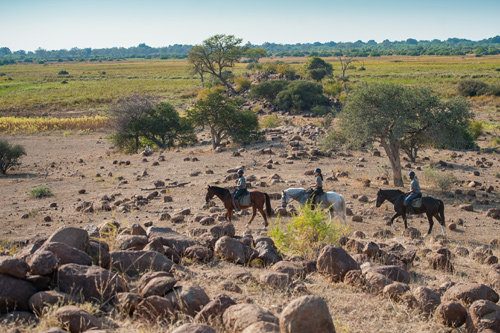 Sample Itinerary for "Tuli 1" - subject to changes
Please note that this is only an example as is subject to change, due to weather or other logistics.
Sample Itinerary for "Tuli 1" - subject to changes
Please note that this is only an example as is subject to change, due to weather or other logistics.
Game drives in the Kgotla Area are included. However the Game Drive with the Mashatu guides in the centre of the reserve need to be paid extra and are subject to availability.
Wildlife that can be seen during the safari include elephant, lion, leopard cheetah, hyena and plains game.
Day 1 (Saturday): Arrival
Pick up from the airport and short transfer to the reception area overlooking the Limpopo river, in time for a light lunch.
Enjoy an introductory ride to check you are suited to your horse, before embarking on your first ride out to our Two Mashatus Camp. This will be your first opportunity to experience the beauty of the Mashatu Game Reserve and view the wildlife on horseback. Mashatu Game Reserve is home to the largest herd of wild free-roaming elephants on private land in Africa, and, although not a guarantee, it is almost assured that there will be great viewing of these incredible creatures.
As evening falls at Two Mashatu Camp, relax in the cool of the thatched rondavel lounge and dining areas, before enjoying a three-course dinner and getting to know your fellow adventurers for the next seven days.
Meals included: Lunch & Dinner
Overnight at Two Mashatus Camp
Day 2 (Sunday): Two Mashatus to Tree Camp
Sunrise, the dawn chorus and tea or coffee which is brought to your tent, sounds the start of your first day. After breakfast, it’s time to mount and depart from the dense woodland that hugs the Limpopo River, and head towards the rocky hills that delineate the edges of the great river valley. As the ride traverses the heartland of Mashatu, you will encounter plentiful game: plains game, many giraffe and herd of elephants.
Having meandered across the hills with vast views back towards South Africa, the ride arrives at Tree Camp in time for lunch. Overlooking the Majale river, it is possible to watch the wildlife from above, coming down to drink at the river.
That afternoon choose a ride or enjoy your first bush walk exploring the area along the West of the Matabole River returning to Tree Camp for sundowners.
Meals included: Breakfast, Lunch & Dinner
Overnight at Tree Camp
Day 3 (Monday): Tree Camp to the Kgotla
The safari passes through the center of Mashatu to the ancient rock formations synonymous with the Limpopo Valley. Giant Baobab trees continue to scatter the landscape as they have for centuries and ancient elephant trails make for wonderful tracks for long canters through open bush veld. Whilst riding alongside the banks of the Motloutse River, discover the old Leadwood ‘Kgotla’ (or enclosure used for the traditional law court of a Botswana village). This open-air enclosure forms the perfect, secure camp for the night.
In the afternoon, we search for the area’s resident lions on a game drive and draw the day’s adventures to a close with sundowners at the ancient “Amphitheatre” rocks. Back at the Kgotla, dinner is enjoyed around a large log fire. The night is spent with a ceiling of stars and Africa’s nighttime melody to sing you to sleep; a veraciously rare experience which is just about as far away from city life and the modern world as anyone can imagine.
Meals included: Breakfast, Lunch & Dinner
Overnight at The Kgotla
Day 4 (Tuesday): Ride around The Kgotla
The sandstone formations, including the famed Solomon’s Wall, one of the numerous dolorite dykes in the area, are explored on horseback. Some of the oldest civilizations in southern Africa settled in this valley. Archaeological evidence in the area includes middle and late stone age tools, rock art and the legendary Mapungubwe Dynasty. Mapungubwe means “Place of the Jackal” in the Venda language and this dynasty existed around 1220 AD. The Mapungubwe topography itself is ancient and timeless, and combined with marvelous wildlife sightings, it makes for an incredible riding experience. This afternoon enjoy a short drive to the Mmamagwa Hills.
For the most visually stunning and ethereal sundowner, we visit the Mmamagwa Hills. A short climb up the sandstone ridge, brings us to the site of the Mmamagwa Ruins, which is of a similar period to Mapungubwe (13th century). To date these ruins have not been excavated and have been left alone. It is conceivable that similar treasures to those found at Mapungubwe (for example the golden rhino) could be buried here. After a short climb, enjoy sundowners beneath a beautiful baobab tree with a breath-taking view of the area.
Meals included: Breakfast, Lunch & Dinner
Overnight at The Kgotla
Day 5 (Wednesday): The Kgotla to Tree Camp
Wind up Elephant Valley along ancient trails stamped into the soil by centuries of migrating elephants, before heading north towards upper reaches of the Majale River. This area is peppered with enormous baobab trees and is one of the more remote areas of the reserve.
After an exhilarating ride through this timeless countryside, enjoy a relaxing lunch at Tree Camp.
An afternoon ride, a bush walk or, subject to availability, a game drive to enjoy the central area of the reserve.
Meals included: Breakfast, Lunch & Dinner
Overnight at Tree Camp
Day 6 (Thursday): Tree Camp to Two Mashatus
Today’s riding promises great game viewing from horseback as we explore the Pitsane River Valley. Drinking holes, dug by elephants along the course of the Pitsane, attract thirsty herds of game. An area, where history has it, there was a skirmish during the Boer war which destroyed Bryce’s Store, an old British supply post. There was a stagecoach line, called Zeederberg’s, that ran from the towns of the Transvaal in South Africa to the newly forged settlements of Southern Rhodesia, now Zimbabwe. Those coaches crossed the broad Limpopo and followed the Pitsane River into Zimbabwe.
The ride returns to the Two Mashatu Camp in time for lunch and a cooling swim in the pool. A guided bush walk to one of the nearby koppies for sundowners is the afternoon excursion.
Meals included: Breakfast, Lunch & Dinner
Overnight at Two Mashatus Camp
Day 7 (Friday): Pitsane River Valley Ride
Our ride today meanders its way through the beautiful plains between the Majale and Pitsane rivers, with abundant game and spectacular views into the Limpopo River Valley.
En route, we explore the remains of an old Boer War fort on a rocky outcrop, followed by a ride down into the cooler wetland area where plentiful game enjoy the lush grasses. In the summer months, rain and water dependent, it can be possible to enjoy cantering through the shallows of the Limpopo River. There is time to relax in camp, before either an afternoon ride or bush walk for your last African sundowner.
Meals included: Breakfast, Lunch & Dinner
Overnight at Two Mashatus Camp
Day 8 (Saturday): Departure
Your last ride in the Limpopo valley is a great opportunity to snap one last picture of elephants and a long and winding canter through the scattered Mustard bush with your guides. Arriving back at the stables with plenty time to enjoy a hot shower and a tasty brunch you get to say farewell to safari companions and newfound friends, it’s time for your onward journey.
Meals included: Brunch
-----------------------------
Sample Itinerary for "Tuli 2": SPECIAL PROGRAM - subject to changes
Please note that this is only an example as is subject to change, due to weather or other logistics.
Game drives in the Kgotla Area are included. However the Game Drive with the Mashatu guides in the centre of the reserve need to be paid extra and are subject to availability.
Elephant, lion, leopard, hyena, giraffe, hippo, cape buffalo, eland, kudu, impala, waterbuck, blue wildebeest, bushbuck, ostrich, baboon, vervet monkey, warthog, bat-eared foxes and jackal. Occasionally seen are crocodile, brown hyena, serval, duiker, bush pig, steenbuck and reedbuck. These are all beautiful animals and a privilege to observe in their natural environment.
Day 1 (Monday): Arrival
Pick up from the airport and short transfer to the reception area overlooking the Limpopo river, in time for a light lunch.
Enjoy an introductory ride to check you are suited to your horse, before embarking on your first ride out to our Two Mashatus Camp. This will be your first opportunity to experience the beauty of the Mashatu Game Reserve and view the wildlife on horseback. Mashatu Game Reserve is home to the largest herd of wild free-roaming elephants on private land in Africa, and, although not a guarantee, it is almost assured that there will be great viewing of these incredible creatures.
As evening falls at Two Mashatu Camp, relax in the cool of the thatched rondavel lounge and dining areas, before enjoying a three-course dinner and getting to know your fellow adventurers for the next seven days.
Meals included: Lunch & Dinner
Overnight at Two Mashatus Camp
Day 2 (Tuesday): Two Mashatus to Tree Camp
The first full day of riding crosses the game rich areas of the central reserve. Following breakfast at dawn, riders set off first along the Majali and then the Mataboli rivers in a north western arc towards the beautifully appointed Tree Camp. The route typically yields rich encounters with elephant, waterbuck, giraffe, impala, wildebeest and zebra. Signs of the many predators that make these rich riverine environments their home are bountiful, and chance encounters possible. The ride typically takes between four and five hours, and riders start to form a true bond with their individual mounts. The trappings of modern living begin to fall away as the sense of adventure and journey deepens.
Tree Camp will be reached in time for a refreshing shower and lunch. After a welcome rest in the comfort of the camp, nestled in the cooling shade of the majestic Mashatu Tree, a hearty tea will be served. This is followed by a guided bush walk up the Majali River in search of crocodile and other game. Kudu, warthog, klipspringer and eland are all present in the area around the camp, as are elephant, lion and hyena. Waterfowl fly low past the camp and birdsong abounds. This is a truly beautiful place and it is impossible not to immerse oneself in nature and experience the exceptional qualities of Africa’s wilderness areas.
Meals included: Breakfast, Lunch & Dinner
Overnight at Tree Camp
Day 3 (Wednesday): Tree Camp to the Kgotla
The safari passes through the center of Mashatu to the ancient rock formations synonymous with the Limpopo Valley. Giant Baobab trees continue to scatter the landscape as they have for centuries and ancient elephant trails make for wonderful tracks for long canters through open bush veld. Whilst riding alongside the banks of the Motloutse River, discover the old Leadwood ‘Kgotla’ (or enclosure used for the traditional law court of a Botswana village). This open-air enclosure forms the perfect, secure camp for the night.
In the afternoon, we search for the area’s resident lions on a game drive and draw the day’s adventures to a close with sundowners at the ancient “Amphitheatre” rocks. Back at the Kgotla, dinner is enjoyed around a large log fire. The night is spent with a ceiling of stars and Africa’s nighttime melody to sing you to sleep; a veraciously rare experience which is just about as far away from city life and the modern world as anyone can imagine.
Meals included: Breakfast, Lunch & Dinner
Overnight at The Kgotla
Day 4 (Thursday): Ride around The Kgotla
The sandstone formations, including the famed Solomon’s Wall, one of the numerous dolorite dykes in the area, are explored on horseback. Some of the oldest civilizations in southern Africa settled in this valley. Archaeological evidence in the area includes middle and late stone age tools, rock art and the legendary Mapungubwe Dynasty. Mapungubwe means “Place of the Jackal” in the Venda language and this dynasty existed around 1220 AD. The Mapungubwe topography itself is ancient and timeless, and combined with marvelous wildlife sightings, it makes for an incredible riding experience. This afternoon enjoy a short drive to the Mmamagwa Hills.
For the most visually stunning and ethereal sundowner, we visit the Mmamagwa Hills. A short climb up the sandstone ridge, brings us to the site of the Mmamagwa Ruins, which is of a similar period to Mapungubwe (13th century). To date these ruins have not been excavated and have been left alone. It is conceivable that similar treasures to those found at Mapungubwe (for example the golden rhino) could be buried here. After a short climb, enjoy sundowners beneath a beautiful baobab tree with a breath-taking view of the area.
Meals included: Breakfast, Lunch & Dinner
Overnight at The Kgotla
Day 5 (Friday): Western reserve ride
Today, you will ride across basalt ridges in search of elephants. Enjoy long canters before a relaxing lunch back at camp.
This afternoon, you have the opportunity to go on another ride or opt for a bush walk.
Meals included: Breakfast, Lunch & Dinner
Overnight at The Kgotla
Day 6 (Saturday): The Kgotla to Tree Camp
Wind up Elephant Valley along ancient trails stamped into the soil by centuries of migrating elephants, before heading north towards upper reaches of the Majale River. This area is peppered with enormous baobab trees and is one of the more remote areas of the reserve.
After an exhilarating ride through this timeless countryside, enjoy a relaxing lunch at Tree Camp.
An afternoon ride, a bush walk or, subject to availability, a game drive to enjoy the central area of the reserve.
Meals included: Breakfast, Lunch & Dinner
Overnight at Tree Camp
Day 7 (Sunday): Pitsane River Valley Ride
With an early departure from Tree Camp, this ride offers sweeping views to the east and south, bathed in early morning light, as it traverses along the edge of a ridge near the centre of the reserve. The path then descends to a game rich area along the Majali River. The deep river pools are the favourite haunt of baboon and impala. Sooner or later the great herds of elephant come past for their daily drink, to play in the water and enjoy a dust bath.
The final part of the ride is first across open plains with some fast canters, and then through cool riverine vegetation along the approaches to Two Mashatus Camp. This area typically boasts the highest density of elephants in the reserve, who sometimes roam through the camp in a gentle yet determined way. It is also excellent for lion and leopard as well as baboon, bushbuck and waterbuck.
Meals included: Breakfast, Lunch & Dinner
Overnight at Two Mashatus Camp
Day 8 (Monday): Departure
Your last ride in the Limpopo valley is a great opportunity to snap one last picture of elephants and a long and winding canter through the scattered Mustard bush with your guides. Arriving back at the stables with plenty time to enjoy a hot shower and a tasty brunch you get to say farewell to safari companions and newfound friends, it’s time for your onward journey.
Meals included: Brunch
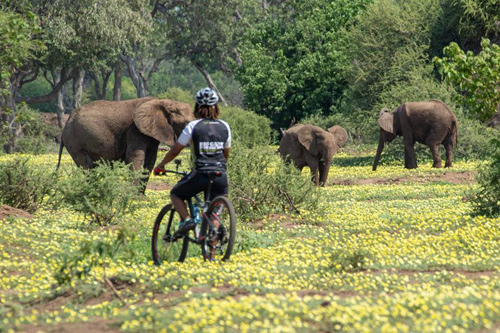 Non-Riding Activities
For those who do not ride a horse, we now have the exciting option of joining the safari on a bicycle. Cycle out each day on one of our Mountain bikes, with our mountain bike guides, before regrouping with the horse riders in your group for meals and sundowners.
Meeting:
Mashatu Game Reserve
Airport:
O.R. Tambo International Airport (JHB)
Transfer:
Johannesburg International
Transfers available from OR Tambo airport in Johannesburg.
We ask that clients land before 9:00 am at the latest on the first day of the safari in order to meet the pickup transfer.
On your departure for home, do not plan to fly out before 8:00pm or else a special transfer is required at further surcharge.
|
Tack:
|
|
English trekking
|
|
Horses:
|
|
Boerperd, Boepferd and other cross breds
|
|
Pace:
|
|
Up to 5.5 hours in saddle / day; fast, exhilarating, challenging!
~120 miles total (20-30 km daily)
|
Walk |
Trot |
Canter |
|
|
Level:
|
|
 (4
to
5
out of 5) Strong Intermediate
(4
to
5
out of 5) Strong Intermediate
|
|
Age:
|
|
Min
16
|
|
|
Weight:
|
|
Max
190 lbs / 85 kg
|
|
Riders:
|
|
Min
2 riders
|
Max
8 riders
|
|
|
|
|
Riding helmets are mandatory for this ride.
|
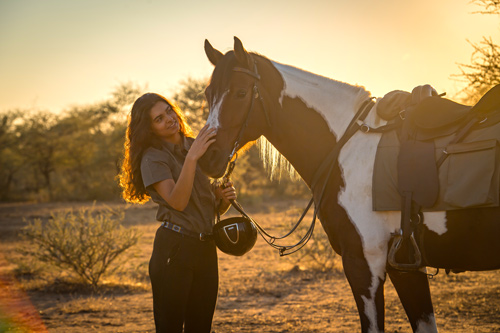 Riding Experience
Guests must be experienced riders. They must ride regularly (at least once or twice a week) and be comfortable at a canter and gallop as well as being able to do small jumps should they have to. Ability to jump natural obstacle, a benefit, but not essential as can be ridden around. We ask riders to be able to take a light seat at canter.
Before each safari, every rider will take a short riding test to ensure they are competent enough for the safari, and fall into the above guideline. The decision of the manager conducting the test is final.
Our horses are mostly English schooled, so we highly recommend that Western riders have a course of lessons in English style prior to arrival.
Pace & Riding Terrain
We cover approximately 120 miles over the course of the week (6 riding days). Long extended canters are a feature of the safari. We cover about 20-30 km daily and spend up to 5.5 hours in the saddle per day.
We will enjoy exploring the differing topography of the area: open bush, wooded riverine areas, wetlands, and strange rock formations home to large baobabs.
Horses
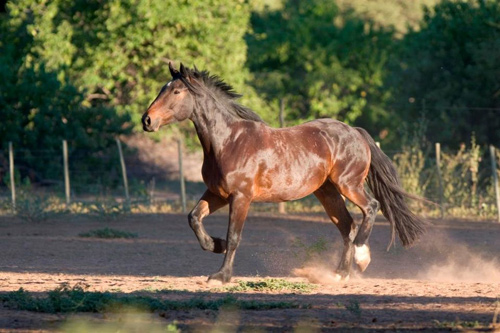
We have a stable of 70 well cared for horses, with something to suit everyone including warmbloods, boerpherds, and other cross breeds, ranging from 15 to 17 hands.
Our safari horses have been hand selected for their endurance, courage and responsiveness.
Our philosophy has entailed managing our horses as a free roaming herd within large tracts of natural pasture, rather than in stables or paddocks. Our horses are at ease with each other and within their environment, which generates calm and contented natures. As a result, we can offer our guests responsive, subtle and honest rides.
 Tack
Tack
Saddles are South African McClellan’s a military saddle designed for long hours in the saddle. They offer particular comfort and airflow for the horses back and padded seats and fenders for the riders comfort.
Weight Limit
No proper weight limit but please inquire if over 95 kg.
Guides & Safety
Guides leading the safari have many years’ experience and most have grown up in the area and know the bush like the back of their hand. Our guides have either professional or assistant guiding licenses with the Botswana Qualifications Authority. They are qualified to use firearms and qualified in first aid.
All rides are conducted by 2 experienced professional guides. The lead guide is armed with a rifle and a bull whip. All management staff and guides do regular first aid training with a specialized doctor for remote areas. The lead guide has a local phone and a radio for use in emergencies.
Hard Hats
They are compulsory. Please bring your own well-fitting hard hat.
Children
Children under 16 please enquire. Strictly no under 12’s.
Non-Riders
Non-riders are welcome on this trip. We can provide guides for walking safaris. It is also possible to follow the same itinerary as the riders by bike (the route will be different) for the same pricing as riders. A relaxed bike ride could cover 15- 25km in the morning and more advanced cyclists could cover up to 40km per day. The pace is generally easy going with regular game sightings, and a scenic picnic stop with an option to opt out of the ride at the mid-morning break if preferred.
Passport and Visa Requirements:
Passports valid for at least six months required by all nationals referred to in the chart.Not required by all nationals referred to in the chart above for stays of up to 90 days except the following:. more
Selebi Phikwe area
|
Month
|
Jan
|
Feb
|
Mar
|
Apr
|
May
|
Jun
|
Jul
|
Aug
|
Sep
|
Oct
|
Nov
|
Dec
|
|
Average High Temperature (°F)
|
89
|
90
|
88
|
83
|
81
|
76
|
75
|
81
|
87
|
90
|
91
|
90
|
|
Average Low Temperature (°F)
|
69
|
68
|
66
|
59
|
51
|
45
|
44
|
49
|
57
|
64
|
68
|
69
|
|
Average High Temperature (°C)
|
32
|
32
|
31
|
28
|
27
|
24
|
24
|
27
|
30
|
32
|
33
|
32
|
|
Average Low Temperature (°C)
|
21
|
20
|
19
|
15
|
10
|
7
|
7
|
10
|
14
|
18
|
20
|
21
|
Source: NOAA
Seasons
Botswana's climate is semi-arid. Though it is hot and dry for much of the year, there is a rainy season, which runs through the summer months. Rainfall tends to be erratic, unpredictable and highly regional. Often a heavy downpour may occur in one area while 10 or 15 kilometers away there is no rain at all. Showers are often followed by strong sunshine so that a good deal of the rainfall does not penetrate the ground but is lost to evaporation and transpiration.
Summer (September to April)
October, November and February are the hottest months! Temperatures in summer can vary from 12 C to 38 C at midday. The rainy season falls in summer, between November and March. In summer during the morning period humidity ranges from 60 to 80% and drops to between 30 and 40% in the afternoon.
Winter (May to August)
This is a period of very little rain, and delightful temperatures by day and refreshingly cool at night. Great time for those who prefer to avoid intense heat or insects. Temperatures during winter months vary from 4 C to 24 C at midday. In winter humidity is can vary between 40 and 70% during the morning and fall to between 20 and 30% in the afternoon.
For tourists, the best visiting months are from April through to October - in terms of both weather and game viewing. It is during this period that the wildlife of the great spaces gather around what water there is - the natural waterholes and the borehole-fed dams - and are at their most visible. However, as the wildlife in this area is not seasonal, wonderful game viewing experiences are possible throughout the year.
If taking the vehicle transfer, we have no weight limit for luggage.
If taking the air transfer, you are limited to 15kg + 6kg carry-on per person. Soft bags only!
When packing, do bear in mind the fact that we offer a free of charge laundry service. In Botswana, we offer a laundry service once or twice during your seven-night safari. We can normally turn laundry around within 24 – 48 hours.
What is supplied?
- Towels
- Shampoo
- Shower gel
- Lotion
What we recommend you bring
• Your own well-fitting hard hat - Hard hats are mandatory (we can supply if needed)
• Comfortable riding clothes, this is not the place to test out brand new boots, wear everything a couple of times before bringing it on safari. Neutral colours such as khaki, brown, navy, and green are preferable. Light-coloured garments such as whites and creams should be avoided.
• Short boots and half chaps, ride/walk boot are perfect. Long leather boots are also good but long rubber boots are not advised.
• Bum bag
• Lip salve, hand cream, and moisturiser (it’s dry here!)
• Strong sun protection cream factor 30 or higher
• Mosquito repellent
• Hiking boots or sneakers
• Swimsuit
• Light weight long sleeved shirts
• Camera, memory cards and spare camera batteries
• If you ever suffer from regular bouts of illness e.g. cystitis, sinusitis, eczema, asthma, allergies etc please bring your preferred medication its best to have whatever you may need with you
• Ibuprofen and deep heat are also useful items, especially if you aren’t used to long hours in the saddle
• In our Winter, mornings can be chilly and days hot so bring layers, a vest, shirt fleece and body warmer are ideal winter wear.
• In summer pack a lightweight rain coat
• Books for when you are relaxing between rides
• High lumen torch or head torch
• A strong power bank of up to a maximum of 20,000 mAh
This may sound strange but if you would like to purchase a spare pack of sanitary items to donate, please do, we donate them to local schools, many girls cannot afford them and have to miss school and exams also if you have any old clothes, shoes, blankets, books or stationary that you would otherwise throw away and have some room in your luggage please do bring it with you. We are involved with local schools and crèches and help where possible with a local outreach project working with the very poor. As such we have lots of people who are grateful for any old clothing. Please do not feel you have to now go out and buy items to bring, - it is not by any means expected - it is just that over the years so many people have expressed regret at not knowing how useful that item they threw away last week would have been to someone here.
*Important Notice: The following ratings have been submitted by guests and do not necessarily represent the views of Hidden Trails, its partners or employees.
Every care is taken to ensure accuracy but Hidden Trails is not liable for any errors or omissions.
..view other reports for different trips
 Accommodations
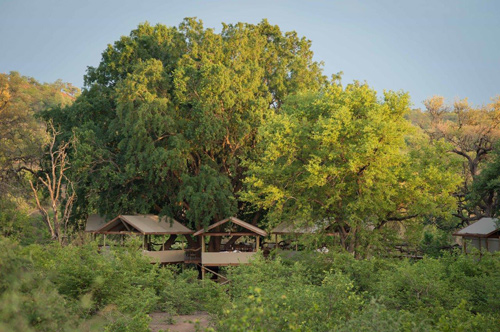
This is a wilderness ride, so nights will be spent in a mixture of lodges and camps.
Description
A laundry service is offered twice a week from either Tree Camp or Two Mashatus and may not be a 24 hour turn around.
We have electricity at the stables and can return batteries to be charged within 24 hours.
New for 2026 season: all three camps in Botswana now have electric lighting and charging points. Two Mashatus has a charging point in each tent and Tree Camp and The Kgotla have one central area charging station in each camp.
Accommodation Itinerary - subject to changes
Night 1: Two Mashatus Camp
Night 2: Tree Camp
Night 3 & 4: Kgotla
Night 5: Tree Camp
Night 6 & 7: Two Mashatus Camp
Accommodation for Special Itinerary - subject to changes
Night 1: Two Mashatus Camp
Night 2: Tree Camp
Night 3,4 & 5: Kgotla
Night 6: Tree Camp
Night 7: Two Mashatus Camp
Two Mashatus Camp
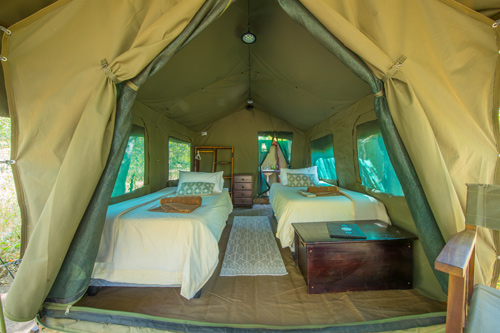
Nestled in the shade of a Mashatu tree with two traditionally built Lala palm rondavel dining and lounge areas. Accommodation is in big A-frame walk-in tents pitched on teak platforms with en-suite bathrooms. Each tent is private and positioned in the shade of a tree with a small deck area in front on which to relax during the afternoons. There is also a pool onsite.
 Tree Camp
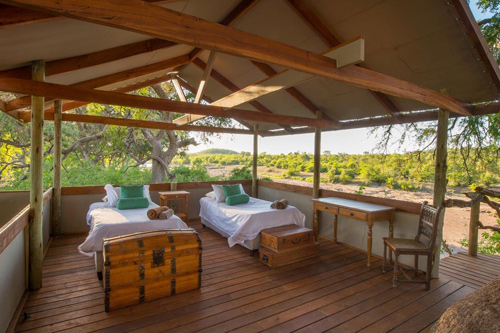
This is a very unique camp. Nestled in the bough of a giant Mashatu tree and two ancient Leadwood trees, this Seligna deck, 4 meters off the ground, will be your retreat for the night. Two guests each share an airy and cool sleeping pod. Along a short walkway, shared showers and toilets are under the Leadwood trees.
The spacious dining and lounge area flow from the sleeping pods and overlook the Majale River.
 The Kgotla
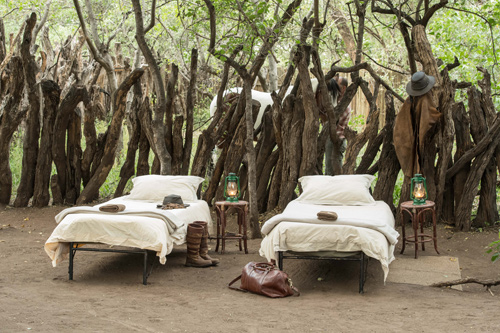
The Kgotla is an old tribal court from a nearby community, which was relocated to the banks of the Motloutse River on the western periphery of Mashatu. The boma is an open-air traditional African enclosure made up of a circle of Leadwood logs. The camp has hot running water, beautiful open-air showers and flushing toilets (shared): the perfect combination for comfort and an authentic bush experience. Guests sleep on single beds around a large log fire in the center of the enclosure.
Room Occupancy
Triple occupancy is possible, however it may be a bit of a squeeze.
If you are willing to share, the single supplement fee does not apply.
 Meals
Meals
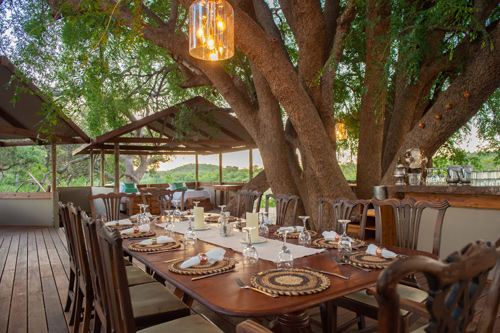
All meals are included in this trip and 2 highly trained experienced bush chefs will look after your every need.
Breakfast is buffet of cereals, toast, fruit yoghurt and an egg or other dish (omelets or pancakes or muffins or porridge).
Lunch is a buffet eg quiches, salads, and home made breads.
Dinner is a 3 course meal served to you at the table, often under the canopy of stars! Vegetarians and other special diets are catered for; please inform us of any special dietary requirements.
Drinks included in the rate feature beers, ciders, local wines and spirits such as Gin. If you have a preference for a cognac or an aged whiskey we would suggest to bring a bottle with you.
All water in the camp is filtered to the highest standards and is guaranteed perfectly safe for drinking.
Dietary Restrictions
Please also advise us if any guests will be celebrating a birthday or special occasion, that you may want us to be aware of to help plan something special!
This trip
includes some wine with dinner
and
can accommodate special dietary requests.
|
Tack:
|
|
English trekking
|
|
Horses:
|
|
Boerperd, Boepferd and other cross breds
|
|
Pace:
|
|
Up to 5.5 hours in saddle / day; fast, exhilarating, challenging!
~120 miles total (20-30 km daily)
|
Walk |
Trot |
Canter |
|
|
Level:
|
|
(4
to
5
out of 5) Strong Intermediate
|
|
Age:
|
|
Min
16
|
|
|
Weight:
|
|
Max
190 lbs / 85 kg
|
|
Riders:
|
|
Min
2 riders
|
Max
8 riders
|
|
Riding Experience
Guests must be experienced riders. They must ride regularly (at least once or twice a week) and be comfortable at a canter and gallop as well as being able to do small jumps should they have to. Ability to jump natural obstacle, a benefit, but not essential as can be ridden around. We ask riders to be able to take a light seat at canter.
Before each safari, every rider will take a short riding test to ensure they are competent enough for the safari, and fall into the above guideline. The decision of the manager conducting the test is final.
Our horses are mostly English schooled, so we highly recommend that Western riders have a course of lessons in English style prior to arrival.
Pace & Riding Terrain
We cover approximately 120 miles over the course of the week (6 riding days). Long extended canters are a feature of the safari. We cover about 20-30 km daily and spend up to 5.5 hours in the saddle per day.
We will enjoy exploring the differing topography of the area: open bush, wooded riverine areas, wetlands, and strange rock formations home to large baobabs.
Horses
We have a stable of 70 well cared for horses, with something to suit everyone including warmbloods, boerpherds, and other cross breeds, ranging from 15 to 17 hands.
Our safari horses have been hand selected for their endurance, courage and responsiveness.
Our philosophy has entailed managing our horses as a free roaming herd within large tracts of natural pasture, rather than in stables or paddocks. Our horses are at ease with each other and within their environment, which generates calm and contented natures. As a result, we can offer our guests responsive, subtle and honest rides.
Tack
Saddles are South African McClellan’s a military saddle designed for long hours in the saddle. They offer particular comfort and airflow for the horses back and padded seats and fenders for the riders comfort.
Weight Limit
No proper weight limit but please inquire if over 95 kg.
Guides & Safety
Guides leading the safari have many years’ experience and most have grown up in the area and know the bush like the back of their hand. Our guides have either professional or assistant guiding licenses with the Botswana Qualifications Authority. They are qualified to use firearms and qualified in first aid.
All rides are conducted by 2 experienced professional guides. The lead guide is armed with a rifle and a bull whip. All management staff and guides do regular first aid training with a specialized doctor for remote areas. The lead guide has a local phone and a radio for use in emergencies.
Hard Hats
They are compulsory. Please bring your own well-fitting hard hat.
Children
Children under 16 please enquire. Strictly no under 12’s.
Non-Riders
Non-riders are welcome on this trip. We can provide guides for walking safaris. It is also possible to follow the same itinerary as the riders by bike (the route will be different) for the same pricing as riders. A relaxed bike ride could cover 15- 25km in the morning and more advanced cyclists could cover up to 40km per day. The pace is generally easy going with regular game sightings, and a scenic picnic stop with an option to opt out of the ride at the mid-morning break if preferred.
Passports
Passports valid for at least six months required by all nationals referred to in the chart.
Visas
Not required by all nationals referred to in the chart above for stays of up to 90 days except the following:
(a) 1. nationals of Bulgaria, Czech Republic, Estonia, Hungary, Latvia, Lithuania, Poland, Romania, Slovak Republic and Slovenia, who do need a visa);
(b) transit passengers provided continuing their journey by the same or first connecting aircraft and not leaving the airport.
Note: Nationals not referred to in the chart above are advised to contact the high commission/embassy to check visa requirements (see Contact Addresses).
Visa Note
Nationals travelling to South Africa, before or after entering Botswana, will require two clear pages in their passport for the South African stamp.
Types of Visa and Cost
General Entry: £60 (single- or multiple-entry).
Validity
Up to 90 days from the date of issue. Extensions are available from the Department of Immigration in Botswana.
Applications to:
Consulate (or consular section at embassy or high commission); see Contact Addresses.
Working Days Required
One to three.
| Passport Required? |
| British |
Yes |
| Australian |
Yes |
| Canadian |
Yes |
| USA |
Yes |
| Other EU |
Yes |
| Visa Required? |
| British |
No |
| Australian |
No |
| Canadian |
No |
| USA |
No |
| Other EU |
1 |
| Return Ticket Required? |
| British |
Yes |
| Australian |
Yes |
| Canadian |
Yes |
| USA |
Yes |
| Other EU |
Yes |
This information is not being updated on a regular basis. Hidden Trails does not
take any responsibility for the accuracy of the above information. Please, consult
the embassy or consulate for updated info.
|

|
|
|
Land of the Giants - Tuli Riding Safari
Tour Code:
IT-BORT04
8 days /
7 nights
Dates :
Available all Year
Trip Rating :
Difficulty :

Riding Level Explained | A | Beginner
 | Beginner A rider who has limited experience, is unable to post the trot and does not canter. | | B | Novice
 | Novice A rider who is capable of mounting and dismounting unassisted, capable of
applying basic aids, comfortable and in control at the walk, moderate length posting
trots, and short canters. | | C | Intermediate
 | Intermediate A rider who has a firm seat, is confident and in control at all paces
(including posting trots, two point canters and gallops), but does not ride regularly. |
| D | Strong Intermediate
 | Strong Intermediate An intermediate rider who is currently riding regularly and is comfortable in the saddle for at least 6 hours per day. | | E | Advanced
 | All of the above, plus an independent seat, soft hands, and capable of handlinga spirited horse in open country. |

|