Airport:
Keflavik Airport
Pick-up / drop-off for this trip is from downtown Reykjavík.
Transfers can be arranged from/to your accommodation in Reykjavík or at the BSÍ bus terminal.
|
Tack:
|
|
Icelandic tack with saddle bags
|
|
Horses:
|
|
Icelandic Horses
|
|
Pace:
|
|
Riding 15-25 km per day (3-6 hours in the saddle)
|
Walk |
Trot |
Canter |
|
|
Level:
|
|
 (4
out of 5) Strong Intermediate
(4
out of 5) Strong Intermediate
|
|
Age:
|
|
Min
12
|
|
|
Weight:
|
|
Max
210 lbs / 95 kg
|
|
Riders:
|
|
Min
2 riders
|
Max
4 riders
|
|
|
|
|
Riding helmets are mandatory for this ride.
|
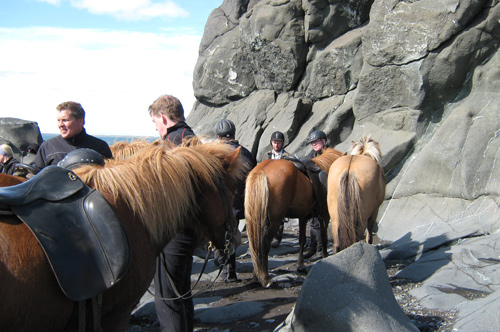
We usually ride with some spare horses as we ride at least 2 horses every day. We mostly ride at a tölt but also walk, trot and canter.
We operate our horse riding tours in Iceland in cooperation with local partners that are horse people through and through.
They breed their own horses and train them themselves. They operate their tours in their home region where they know each and every mountain, creek and canyon.
Riding Gear
Our tack is very similar to the one used by English style riding. But don´t worry if you come from a Western Riding background, we will assist you and you will get used to the tack in no time. We use safety stirrups on all our saddles and will ask you to wear a helmet at all times. You can bring your own helmet (please disinfect your riding gear) or you can borrow one locally.
Our bridles are very practical, they have clip on reins that you can release so that your horse can have some grass while you enjoy your break! We also provide you with a saddle bag, big enough for your picnic, gloves and a small camera.
Riding with the Herd
One of the things that makes riding tours in Iceland completely different from tours in other countries is the fact that we take lots of spare horses along when we travel. The sight of 40 – 80 horses running free over the mountain trails with the wind in their mane is a view you will not forget – we promise! On each tour you can expect to ride different horses every day. That means that we need at least three to four horses per person. The horses we are not riding run along freely in a herd.
Our partners and their staff will take care of the herd and if you want to, you can help them with the herding. But please note that you should always follow the instructions by the staff. We will go over the safety procedures on the first day of the trip. Riding with the herd is a once- in- a -lifetime experience for every rider!
Hand horses and loose herd
In our tours we usually ride with a hand horse (also known as ponying). If you have never ridden with a hand horse before we will teach you how to manage and help you in any way we can.
If your hand horse is bugging your riding horse please let the staff know and they will either take him or have him run along.
Some roads can be narrow and then it is best to have a long rein on the hand horse and make him go behind you, but if you find it difficult just put the reins over his head and let him loose.
We pair our horses together so the riding horse and the hand horse know each other and have no problem being side by side.
The staff usually have more than on hand horse.
Please note: If you are having trouble with your hand horse, try to let the staff know as soon as possible. In all cases it is better to drop the hand horse (he will not go anywhere) if you have any problems. Do not try to hold on the hand horse as you might loose your balance.
We always try to have a loose herd once on every tour, just to get the feeling. But that means we need your help with the herd! Some riders will be in the front, some in the back and then the loose herd in the middle. For those in the front it is very important to never let a loose horse get passed you. And for those in the back do not push on the loose horses. But no worries, we will explain it better on the tour.
Riding Experience
You do not need any prior knowledge of Icelandic Horses or the special gait tölt. We will explain our way of riding and will take time and patience to teach you how to ride the tölt. However, you might get more out of a multi-day trip if you know already a little bit about tölting. This is why we offer a pre-tour for our multi-day tours in cooperation with our partners (inquire for more information). We especially recommend this pre-tour for riders that are used to Western Riding. But as already mentioned above, this pre-tour is just a service to make sure you enjoy the tour even more but it is not a requirement. We will take good care of you either way!
Horse Welfare
Horse Welfare is not just a slogan for us. All of our Team Members own horses and ride on a regular basis. Some of us even breed horses. We love horses - in fact they are everything to us! That is why we carefully pick and choose our partners. We visit them on a regular basis – even without prior notice - to make sure that their horses are kept in good conditions all year round. That is also the reason why you will not find many departures in a row for our tours.
We want to make sure that both horses and the human team behind each tour gets a good rest in between departures so that they can deliver 100% service once you arrive.
During a typical year our horses are kept outside 24/7 during summer on usually rather large fields with access to good grazing and fresh water. If they are close to the stable or a paddock we will keep them there for a few hours during the day when we want to ride them in order to have them nearby and dry. Also in some cases to prevent them from eating 24 hours! Obesity can be a problem in Icelandic Horses. During autumn (usually from Mid September to December) we take their shoes off (all horses in Iceland are ridden with shoes) and they are turned onto big autumn fields where they live nearly „half-wild“ in large herds. During this time they are completely „on vacation“, they are not ridden but we visit them regularly to make sure that every horse is doing well. End of December/beginning of January we take the young and competition horses into the stable for training. Then they are kept in stalls but the Icelandic Law for Horse Welfare states clear regulations regarding stall sizes, daily playtime outside, paddock fencing, food... Older fully trained horses, breeding mares, untrained youngster and horses that are not ridden during wintertime like many of our horses that we use for the tours usually stay outside on winter fields in large herds where they are fed with hay and where sufficient water and wind protection is provided, either natural or man made. From May/June all horses again are on summer fields where they stay outside 24/7 feeding on grass. A few exemptions from these rules are made regarding stallions due to their nature.
Travel Insurance
Individual travel insurance is not included in the tour prices. We urge our guests to purchase relevant travel insurance before visiting Iceland. Guests from Europe should bring their European Health Insurance Card (EHIC).
Passport and Visa Requirements:
Passport valid for at least three months beyond length of stay required by all except:(a) 1. nationals of Austria, Belgium, Denmark, Finland, France, Germany, Greece, Italy, Luxembourg, the Netherland.
more